You’re standing in front of a wall of T‑shirts, all identical except for one thing: the colour.
Your hand hesitates, then almost on its own it reaches for the same shade you always end up buying. Navy blue again. Or that soft beige. Or the loud canary yellow that your friends tease you about.
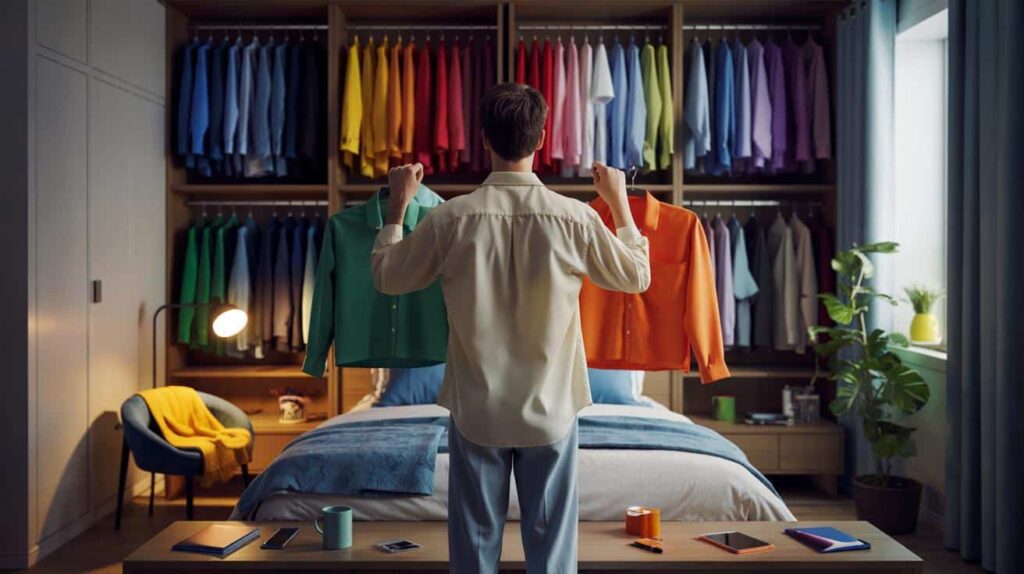
You tell yourself it’s just a habit, a vibe, a season. Yet when you look around your home, your phone case, even your toothbrush, the pattern is almost embarrassing.
Psychologists say that pattern is rarely random.
Your favourite colour is quietly broadcasting who you are, long before you open your mouth.
What your favourite colour quietly says about you
Walk into any office and look at the coffee mugs. The woman with the bright red cup often speaks a bit louder, laughs a bit bigger, moves a bit faster. The guy with the black, minimalist mug tends to choose his words like he chooses his clothes: carefully, with edges.
Colour psychology has been studying these tiny clues for decades, from marketing boards to therapy rooms.
We think we’re choosing “what looks nice”. Our brain is actually voting for what feels like home.
Researchers at the University of Georgia found that people who consistently chose blue in tests scored higher on traits linked to reliability and calm. Those drawn to red leaned toward assertiveness and competitiveness.
Think of your friend whose life is basically a yellow filter: sunflower phone background, mustard cardigan, golden jewellery. You probably go to them when you need cheering up or a last‑minute plan for Friday night.
Then there’s the green lover who suggests “a walk instead of drinks” and somehow knows the name of every plant on the way. Their colour choice often matches a deeper hunger for balance, nature, and quiet progress.
Psychologists explain this link with two big ideas: association and projection.
Association is simple. Red is tied to blood, danger, passion. Blue to the sea and sky, stability and distance. Over years, your brain weaves emotional memories into these basic cues.
Projection comes next: you start choosing the colour that matches who you are, or who you secretly wish to be.
So the person clinging to black might not just “like it”: they may be protecting their inner world behind a clear, controlled surface. *Your favourite colour can be both a mirror and a mask at the same time.*
What different favourite colours often reveal (and how to read yours)
Here’s a simple way to explore your own pattern.
Step one: forget fashion trends. Think of the colour you love when nobody’s watching. The one you’d paint your bedroom, not your Instagram grid.
Step two: look at where that colour shows up when you’re relaxed – your pyjamas, your water bottle, your notebook. That’s your “true” favourite.
Now match it with some of the classic psychological profiles:
Blue hints at loyalty and a need for peace.
Red loves action and intensity.
Green seeks growth and stability.
Yellow craves joy and visibility.
Black wants control and depth.
Purple leans to imagination and uniqueness.
White searches for clarity and fresh starts.
A reader once told me about her “red era”. She had just left a long, suffocating relationship. Overnight, her wardrobe went from beige to scarlet dresses, raspberry lipstick, cherry nails.
She didn’t plan a transformation. She just felt pulled to red.
Looking back, she realised she was reclaiming her right to be seen, to want, to say yes and no loudly. Her favourite colour shifted again a few years later, softening into coral and warm orange as her life did.
We’ve all been there, that moment when your Pinterest board quietly announces that something inside you has changed before you dare to say it out loud.
This doesn’t mean red lovers are all extroverts and blue fans are automatically shy. Personality is more nuanced than a paint chart. What colour psychology does say is that your preference reveals your emotional priorities.
Someone whose favourite is blue may crave safety in relationships and hate sudden change. A yellow lover might tolerate chaos if it comes with fun. A green person often needs time to recharge outdoors or in cosy, quiet spaces.
Let’s be honest: nobody really does this every single day. Few of us sit around analysing our socks for hidden truths. Yet when you start noticing your colours, you begin to notice your needs. And that can change how you choose jobs, partners, even how you rest.
How to use your colour profile in everyday life
There’s a simple, almost playful method therapists sometimes use: a “colour audit”.
Take ten minutes and walk through your home with your phone camera. Snap your wardrobe, your desk, your bed, your bathroom shelf. Then scroll the photos and look at the dominant shades.
Ask yourself three questions.
What colour do I wear the most? What colour do I decorate with the most? What colour do I secretly wish I dared to use more? The gaps between those answers reveal where your personality feels free – and where it feels a bit censored.
If you realise your favourite colour almost never shows up in your daily life, that’s a small red flag. The purple‑soul stuck in a grey office, the orange‑lover living in a beige rental, the blue‑heart constantly in neon spaces.
You don’t need to repaint everything overnight. Start with micro‑moves. A phone wallpaper in your favourite shade. A pen, a mug, a scarf that feels like “you”.
One common mistake is copying someone else’s palette because it “looks aesthetic” online. What calms your best friend might drain you. What energises your partner might overstimulate you. Listen to your own nervous system first. It always tells the truth, even when your mind is trying to be trendy.
Sometimes a favourite colour isn’t about taste at all, but about survival. We choose the colour that makes us feel safest in a world that often doesn’t.
- If you love blue: Lean into it when you need stability. Blue notebooks for difficult projects, blue bedding for deeper sleep.
- If you love red: Use it in short, sharp bursts. A red accessory in big meetings, red sneakers for workouts, not necessarily a red bedroom.
- If you love green or yellow: Bring them into your workspace to boost focus and optimism when screens drain you.
- If you love black or white: add one soft accent (dusty rose, sage, sand) to avoid locking yourself in emotional “all or nothing” mode.
- If you love purple or orange: keep them near where you create or socialise. Those colours tend to amplify expression and play.
When your colour changes, you’ve changed too
There’s a quiet moment many people notice only in hindsight. One day your favourite colour just… doesn’t fit you anymore. The fiery red lover starts buying soft blues. The minimalist black‑and‑white person suddenly falls for houseplants and earthy greens.
Psychologists often see this during big life transitions: breakups, childbirth, burnout, recovery, moving countries. Your nervous system shifts gear, and your colour compass moves with it.
You’re not being fickle. You’re updating.
If you look back over your life in “colour eras”, you might see your own story more clearly. Childhood yellow, teenage black, early‑career navy, post‑burnout sage. Each shade marking what you needed most at that time: safety, rebellion, respect, healing.
The plain truth is that your favourite colour is one of the cheapest, simplest tools you have to feel a little more like yourself. And when you pay attention to it, the world around you begins to feel less random, more intentional, almost like it’s finally speaking your language.
| Key point | Detail | Value for the reader |
|---|---|---|
| Favourite colours reflect emotional needs | Red often links to intensity, blue to calm, green to balance, yellow to joy, black to control | Helps you understand why you feel drawn to certain spaces, clothes, and people |
| Patterns matter more than a single choice | Looking at your home, wardrobe, and objects reveals your deeper “colour story” | Gives you a practical way to decode your personality without complex tests |
| You can use colour intentionally | Aligning environment and favourite shades supports focus, rest, or confidence | Turns colour into a daily tool for mood and energy, not just decoration |
FAQ:
- Question 1Can I have more than one favourite colour, and what does that mean?
- Answer 1Yes, many people rotate between two or three shades. It often reflects mixed needs: for example, someone who loves both blue and yellow might crave both calm and fun, switching depending on context.
- Question 2Does science really back colour psychology, or is it just pop culture?
- Answer 2There are peer‑reviewed studies on colour and emotion, but results vary by culture and context. Think of it as a helpful lens, not a rigid diagnosis.
- Question 3What if my favourite colour is black or white, is that “bad”?
- Answer 3No. Black often signals depth, protection, and sophistication; white can point to a need for clarity and a fresh slate. It only becomes an issue if you feel emotionally numb or boxed in.
- Question 4Can changing the colours around me really change how I feel?
- Answer 4It can nudge your mood and energy. A blue bedroom can support relaxation, warm accents can combat a sterile office, and small hits of your favourite colour can boost comfort and confidence.
- Question 5How do I start using my favourite colour more intentionally?
- Answer 5Begin with low‑risk items: a notebook, a background, a throw pillow, workout gear. Then experiment in spaces where you need specific support, like your desk (focus) or entryway (motivation).