
You kick off your shoes at the door, as always. The relief is instant: no tight laces, no hard soles, no clunky weight. Just skin on floor. Tiles a bit cold, wooden planks with their tiny ridges, that soft rug you step on without even thinking. You cross the living room, phone in hand, and only realize you’ve walked differently when you catch yourself not stumbling over the corner of the coffee table this time.
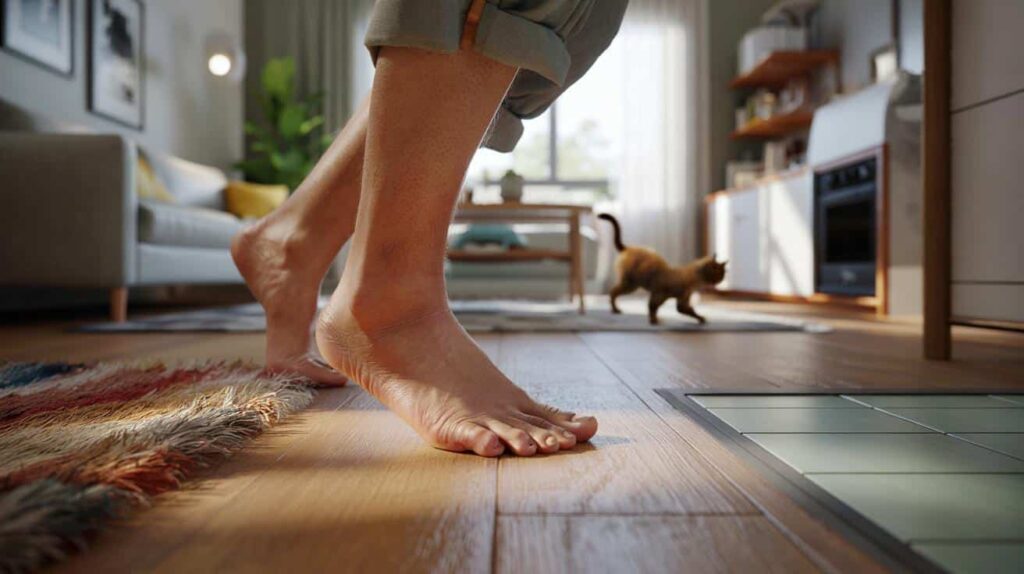
It feels small. Almost nothing.

But your feet are quietly collecting data, sending signals, training your balance like a hidden coach working overtime.

Something changes when home becomes a barefoot zone.

Why your feet love it when you walk barefoot at home
Strip away the shoes and your feet suddenly wake up. Under all that cushioning and support, they spend most of the day half-asleep, numbed by rubber and foam. At home, on bare floors, your toes start to spread, your arches try to do their real job, and tiny muscles that almost never get called up finally get some action.
Your body notices.
You walk slower, you feel the ground, you adjust a bit with every step. That’s balance training, just without the yoga mat or the fancy gym membership.
Picture a typical end of day. You drop your bag, toss your keys in the bowl, kick off your sneakers and shuffle towards the kitchen. For months, you bump your hip on the counter, stub your toe on that same cursed chair, lose your balance when the cat decides to race under your feet. Then one evening you realize: that didn’t happen.
There’s even data behind that kind of tiny miracle. Some physio clinics report fewer falls and better stability in older patients who regularly walk barefoot on safe indoor surfaces 10–20 minutes a day. No high-tech program. Just skin on floor, consistently.
Your feet adapt, quietly and stubbornly, like they’ve been waiting for this chance.
The logic is simple and surprisingly elegant. Your soles are packed with receptors that read texture, pressure and temperature. When you’re barefoot, those receptors send sharper, more detailed messages to the brain. Your brain uses that information to fine-tune your posture, micro-correct your steps and predict what’s coming next.
Shoes blur the signal. Bare feet sharpen it.
Over time, that better “conversation” between feet and brain translates into stronger ankle muscles, more reactive toes, and a more stable center of gravity. *It’s low-key neurotraining, done while you walk to the fridge.*

How to turn your home into a quiet balance-training zone
Start small. The goal isn’t to toss all your shoes in the trash and go full caveman overnight. Begin with specific barefoot windows: the first 15 minutes after you get home, or that time you spend tidying the living room or making coffee in the morning.
Use those moments to really feel each step. Let your heels land gently, let your toes spread, notice how your weight moves from one foot to the other.
On days when the floor feels too hard, use thin socks, not thick ones. You still want sensation, just with a little comfort.
If you’re not used to going barefoot, your feet might complain at first. A bit of fatigue, some stiffness in the arches, the odd cramp in the toes. That’s not a failure, that’s deconditioned muscles waking up.
The big mistake is to do too much, too fast. Going from all-day sneakers to three hours barefoot on tile can feel like running a marathon cold. Be kind with yourself. Rotate: 10 minutes barefoot, then back into soft slippers, then another short round later.
Let’s be honest: nobody really does this every single day. The win comes from coming back to it regularly, not from being perfect.
“People think balance training has to look like standing on a wobble board at the gym,” a sports physio told me. “But half of what I ask my patients to do is just walk barefoot at home and pay attention to how their feet land.”
- Scan your house for hazards: loose cables, slippery rugs, Lego mines on the floor.
- Keep one pair of **thin, flexible slippers** if the floor is very cold or rough.
- Go slower than usual when barefoot, especially on stairs or wet areas.
- Mix surfaces: wood, tile, a firm rug, a yoga mat for extra sensory variety.
- Stop if you feel sharp pain and switch to support, not stubbornness.
Learning to balance with your feet, not just your shoes
Once you start noticing what your feet do at home, it’s hard to unsee it. The way the big toe grips a little when you turn. The way your ankle wobbles on that uneven patch of rug. The way you automatically adjust when you step on a crumb or that invisible drop of water near the sink.
These micro-corrections add up over weeks and months. Less tripping over nothing. Fewer “whoa” moments on the stairs. A slightly more confident stride when you carry laundry, or a toddler, or both.
You might still wear shoes outside all day. Yet your body remembers those barefoot minutes, and quietly updates its balance software.
| Key point | Detail | Value for the reader |
|---|---|---|
| Waking up foot muscles | Barefoot time activates small stabilizing muscles and toe flexors | Improves natural balance without extra workouts |
| Sharper sensory feedback | Feet send clearer information to the brain when not blocked by thick soles | Helps prevent stumbles and missteps at home and outside |
| Gradual daily habit | Short, regular barefoot sessions on safe surfaces | Makes progress realistic and sustainable in everyday life |
FAQ:
- Question 1Is walking barefoot at home safe for everyone?
- Question 2How long should I walk barefoot each day to see a difference?
- Question 3Can barefoot walking replace specific balance exercises?
- Question 4What if I have flat feet or wear orthotics?
- Question 5Is it better to walk barefoot on hard floors or rugs?
