
On a gray winter morning outside Bakersfield, California, a row of pickup trucks lines the edge of an exhausted oil field. The pumps are silent. Instead, hoses snake across the mud, feeding millions of gallons of treated water into the ground where crude once flowed. A project engineer, boots sunk in the clay, tells me with quiet pride that the land has stopped sinking here. The subsidence curves on his tablet flatten out, like a calm heartbeat. It feels like a small victory in a losing game against gravity and time.
Yet just a few miles away, in a subdivision of identical stucco homes, a woman points to a fresh crack above her kitchen doorframe. The street looks level, but the spirit level in her hand says otherwise. Her house is tilting, by millimeters each year.

The city hasn’t changed on the surface. Underground, everything has.

When the ground moves and the city pretends not to notice
Walk through any fast-growing oil town and you’ll see the same illusion. Perfectly painted curbs, fresh asphalt, brand-new warehouses with clean white facades. On the surface, the future looks stable. Underneath, the ground is remembering every barrel of oil, every cubic meter of water, every ton of gas we pulled out. The result is subtle at first: hairline cracks in sidewalks, doors that don’t fully close, a storm drain that suddenly sits a bit lower than last year.
 Turning the heating down when you go out: experts reveal the trap that wrecks comfort and savings
Engineers call it land subsidence. Residents call it “my house is sinking.”
In parts of California’s Central Valley, the land has sunk by nearly 30 feet over the past century, mostly from groundwater extraction. That’s the dramatic version, with satellite images and scary graphs. In oil and gas regions, the same physics plays out quieter and slower. In Mexico City, parts of the city drop 15 inches a year because of depleted aquifers. In Jakarta, some neighborhoods sink so fast that seawalls have become a desperate bandage.
Then there’s the lesser-known tactic: flooding exhausted oil fields to push the ground back up, or at least hold it in place. The numbers look reassuring in reports. A few centimeters of uplift here. A stabilization curve there. City planners breathe a little easier.
The basic logic sounds simple: remove fluids from the subsurface and rock layers compress; re-inject fluids and you restore pressure, slowing or partially reversing the sinking. Using water flooding or wastewater reinjection, oil companies can say they’re both managing waste and “supporting” the ground. Yet geology holds grudges. Once rock layers have compacted, they rarely bounce back perfectly. Some zones swell, others stay rigid. You get a patchwork of micro-movements instead of a gentle, even lift.
On paper, the land is “stabilized.” On the street, one building settles while another tilts.
The tempting fix: just add water to the empty oil fields
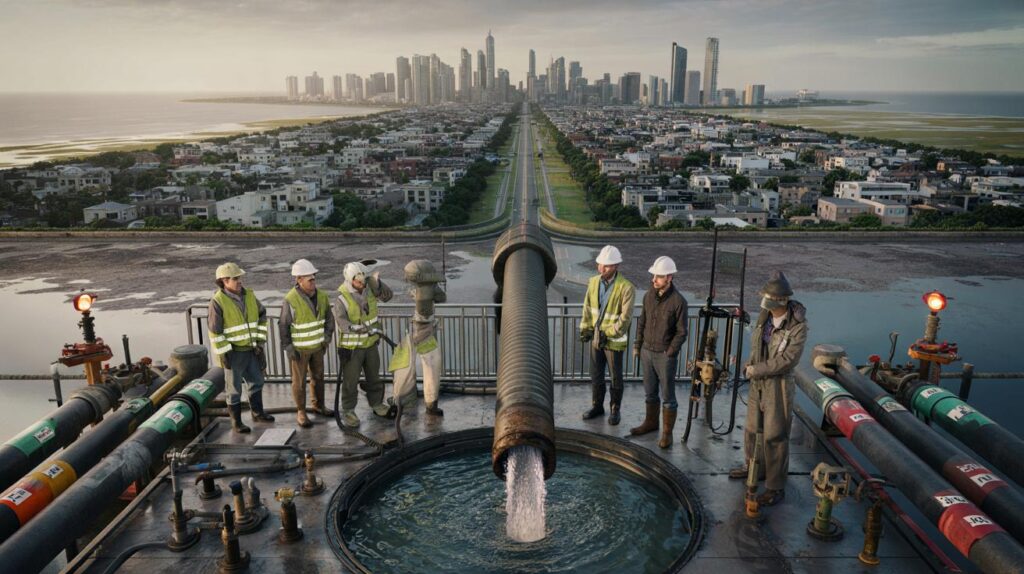
The method looks elegant on a powerpoint slide. After an oil field is exhausted or no longer profitable, operators convert old production wells into injection wells. Treated water, sometimes mixed with brine or wastewater from other operations, is pumped back into the same geological formations that once held oil. The goal is to restore subsurface pressure, slow compaction of rock layers and, as a bonus, dispose of industrial water that nobody wants at the surface.
Done carefully, the pressure is monitored well by well. Engineers watch for uplift with GPS, laser surveys, and satellite interferometry. The dream is a steady, controlled “pause” in subsidence.
In the oil patch outside Bakersfield, one such project has become a sort of local legend among engineers. When the field was producing, some monitoring wells showed the land dropping up to 3 centimeters a year. Roads wavered, and one small bridge developed unsettling misalignments. After the switch to water injection, that downward slide nearly stopped. Residents nearby noticed fewer cracks in their garden walls, and the county stopped getting weekly calls about bumpy intersections.
The story gets repeated at conferences, always with the same moral: **with clever engineering, we can live with past extraction**. It’s a comforting narrative. A technical answer to a political and urban problem.

Look closer and the comfort starts to fray. Flooding one exhausted field doesn’t erase the dozens of other pressure changes happening across a whole basin. Some zones are still draining groundwater, others are being pressurized by injection, and a few are crisscrossed by aging gas storage caverns. Instead of one big predictable movement, the city ends up perched over a mosaic of subtly shifting patches. Streets cross from a slowly rising block into a gently sinking one. Rail lines, pipelines, and sewer networks span these invisible boundaries.
Every joint, every weld, every foundation becomes a stress test. *A city likes uniformity; geology rarely offers it.*
Why the “solution” may be quietly loading the next disaster
The most unsettling thing about using water to delay subsidence is that it works just well enough to lull everyone into a false sense of security. Risk managers get numbers they can plot. Mayors get talking points. Developers get permits. Nobody has to say aloud that the city is building higher and denser on ground that has already been weakened once. This is how you end up with apartment towers and data centers on land that behaved perfectly for decades…until the pressures, literally, shifted.
There’s another complicating twist: injection itself can trigger small earthquakes when pressures migrate onto old faults.
We’ve all been there, that moment when a fix that felt smart at first suddenly seems like a shortcut. In Oklahoma, the sharp rise in wastewater injection linked to oil and gas operations coincided with a surge in induced seismicity. Some of those quakes were not minor. The lesson spread through the global engineering community quickly: watch the pressures, understand the faults, and accept that the subsurface has a longer memory than any project timeline. Yet cities hungry for growth often move faster than the lessons can be fully absorbed.
Let’s be honest: nobody really reads every line of those environmental risk annexes.
Urban planners who work near these fields talk about a quiet tension. On one side, **geotechnical engineers** insist on red zones, cautious building codes, flexible joints for buried infrastructure, and ongoing monitoring long after the oil field is “retired.” On the other side, budget offices look at the cost of retrofitting and shake their heads. The political calendar competes with the geological one.
As one hydrologist in Mexico City told me, sitting in a cramped office stacked with worn maps and coffee-stained reports:
“We are treating subsidence like a pothole problem when it’s actually a slow-motion re-engineering of the entire city. Injecting water into old fields buys us time, but it also lets us pretend the deeper question doesn’t exist: how heavy, how rigid, how greedy can a city be before the ground stops cooperating?”
- Old extraction zones rarely behave uniformly once flooded again.
- Critical networks—sewers, subways, fiber, gas lines—suffer first from uneven movement.
- Policies that look safe on a 5-year horizon can be risky on a 50-year one.
- Residents usually notice cracks before any official monitoring does.
- Waiting for a visible “disaster” often means waiting too long.
What if delaying subsidence is just buying fragile time?
The unsettling question behind all this is simple: are we stabilizing our cities or just stretching out the timeline of a failure we don’t want to name? Flooding exhausted oil fields to prop up sagging land feels like putting braces on a jaw that’s already been broken twice. It helps, especially in the short term. It reduces the worst movements, protects some neighborhoods, keeps highways and runways serviceable. Yet every year that passes, more weight is added above—more people, more towers, more concrete, more buried infrastructure that assumes the ground beneath it is done changing.
A few urbanists argue that the honest path would be to redesign cities around movement, not against it. Flexible utilities. Buildings that can tolerate a few centimeters of tilt. Clear no-build corridors over the most unstable zones. And, yes, sometimes the hardest step of all: saying no to development where the subsurface story is just too messy.
| Key point | Detail | Value for the reader |
|---|---|---|
| Invisible subsidence | Ground can sink or tilt by centimeters each year without obvious early signs | Helps you read subtle warning signs in your own streets and buildings |
| Engineered delay | Flooding exhausted oil fields can slow sinking but introduces new uncertainties | Gives context when you hear about “stabilization” projects in your area |
| Long-term risk | Short-term fixes may encourage riskier urban growth on fragile ground | Invites you to question how and where your city chooses to expand |
FAQ:
- Question 1Does flooding exhausted oil fields really stop land subsidence?
- Question 2Is this practice common in cities, or only in remote fields?
- Question 3Can these water injections cause earthquakes?
- Question 4What signs should residents watch for in sinking neighborhoods?
- Question 5Are there safer long-term strategies than relying on injection projects?
