On a dusty plain in Ethiopia, the ground looks still. A goat wanders past a cracked patch of earth, kids chase an old football, and the late afternoon sun lays a golden filter over everything. Then a geologist kneels down, runs their hand along a thin, jagged line, and whispers to a colleague: “This is where a continent breaks.”
The line isn’t dramatic. No gaping canyon, no lava fountains, no movie-style earthquake. Just a shallow fracture, stretching farther than the eye can follow.
Yet satellites say this scar is part of something vast, something slow and relentless. Africa, the world’s second‑largest continent, is gradually tearing itself in two.
And if scientists are right, a brand‑new ocean may already be on the way.
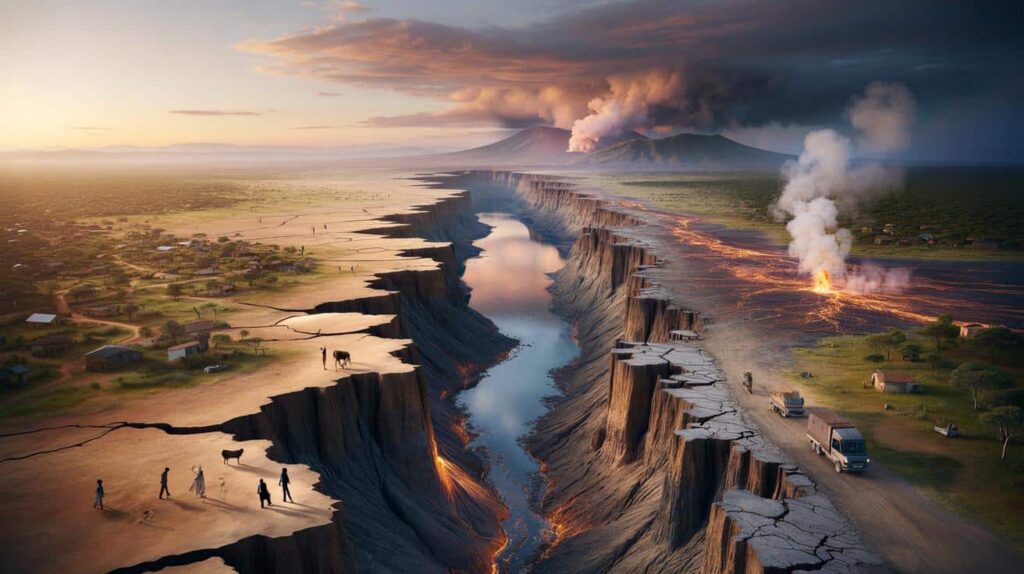
A gigantic crack that keeps growing beneath our feet
People really started paying attention in 2005, when a gigantic crack suddenly opened up in Ethiopia’s Afar region. In just a few days, a fissure nearly 60 kilometers long ripped across the landscape, as if some invisible giant had drawn a line with a knife. Villagers woke up to find fields sliced in two and paths impossible to cross.
Geologists rushed to the scene with drones, seismometers, and cameras. What they saw confirmed a suspicion that had been murmured in labs for years: Africa’s crust wasn’t simply cracking, it was stretching like warm chewing gum. And that stretch was focused along one main scar – the East African Rift.
If you look at a map, this rift is enormous. It runs from the Red Sea down through Ethiopia, Kenya, Uganda, Rwanda, Tanzania, and beyond, tracing a broken backbone through eastern Africa. Parts of it are dramatic, with sheer cliffs and long, deep lakes like Tanganyika and Malawi that already resemble young ocean basins.
Local communities live with subtle reminders that the ground is restless: small tremors, hot springs, fumaroles, the rumble of distant volcanoes such as Erta Ale or Nyiragongo. To them, the rift is not an abstract map feature. It’s part of daily life, planting uncertainty under every house foundation and road.
For scientists, the evidence is stacking up. GPS stations anchored into bedrock show that the African plate is literally stretching, at a rate of millimeters per year. The eastern block, often called the Somali plate, is drifting away from the larger Nubian plate. Seismic waves from earthquakes reveal that hot, partially molten rock is rising from deep within the mantle, thinning the crust like pizza dough tossed too many times.
*Over millions of years, this kind of slow torture is exactly how oceans are born.* Today’s African rift looks eerily similar to what the Atlantic Ocean might have looked like more than 100 million years ago, when South America first started pulling away from Africa.
The viral “Africa is splitting” video – and what’s really going on
The story exploded far beyond geology circles when a dramatic video and photos went viral in 2018. A huge crack appeared near the Mai Mahiu–Narok road in Kenya, swallowing chunks of tarmac and carving straight through farmland. Drivers stopped, people filmed with their phones, and suddenly the internet decided: Africa is breaking in half right now.
News sites ran punchy headlines, TikToks stacked up millions of views, and the clip got recycled every few months with fresh captions. **It looked like the trailer for a disaster movie**, and many viewers took it at face value.
On the ground, the story was less apocalyptic and a lot messier. Local geologists explained that heavy rains had triggered erosion of old, hidden faults and soft volcanic soils. The terrifying canyon in the clips was partly the rift, yes, but also partly a very normal kind of ground collapse. One farmer watched his land crumble and shrugged sadly: this wasn’t the first time the earth had shifted under his feet.
We’ve all been there, that moment when social media serves us a clip so spectacular we don’t even question it. The Kenyan crack became the symbol of a continent in crisis, even though the real process is way slower and way less cinematic.
This is where opinion splits. Some scientists feel the viral narrative is misleading, almost sensationalist. They insist: Africa is not about to snap catastrophically in our lifetime. Others argue that if a shocking video pushes people to care about geology and plate tectonics, maybe that’s not such a bad thing.
The plain truth is: continents do tear apart, they always have, and East Africa is one of the best live laboratories to study that. What the video doesn’t show is the timescale. We’re talking millions of years before a fully formed ocean swallows up parts of Ethiopia, Kenya, and Tanzania. For people living there now, the real issues are more immediate: earthquakes, infrastructure damage, and how to build cities on a moving puzzle.
What the “new ocean” could look like – and how scientists are tracking it
To understand what might come next, researchers watch the rift like doctors monitoring a patient with a very slow, chronic condition. They install GPS sensors that can detect movements smaller than a fingernail each year. They map small quakes that most people never feel, building 3D images of the stretching crust. They fly over rift valleys with radar and even bounce satellites’ signals off the ground to catch tiny vertical shifts.
One practical method is simple but powerful: comparing repeated satellite images over months and years. Bright pixels shift. Dark lines widen. Patterns emerge that no naked eye on the ground could spot.
For non‑scientists, this story often feels distant, almost unreal. A crack growing a few millimeters a year doesn’t compete with rent prices or traffic jams. Yet the rift already shapes life in subtle ways. Roads need constant repair. Buildings must be reinforced against tremors. Hot springs and geothermal fields offer clean energy potential, but they also demand careful monitoring.
Let’s be honest: nobody really reads geophysical reports every single day. So when a spectacular claim like “Africa is splitting into two continents” pops up, it hits us without context. That’s how myths grow in the gaps of our attention.
Scientists themselves are torn between caution and fascination. Some admit they feel a deep awe when they stand on rift cliffs and realize they’re watching the distant birth of a sea their descendants will never see. Others worry more about the headlines than the magma. As Kenyan geologist David Adede said during a field workshop:
“People hear ‘new ocean’ and think of an overnight catastrophe. That’s not what’s happening. What we’re seeing is a long, slow, beautiful break‑up, and it comes with real local risks we can manage if we talk about them honestly.”
To ground the hype, many researchers now share clear key points:
- The split is real: GPS and seismic data confirm the Somali plate is drifting from the Nubian plate.
- The timescale is immense: tens of millions of years before a full ocean opens.
- Today’s stakes are local: earthquakes, volcano hazards, infrastructure, and energy opportunities.
A continent in slow motion – and a story still being written
So where does that leave us, between viral fear and patient science? Somewhere in the middle, probably. Africa is not about to tear open tomorrow, but under the feet of farmers, taxi drivers, and school kids, the crust is quietly changing shape. Lakes may widen, volcanoes may shift behavior, some regions may slowly sink while others rise. What looks fixed on a political map is anything but stable in deep time.
For people living in the rift today, the “new ocean” isn’t a fantasy. It’s a conversation starter about housing safety, disaster planning, and smarter use of geothermal energy. For the rest of the world, it’s a rare chance to watch a process usually buried in textbooks actually unfolding on satellite screens and smartphone feeds.
This story will outlast us all, stretching across millions of years. Yet the way we talk about it now – fear or curiosity, clickbait or clarity – will shape how future generations remember that, once, we saw a continent begin to breathe apart.
| Key point | Detail | Value for the reader |
|---|---|---|
| Rift evidence | GPS, seismic data, and satellite images show the Somali and Nubian plates slowly separating | Helps you sort real science from sensational headlines |
| Timescale | Ocean formation would take tens of millions of years, not decades | Reduces unnecessary fear about sudden catastrophe |
| Local impact | Earthquakes, volcanism, infrastructure damage, and geothermal potential along the East African Rift | Shows how a “distant” story already affects real communities and future energy choices |
FAQ:
- Is Africa really splitting into two continents?
Yes, geophysicists agree that the African plate is gradually breaking into two main parts – the Nubian and Somali plates – along the East African Rift. The motion is very slow, measured in millimeters per year.- Will a new ocean really form?
Current models suggest that if the rifting continues, ocean water will eventually flood the deepest parts of the rift, forming a new ocean basin similar to the Red Sea today. This process will unfold over tens of millions of years.- Could this cause a sudden, massive disaster?
Not in the way viral videos suggest. There will be local earthquakes, volcanic eruptions, and ground collapses, but no instant “continent split” event. The hazards are serious yet manageable with good monitoring and planning.- Is the famous Kenyan crack proof that Africa is breaking?
The Kenyan crack sits in the broader rift zone, but its sudden appearance was strongly influenced by heavy rains and erosion of soft ground. It’s a striking illustration, not the main driver of the continental split.- Why should people outside Africa care about this?
The East African Rift is one of the best natural labs for understanding how continents break and oceans form, knowledge that feeds into global hazard assessment, energy exploration, and our broader understanding of how the planet reshapes itself.