
On a clear desert night, the sky over the eastern Mediterranean looks almost peaceful. A faint line of lights tracks across the darkness, barely visible from the ground, just another passenger jet heading for Europe. Up above that, at altitudes where the air is thin and unforgiving, something very different is moving fast — tanker aircraft, radar planes, and the sharp, predatory silhouettes of American fighters sliding quietly into position.
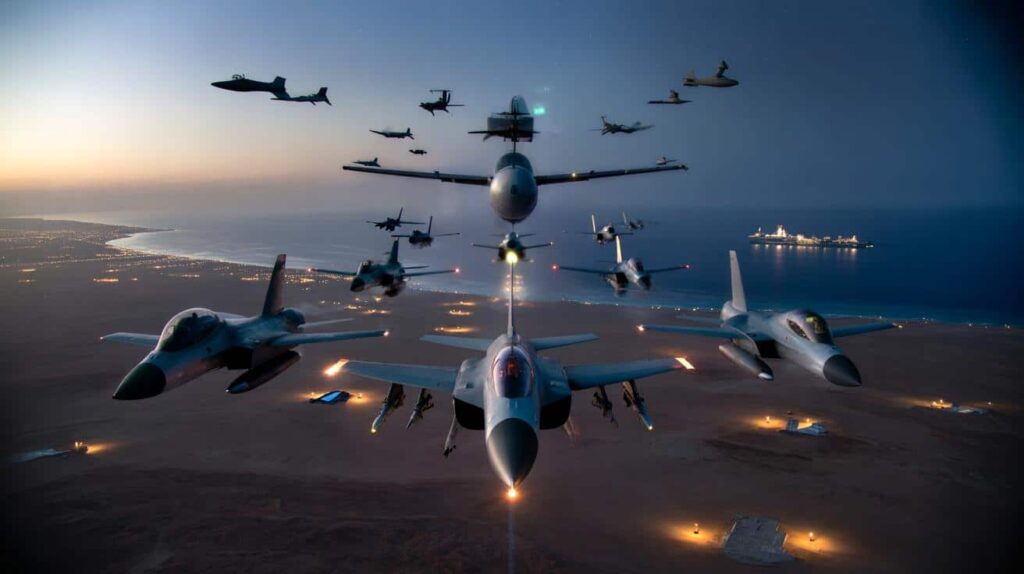
Pilots in green-lit cockpits check radios and fuel levels. Ground crews in Qatar, Jordan, and aboard carriers in the Red Sea scroll through flight schedules that suddenly feel a lot heavier than last month’s. The U.S. is pulling combat aircraft from multiple directions, like someone stacking chess pieces toward the center of the board.

Nobody says it out loud, but the message is already visible on every radar screen in the region.

Why dozens of US jets are suddenly crowding Middle East skies
In the past few days, American air power in the Middle East has gone from “steady presence” to “something serious is happening here.” F‑15s, F‑16s, F‑22s and F‑35s — the backbone of U.S. tactical aviation — are being flown into bases from the Gulf to the Levant. Each has a different role, a different personality in the air, but together they send one clear signal: Washington wants options.

This kind of surge doesn’t happen on a whim. It means planners are looking at maps, targets, and escalation scenarios and deciding they’d rather have too much firepower within reach than not enough. It’s deterrence, but it’s also preparation.
You can almost trace the tension by watching flight trackers and leaked deployment photos. F‑15E Strike Eagles arriving at Al Udeid in Qatar, their noses still dusty from previous taskings. F‑16s lined up at Muwaffaq Salti in Jordan, carrying air‑to‑air missiles under their wings, a reminder that patrols here might not stay routine forever.
Satellite imagery has started to show new shelters filling up, more tugs on the aprons, extra fuel trucks near hardened aircraft shelters. One U.S. carrier strike group sits in the eastern Mediterranean, another in or near the Red Sea, each bringing its own air wing of multi‑role jets. From the ground it can look like “just more planes,” yet in military math, a few dozen extra fighters can change a whole regional balance.
There’s a simple logic behind this rush of metal and noise. The Middle East is running hot on multiple fronts: Gaza and Israel, Lebanon, Syria, Iraq, the Red Sea shipping lanes. Any one of these flashpoints can spill over quickly, dragging in Iran-backed militias, Israeli forces, Gulf states, and then, almost inevitably, the U.S.
So Washington is stacking the deck with jets that can do different jobs at once. The F‑15s bring payload and range, the F‑16s bring flexibility, the **F‑22s bring air dominance**, and the F‑35s bring stealth and data. When you put them all in the same sky, you’re not just preparing for one scenario. You’re trying to cover every single bad day at the same time.
Different jets, different messages — and how they actually get used
To understand what’s really happening, start with something practical: who flies where, and why. The U.S. doesn’t just throw jets at the region like confetti. Each type is slotted into a role and a location, based on the threats nearby and the politics on the ground.
F‑15Es, for instance, are often sent to bases with long runways and good logistics, where their heavy loads of bombs and fuel can be supported. F‑16s are more flexible, able to squeeze into smaller footprints and shift quickly between air patrol and close air support. The more sensitive jets — like the F‑22 and **F‑35** — are kept where there’s tighter security and stronger infrastructure.
One recent deployment pattern tells its own story. F‑22 Raptors, America’s top air‑to‑air fighters, have rotated through places like Al Dhafra in the UAE and have already been used to intercept drones and suspicious aircraft in the region. They don’t need to fire a shot to be useful; just being on the map makes adversary planners think twice about sending fighters of their own.
F‑35s, on the other hand, tend to show up in smaller numbers. They might sit quietly at a base in the Gulf or even operate off an amphibious ship, running missions that are less about dropping bombs and more about soaking up data. They can see deep, share what they see, and help older jets like the F‑16s and F‑15s fight smarter.

Behind the hardware is a plain calculation: protect U.S. troops, reassure allies, and scare off anyone thinking of taking advantage of the chaos. When militias launch rockets at American bases in Iraq or Syria, or when Houthi forces in Yemen fire at shipping in the Red Sea, those jets aren’t just for show. They escort bombers, they fly deterrence patrols, they stand ready to hit back.
Let’s be honest: nobody really does this every single day without expecting the phone to ring at 3 a.m. with new orders. The tempo of sorties, the constant CAPs — combat air patrols — and the web of tankers overhead all hint at one thing. The U.S. wants to be able to go from “watching” to “acting” almost instantly, without waiting for reinforcement flights from Europe or the States.
The unspoken risks, the human side, and what this buildup really signals
If you strip away the acronyms, there’s a simple method behind US air build‑ups like this: layer your defenses, then layer your options. First come the surveillance assets — AWACS radar planes, drones, satellites feeding live video. Then fighters fill the air routes, armed and visible. Behind them sit strike packages and cruise missiles, held in reserve.
For a Pentagon planner, that’s the “toolkit.” For the people on the ground — from Israeli towns under rocket threat to sailors dodging drones in the Red Sea — it feels more like a fragile safety net held together by moving parts and human reflexes.
The mistakes usually don’t come from bad intentions, but from fatigue, misreading signals, or sheer overload. We’ve all been there, that moment when the dashboard is screaming, the phone is buzzing, and your brain is two steps behind your hands. Now imagine that, except what’s blinking are missile alerts and radar tracks.
Aircrews rotate through 10‑, 12‑, 14‑hour duty days. Pilots fly night after night, often over the same tense borders. One mis‑ID of a radar blip, one rushed radio call, and a warning shot can become a lethal exchange. *This is the part of deterrence nobody puts in the glossy briefing slides.*
“Every extra squadron you send is another chance to deter a crisis — and another chance to start one by accident,” a former U.S. air operations officer told me. “The trick is flying close enough to be taken seriously, without flying so close that someone panics.”
- F‑15s: Long‑range, heavy‑hitting jets, often used to carry big bomb loads and patrol wide distances.
- F‑16s: Versatile workhorses, doing everything from air policing to striking small militant camps.
- F‑22s: High‑end air superiority fighters, meant to win the fight before the other side even knows they’re there.
- F‑35s: Stealthy, sensor‑rich jets that act like flying command posts and scouts, feeding data to the whole force.
- Tanker and support aircraft: The quiet backbone, without which none of the above could stay in the air long enough to matter.
What this means for the next weeks — and why it’s bigger than one crisis
The real story in this convergence of F‑15s, F‑16s, F‑22s and F‑35s isn’t just about hardware. It’s about a region where every actor is watching everyone else, in real time, and adjusting their risks by the day. A militia in Iraq fires fewer rockets when U.S. jets start circling. An Iranian commander rethinks a drone launch when Raptors show up on the news. Israeli decision‑makers feel slightly bolder — or slightly more constrained — knowing American fighters are next door.
For people living under these air routes, it can feel like existing under a ceiling of metal you did not ask for. Yet for shipping companies sending crews through the Red Sea, or families near U.S. bases in the Gulf, that same ceiling can feel like a shield. The tension lives in that contradiction.
The coming weeks will likely bring more of these quiet moves: another squadron rotating in, another carrier adjusting its position, another set of jets photographed at dawn on some desert runway. Whether this buildup ends in a negotiated de‑escalation, a short, sharp exchange of strikes, or something more sustained will depend less on the planes themselves than on the choices made in dim, cluttered rooms far from the flight line. The jets are already in place. The real uncertainty is what, and whom, they’ll be asked to answer to.
| Key point | Detail | Value for the reader |
|---|---|---|
| U.S. fighter surge | Dozens of F‑15s, F‑16s, F‑22s, and F‑35s are converging on bases across the Middle East | Helps you read headlines about new deployments as signs of rising or falling tension |
| Different jets, different roles | Each aircraft type brings specific strengths: payload, flexibility, stealth, or air dominance | Gives context when you see a specific model mentioned in news or social feeds |
| Deterrence vs. risk | More air power can prevent conflict, but also increases chances of miscalculation | Offers a more nuanced way to think about “shows of force” in a volatile region |
FAQ:
- Question 1Why are F‑22s and F‑35s being sent when older jets already operate in the region?They bring stealth and advanced sensors that let the U.S. see and track threats earlier, while also deterring advanced enemy aircraft or air defenses that older jets might struggle against.
- Question 2Does this buildup mean war is about to start?Not necessarily. Large deployments are often used to prevent war by showing that the U.S. can respond quickly and forcefully if its forces or allies are attacked.
- Question 3Which countries are hosting these U.S. jets right now?Public reporting points to locations like Qatar, Jordan, the UAE, and U.S. Navy carriers at sea, though exact numbers and bases are often classified or only partially disclosed.
- Question 4Can these jets defend both Israel and U.S. forces in the Gulf at the same time?They can cover multiple fronts thanks to aerial refueling and careful planning, but distance and timing still matter. That’s one reason extra squadrons and tankers are being sent forward.
- Question 5What should I watch for as a sign the situation is getting worse?Indicators include additional emergency deployments, evacuation advisories for U.S. personnel, open talk of “rules of engagement” changes, and reports of near‑misses or clashes in the air or at sea.
