
Thirty‑two kinds of yogurt, all staring back at you with smug little labels. You reach out, pull your hand back, read one label, then another. Low‑fat, Greek, plant‑based, protein‑boost, gut‑friendly. Your basket is already heavy, your brain even more.
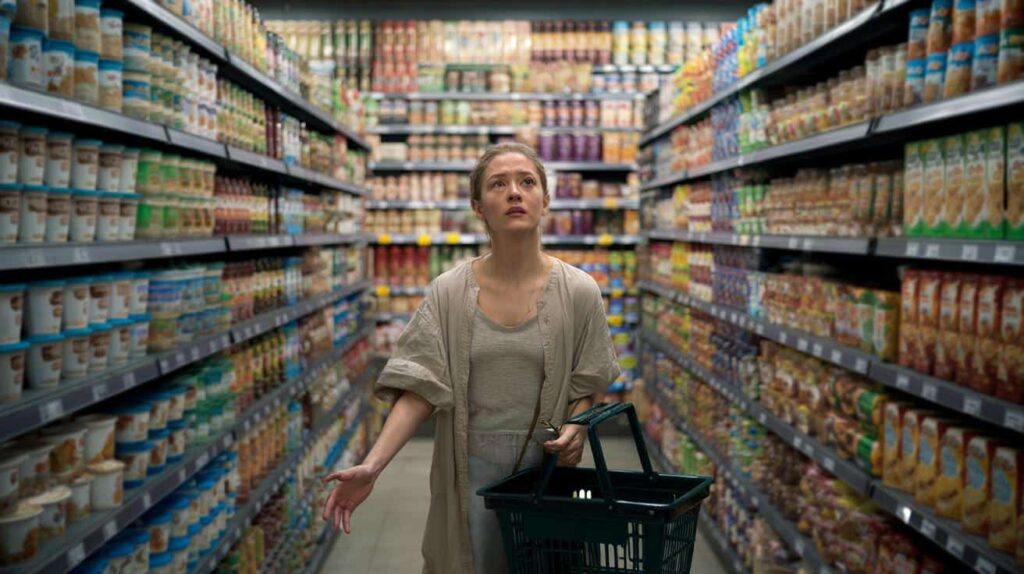
You came in for “just a few things”. Somehow you’re stuck on a £1.20 decision like it’s a life choice. Your shoulders tense. Someone’s waiting behind you with that silent pressure of a trolley nudging closer. You grab something at random, already half convinced it was the wrong one.

Later, you laugh it off, but you feel it again choosing a series on Netflix, or a new phone case, or what to eat for lunch. Tiny choices, big mental weight. Something in the background is misfiring.

And that quiet misfire has a name.

The strange heaviness of tiny choices
There’s a specific kind of fatigue that hits when you’re faced with choices that “shouldn’t” matter. You know the stakes are low. You know it’s “just a coffee size” or “just a T‑shirt colour”. Yet your mind spins as if you’re signing a contract that can’t be undone.
That mismatch – small decision, oversized stress – is where the real story sits. Your nervous system doesn’t calmly ask, “Is this significant?” It reacts to sheer volume. Every option becomes another little tab open in your brain, humming away in the background.
Over time, that hum turns into a buzzing you can’t quite name. You call it being “tired” or “not in the mood”. Often, it’s something more specific: decision overload triggered by choices that, on paper, barely count.
Psychologists have a neat phrase for one piece of this: decision fatigue. Each choice you make draws on the same mental budget. Breakfast, outfit, email replies, Slack messages, “Do I go to the gym?”, “Do I reply to this WhatsApp now or later?” – your brain is quietly spending energy on all of them.
By mid‑afternoon, that budget is limping. A study on judges showed they were more likely to grant parole early in the day, and less likely as decisions wore them down. Different context, same wiring. The more you’ve decided already, *the heavier the next choice feels*, no matter how small.
In modern life, we’re not dealing with just “tea or coffee?”. We’re dealing with dozens of micro‑choices per hour, many dressed up as trivial. Scroll or not. Open or ignore. Switch playlist or keep listening. Each one adds a gram of weight to the mental barbell.
Under the surface, your brain leans on shortcuts. One of the big ones is loss aversion: the ancient instinct that losing feels worse than winning feels good. So when you stand in front of an array of near‑identical options, your brain quietly whispers, “Pick wrong and you’ll miss out.”
You’re not evaluating yogurts or TV shows. You’re trying to avoid regret. That’s why insignificant decisions grab so much space. They poke the part of you that hates the idea of “What if I’d chosen better?”.
There’s another twist. Your sense of identity sneaks into the room. The shirt isn’t just a shirt; it’s “what kind of person am I at work?”. The takeaway isn’t just food; it’s “am I someone who eats healthy?”. Tiny choices become mini referendums on who you are. No wonder they weigh more than they should.
Simple ways to stop drowning in low‑stakes choices
One of the most effective moves is boring on purpose: pre‑decide more of your low‑stakes choices. That doesn’t mean becoming a robot in a grey T‑shirt uniform. It means choosing once, thoughtfully, so you don’t have to choose again every single day.
Create tiny “defaults”: the lunch you order when you don’t care, the standard coffee you get unless you truly want something else, the weekday breakfast that never changes. You’re not limiting freedom; you’re protecting bandwidth for decisions that actually matter.
A helpful trick is asking, “Will I care about this in a week?”. If the answer is no, give yourself a 10‑second limit. When the timer’s up, you go with your first okay option, not the hypothetically perfect one.
Many people try to “organise everything” in a blast of motivation. Colour‑coded apps, five‑step routines, strict rules for every part of the day. Soyons honnêtes : personne ne fait vraiment ça tous les jours.

Start smaller instead. Pick just one decision that drains you absurdly – maybe what to eat, what to wear, or which emails to answer first. Build a loose rule around that single area. For example: three go‑to outfits you rotate without thinking on workdays.
Expect resistance. A part of you may worry that defaults mean being lazy or less intentional. In reality, you’re freeing attention so you can be more present where it counts: with your partner, on a project, in a hard conversation. That’s not laziness. That’s strategy.
“Freedom is not the absence of structure, but the presence of discipline that makes meaningful choices possible.” – paraphrased from routines many high performers quietly live by
To make this feel practical, imagine a tiny “mental settings” menu in your life:
- Set 2–3 “always fine” meals you default to on busy days.
- Choose one supermarket and stick to it for everyday shopping.
- Keep a “Good enough” watchlist so you don’t scroll for 25 minutes every night.
- Decide a cut‑off time after which all non‑urgent decisions wait until tomorrow.
- Use a simple phrase: **“This is not a big decision.”** Say it out loud when you feel yourself spiralling.
These aren’t rules to restrict you. They’re safety rails when your brain is tired and everything starts to feel heavier than it really is.
Learning to live with imperfect choices
The real shift comes when you stop treating every choice as a test. Some decisions genuinely move the needle of your life. Most don’t. Getting honest about that ratio is quietly liberating.
When you catch yourself frozen over a trivial option, try stepping back mentally. Ask, “What’s the actual consequence here?”. Not the imagined one, not the future fantasy, just the concrete reality. A slightly less nice sandwich. A TV series you drop after episode two. A shirt you wear twice and donate.
Your brain loves to inflate these into grand statements about taste, identity, success. Shrinking them back to scale is almost a physical relief. You feel your shoulders drop. Your jaw unclench. The choice turns back into what it always was: one small moment, not a verdict.
On a deeper level, feeling overwhelmed by small choices is often a signal, not a flaw. A signal that your mental budget is shredded. That you’ve been “on” for too many hours, swapping tabs, reacting to pings, juggling invisible to‑do lists.
When that signal shows up, the fix isn’t to “try harder” at choosing. It’s to deliberately choose less for a while. Fewer tabs, fewer “just checking” loops, fewer open‑ended commitments. Your nervous system needs friction, not endless possibility.
There’s also a quiet skill in letting some choices simply be random. Pick the first book your hand touches. Take the third coffee shop on the street. Let a friend choose the restaurant. **You don’t need to optimise every experience to have a good life.** Sometimes, good enough really is.
On a human level, we share this struggle more than we admit. On a screen, it looks like scrolling. In real life, it feels like a soft, constant tension. The sense that you’re always one “wrong” click away from missing the best thing.
Talking about it – with a partner, a friend, even colleagues – often exposes the same pattern in them. That’s oddly comforting. It turns a private flaw into a shared symptom of how we live now. Less “What’s wrong with me?” and more “Look what our brains are trying to cope with.”
When you see it that way, being kinder to yourself stops being a nice idea and starts feeling like basic maintenance. You’re not weak for hating the cereal aisle. You’re wired for a world with fewer choices, dropped into one that never stops multiplying them.
Some days, the goal isn’t choosing perfectly. It’s simply getting through the day with a little bit of attention left for what actually makes it worth living.
| Point clé | Détail | Intérêt pour le lecteur |
|---|---|---|
| La fatigue décisionnelle | Chaque micro‑choix consomme une partie de votre énergie mentale limitée. | Comprendre pourquoi vous êtes épuisé par des décisions “sans importance”. |
| Les “défauts” personnels | Créer des choix par défaut pour les domaines à faible enjeu (repas, vêtements, routines). | Alléger votre journée et garder du mental pour les vrais enjeux. |
| Redimensionner les décisions | Ramener les petites décisions à leur impact réel et accepter l’imperfection. | Réduire l’angoisse, le regret anticipé et la sensation de blocage. |
FAQ :
- Why do I freeze over tiny decisions but handle big ones fine?Big decisions souvent activent vos valeurs profondes et votre sens des priorités, ce qui clarifie la direction. Les petites décisions se ressemblent toutes, offrent trop d’options et déclenchent la peur de “rater mieux” sans repère clair.
- Is feeling overwhelmed by choices a sign of anxiety?Ça peut y ressembler, oui, mais ce n’est pas toujours un trouble anxieux. Souvent, c’est un mélange de fatigue, de surcharge d’options et de pression implicite à tout optimiser.
- How many decisions a day is “too many”?Il n’y a pas de chiffre universel. Le bon indicateur, c’est quand vous ressentez des blocages pour des choix simples, une irritabilité face aux questions banales ou un besoin compulsif d’éviter toute décision.
- Do routines make life boring?Les routines rendent ennuyeux ce qui n’a pas besoin d’être excitant (le matin, les courses), pour libérer de l’attention et de la spontanéité là où ça compte vraiment : projets, relations, loisirs.
- What if I’m afraid of making the “wrong” choice?Essayez de définir concrètement ce que “wrong” signifie pour cette décision précise. Puis demandez‑vous si vous vous en souviendrez encore dans un mois. Très souvent, la réponse est non, et cette prise de conscience fait déjà baisser la pression.
