The elevator doors opened with a groan that echoed straight through the rock.
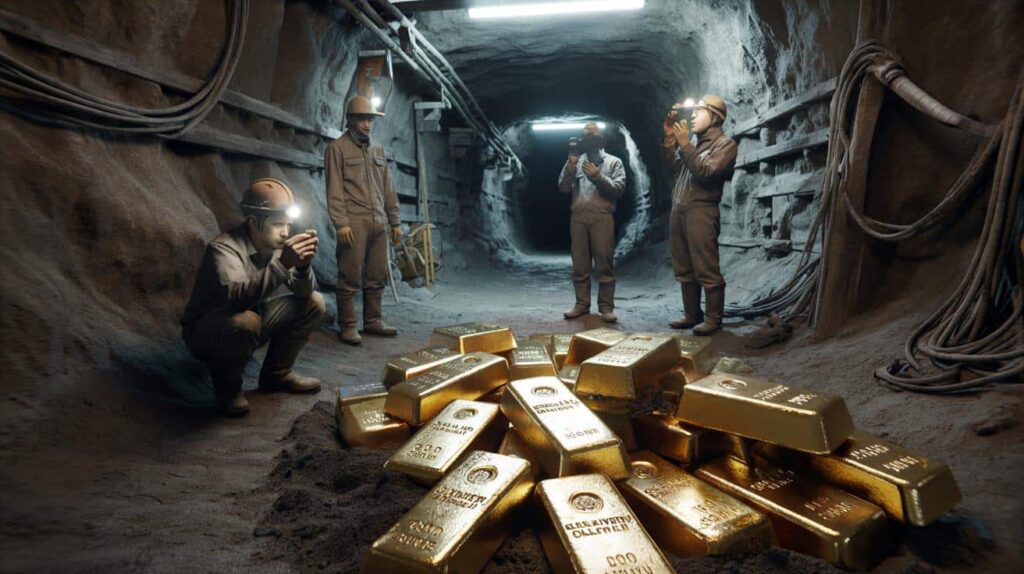
A wave of hot, metallic air hit the group of geologists first, then the silence: that dense kind of silence you only get more than a kilometer underground. Headlamps cut thin lines of light across the rough tunnel wall, dancing over drill marks, pipes, and mud-slick floor. Then one of the beams landed on something that did not belong there. A clean, sharp edge. A color that doesn’t exist in stone.
Nobody spoke for a few seconds.
At 1,120 meters below the surface, resting like forgotten bricks beside a collapsed service shaft, lay a stack of yellow ingots.
Not ore. Not dust. Bars. Stamped, sealed… and unmistakably tied to one flag.
The day gold showed up where geology said “no way”
The first man to understand what he was looking at was not a miner, but a quiet, bespectacled geochemist named Luis Andrade. He’d come down expecting nothing more glamorous than core samples and a failing pump. Instead, his torch slid over that strange gleam and stayed there. The bars were filthy but intact, their edges too straight to be natural, their weight obvious even before anyone tried to lift them.
Gold doesn’t just appear in clean bars a kilometer underground.
That simple fact turned this from a mining curiosity into a geopolitical riddle.
When the dust settled and security had cleared the chamber, the cataloging began. There weren’t two or three bars. There were dozens, stacked in a hasty row, wedged behind fallen timber and rock shards. Each weighed roughly 12.5 kilos, the classic “Good Delivery” style used in central banks and international vaults.
On one side of several bars, faint beneath grime and corrosion, investigators found a crest. Not a company logo. A state emblem, barely visible under the lamp glare, from a country already whispered about in smuggling and sanctions reports. One technician snapped a photo, zoomed in, and just muttered: “You’ve got to be kidding me.”
From that second, this stopped being a mine. It became evidence.
The presence of those bars at that depth makes no geological sense. Gold-bearing veins are common in deep rock, yes, but not refined bricks of bullion with milled edges and official stamps. For them to rest beside a maintenance shaft, they had to be brought down deliberately, through industrial tunnels never meant for treasure.
Investigators now piece together a different map of the mine: forgotten side galleries, old wartime expansions, sealed-off chambers that never made it to public records. The working theory is simple and chilling. Someone used this underground maze as a hidden vault, a place where no customs officer, no satellite, no banking regulator would ever think to look. One nation’s gold, buried not in a fortress above ground, but under a continent.
How a nation’s secret bullion could end up under a mountain
On paper, the method is almost elegant. You move gold in plain sight, coded in shipping manifests as “machinery parts” or “industrial components”. It arrives at a remote mining site owned through layers of shell companies. From there, nothing leaves. Trucks take material in, but not out. Underground, converted storage galleries wait behind walls that look like natural rock.
The mine already has what every secret operation dreams of: noise, dust, and a thousand legitimate reasons to move heavy cargo without questions.
You cloak the extraordinary inside the ordinary.
A former logistics manager, who agreed to speak on condition of anonymity, described how easy it can be to hide anomalies in an industrial system that large. “You’ve got hundreds of shipments a month,” he said. “Containers, pallets, fuel, explosives, spare parts. You add three crates with a plausible code, nobody blinks. On site, a small inner circle diverts those crates straight underground.”
He remembered one winter when trucks rolled in late at night, always the same unmarked convoy, always the same tight security detail that outranked local staff. “We joked they were moving a president down there,” he said. “Turns out, they might have been moving something just as political.”
Years later, looking at the photos of the bars, he recognized the shape of the crates.
The link to one specific nation doesn’t come only from the faint emblem. Analysts also compare serial number patterns, alloy signatures, and casting styles with known bullion stocks. Every country that trades gold at scale leaves its own fingerprint: a preferred refinery, a minting technique, a certain purity and trace mineral profile.
Early lab reports suggest the bars match gold reserves previously declared “sold” or “reallocated” by the same country now at the center of suspicions. If that’s confirmed, the implications are brutal. It would mean part of a national reserve was quietly siphoned off, hidden under foreign soil, perhaps to dodge sanctions, prepare for financial shock, or feed black-budget operations. Let’s be honest: nobody really tracks every ingot once it leaves a central vault, not in real time. This find exposes that blind spot with almost theatrical clarity.
What this underground treasure story really tells us about power
For the teams now cataloging the find, the work is oddly physical and strangely intimate. Each bar is cleaned by hand, lifted, weighed, photographed. A simple gesture — turning one ingot to read its underside — can shift its origin story. Did it pass through a European refinery? Was it once marked for an Asian central bank? Did someone grind off a serial number in a hurry?
The method is part forensic science, part archaeology of the present.
Every scratch becomes a clue.
The temptation, when hearing about hidden gold, is to jump straight to wild maps and treasure fantasies. But the real story here is more sobering and more familiar. A small group somewhere made decisions far from any public eye, assuming the secrecy of a mine would outlast their careers. They gambled that deep rock and forgotten tunnels would bury the past.
We’ve all been there, that moment when a shortcut feels safer than it really is — just on a much smaller, less golden scale. This is that same human impulse, multiplied by billions and wrapped in national colors. *The deeper you bury something, the louder it echoes when it’s finally found.*
“Gold is never just metal,” says a European financial investigator involved in the case. “It’s memory. It keeps records that governments would rather forget, especially when those records are sitting in the wrong place, under the wrong mountain, with the wrong emblem on them.”
- Stamped emblems – Connect the bars to a specific nation’s minting history.
- Serial number fragments – Help reconstruct missing logs and “lost” reserve transfers.
- Alloy composition – Reveals refining practices tied to a time period and region.
- Logistics patterns – Match shipments, shell companies, and border crossings to the site.
- Depth and location – Expose how far a state will go to keep value out of sight.
A mine, a nation, and the uncomfortable question nobody likes
The discovery forces a quiet rethinking of what national reserves even mean, beyond the tidy numbers announced in press conferences. If gold can be hidden a kilometer underground in a foreign mine, outside official ledgers yet still serving a state’s strategic interests, how much of the world’s real wealth sits in similar shadows. The answer changes everything from sanctions policy to public trust.
For the miners who now step around sealed-off zones and fresh security cordons, the tunnels feel different. The same rock, the same damp air, but over their heads hangs a new knowledge: that global power games ran right through the galleries where they eat sandwiches and swap shifts.
There is no neat ending here, no clean moral to wrap like a ribbon around the bars. Investigations will drag on. Governments will deny, deflect, or quietly renegotiate. Gold may be repatriated or quietly re-registered under new paperwork. What will remain is the image: a line of bullion in the beam of a helmet lamp, the kind of scene that doesn’t belong in reality yet suddenly does.
Some of the workers took blurry photos anyway, before phones were banned in that section. Those images will live on in private chats and late-night stories long after the official reports are filed. They know they were standing at the edge of a secret that slipped.
Perhaps the most unsettling thought is also the simplest: this mine was only discovered because of an accident in a maintenance shaft. How many other forgotten galleries, old salt caverns, or deep bunkers already cradle bars with familiar emblems, patiently waiting in the dark. **Gold doesn’t care who owns it on paper. It only cares where it rests.**
Somewhere between those gleaming ingots and the men hauling rock around them lies the real question — not about treasure, but about who gets to hide value, and at what depth the rest of us finally start to notice.
| Key point | Detail | Value for the reader |
|---|---|---|
| Underground gold cache | Refined bullion discovered over a kilometer below ground in an active mine | Offers a rare glimpse into how hidden wealth can bypass normal oversight |
| State-linked origin | Emblems, serials, and alloy signatures trace the bars to one specific nation | Helps readers understand how national reserves can move in secret |
| Hidden systems of power | Use of industrial tunnels as covert vaults tied to geopolitics and sanctions | Invites reflection on transparency, trust, and who really controls global assets |
FAQ:
- Question 1How deep were the gold bars actually found?
- Answer 1They were located at roughly 1,120 meters below the surface, in a secondary tunnel branching off a main service shaft, an area previously logged as a low-priority maintenance zone rather than an ore-rich chamber.
- Question 2How do investigators know the bars belong to one specific nation?
- Answer 2Several clues overlap: faint state emblems, partial serial number sequences consistent with that country’s bullion records, and metallurgical analysis that matches known refining practices and purity standards used by its central bank.
- Question 3Could this just be an old wartime stash with no political meaning today?
- Answer 3Some bars appear older, but others show casting dates and styles from recent decades, which suggests an ongoing or at least post-war strategy rather than a single historical event frozen in time.
- Question 4Is it legal for a country to hide its gold reserves abroad like this?
- Answer 4Storing reserves abroad isn’t unusual; many nations do it openly in foreign vaults. What’s different here is the apparent attempt to conceal the gold off the books, underground, which could clash with both international reporting standards and domestic transparency laws.
- Question 5Will the public ever find out the full story behind this hoard?
- Answer 5Parts of it, probably. Official inquiries tend to release a carefully managed version of events, but leaks, whistleblowers, and independent investigators often fill in the gaps over time, piece by piece, long after headlines fade.