
The woman in the salon chair looks like she’s bracing for a dentist appointment, not a hair color. She fingers the faded blond ends of her bob, eyes fixed on the mirror. “I’m over 50,” she says quietly, “I’m scared of looking harsh. Or worse… like I’m trying too hard.” The hairstylist smiles, lifts a strand towards the light, and turns the color chart around. Among the beiges and chocolates, one shade jumps out like a secret: “Black Cherry.” Deep, velvety, with that hidden red glow you only catch when you move.
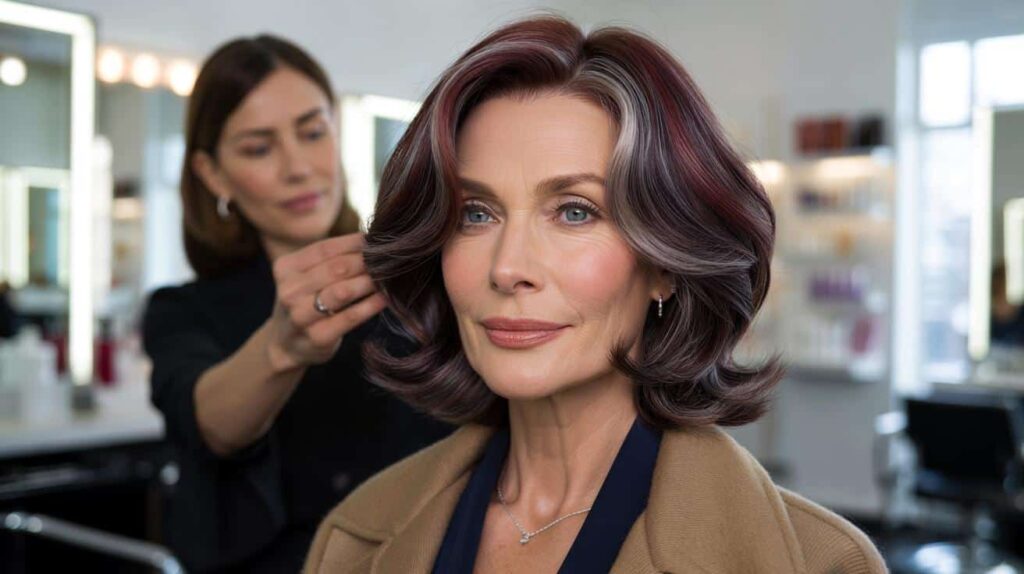
“Trust me,” the stylist insists. “This is the winter shade for you.”

The woman hesitates. Then nods.

When she stands up an hour later, something in the mirror has shifted that has nothing to do with age.

The winter hair color that behaves like soft-focus
Seen in natural light, Black Cherry isn’t the flat, severe black many women fear. It’s a near-black base infused with plum, wine and cherry tones that wake up the face instead of draining it. On women over 50, that mix does something quietly magical: it sharpens the eyes, warms the skin, and makes fine lines fade just a little into the background.
A good colorist will tell you this shade is like a built‑in filter. Not fake, not theatrical. Just richer, deeper, more “alive” than your natural brown that has slowly dulled over the years.
One Parisian hairstylist explained that she started proposing Black Cherry to her 50+ clients “by accident.” A regular came in after a harsh breakup, tired of her highlighted chestnut that was starting to look brassy against her paler winter skin. “Give me something different,” she said. “But not red. And not black.”
The stylist mixed a near-black with a touch of violet and cherry, applied it carefully, and watched. When the cape came off, the client didn’t speak for a second. Then she pulled out her phone, snapped a selfie and whispered, “I look like myself ten years ago… just calmer.”
What happens is quite simple: dark hair creates contrast. With age, our natural contrast fades — brows lighten, lips lose pigment, hair turns grey. That makes us look more “washed out” on photos, especially in winter light. Black Cherry reintroduces that contrast, but the red and plum tones soften the effect, so it doesn’t scream “jet black.” The color hugs the skin instead of fighting it. That’s why so many women hear, “Did you sleep well? You look rested,” instead of, “Oh, you dyed your hair?”
How to wear Black Cherry after 50 without feeling disguised
The first rule, according to colorists, is to adapt Black Cherry to your skin undertone, not copy a Pinterest photo. If your skin is cooler, leaning pink or rosy, you’ll want more plum and wine in the mix. If you run warmer, with golden or olive undertones, the shade should tilt more towards soft cherry and dark chocolate than purple.
Ask your hairstylist for a translucent, multi‑dimensional color rather than a solid block tone. That means subtle lowlights and a very gentle gradient near the roots. The goal: a color that moves and catches light, not a helmet.
The second rule is about length and cut. On long hair, Black Cherry can look almost couture when it’s glossy and layered. On a chin‑length bob, it brings a graphic, modern edge that instantly updates your style without going shorter. If you have very fine hair, a slightly rounded, shoulder‑skimming cut works wonders with this shade, giving the illusion of fullness.
We’ve all been there, that moment when you leave the salon and think, “This is beautiful, but will I manage it at home?” That’s why a low‑maintenance cut matters even more than the color itself. You want a shape that falls into place with a quick rough‑dry, where the richness of the shade does most of the work.

Let’s be honest: nobody really does this every single day. By “this,” colorists mean blow‑drying perfectly, applying three products in the exact order, and going to the salon every four weeks. Past 50, life tends to be full, and energy is not endless.
One London stylist summed it up with a smile:
“Black Cherry is my secret weapon for busy women over 50. It looks high‑effort, but the maintenance can be very low if we plan it right.”
She recommends building your color around your reality:
- Spacing touch‑ups every 6–8 weeks with a soft root shadow
- Using a sulfate‑free shampoo to keep the cherry tones from fading too fast
- Adding a weekly tinted mask to revive the shine between salon visits
- Trimming the ends every 2–3 months so the dark shade doesn’t highlight dryness
What Black Cherry quietly changes in the mirror after 50
There’s a subtle psychological shift when a woman over 50 moves from “safe brown with highlights” to a shade like Black Cherry. It’s not about looking younger at all costs. It’s about reclaiming depth, presence, and that little thrill of catching your reflection and thinking, “That’s me. And I like her.”
Many women report that this color pushes them to edit their makeup, too. A touch less foundation, a soft berry lipstick, maybe a hint of mascara instead of heavy eyeliner. The hair becomes the star, the rest of the face relaxes.
For some, Black Cherry is a gentle rebellion against the narrative that hair after 50 should be lighter, smaller, less “visible.” It says the opposite: I’m here, with all my years, and I choose intensity. Not everyone around you will notice the exact shade, but they’ll see something stronger, more grounded. Like turning up the contrast on a photograph that had slowly faded.
The beauty of this color is that it doesn’t shout. It glows. It lets silver jewelry pop, makes winter coats in camel or navy look more luxurious, and pairs beautifully with glasses, especially frames in tortoiseshell or black.
Some women use Black Cherry as a transition step from dyeing everything to eventually embracing grey. They live with the darker shade for a few winters, enjoy the sophistication, then slowly let the roots grow softer with time. Others fall in love and keep it for a decade.
There’s no rule here, and that might be the real charm. The color is bold enough to feel like a decision, but flexible enough to follow your life as it changes. **That’s exactly the kind of beauty choice that tends to last.**
| Key point | Detail | Value for the reader |
|---|---|---|
| Adapt the shade | Blend cherry, plum and chocolate tones based on your skin undertone | A flattering, personalized color that doesn’t look harsh |
| Think maintenance | Soft root shadow, 6–8 week touch‑ups, weekly tinted mask | Salon‑worthy hair without exhausting routines |
| Update the whole look | Modern cut, lighter makeup, clothes that highlight the new depth | A cohesive, sophisticated style that feels current and confident |
FAQ:
- Is Black Cherry too dark if I’ve always been blonde?If you’ve always been light, ask your stylist for a “soft Black Cherry” on a dark brown base rather than near‑black. The cherry tones will still flatter you, but the contrast will be gentler.
- Does this color emphasize wrinkles?No, the opposite tends to happen when the right tones are used. The warm red‑plum reflections bring life to the skin, which softens the appearance of fine lines.
- Can I do Black Cherry at home with a box dye?
