
From the plane window, the ocean usually looks clean and endless, a flat sheet of blue stretching to forever. On a recent flight over the eastern Atlantic, that illusion snapped. Below, like a scar across the water, ran a thick brown ribbon, curling and folding on itself, darker at the center and fading at the edges. It wasn’t a shadow. It wasn’t a cloud. It was something sitting on the sea itself.
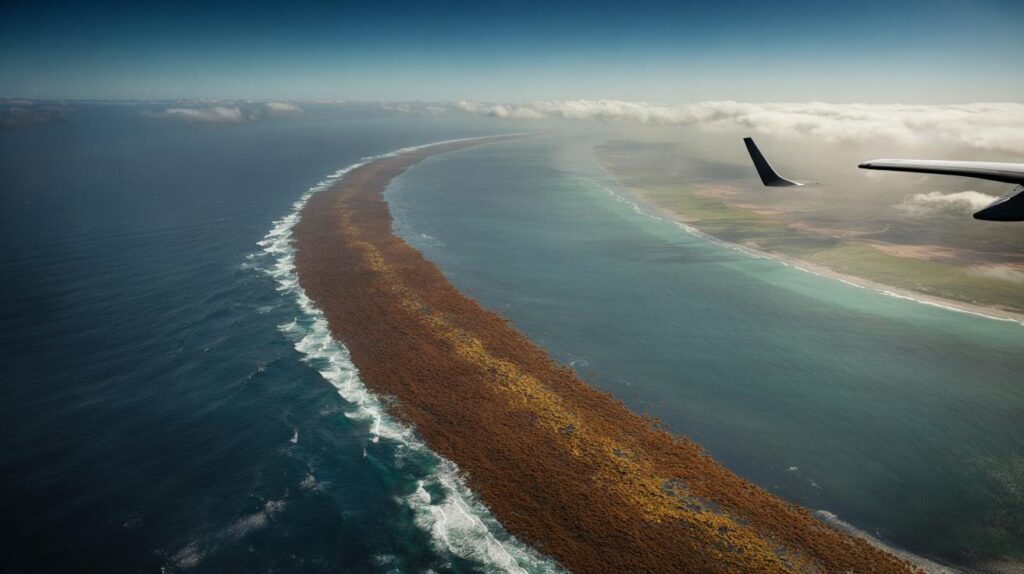
A passenger across the aisle pulled off their headphones to stare, and you could feel that quiet question hanging in the air. What is that doing there?
 “I’ll buy it until I’m 90”: a dermatologist reveals the name of her favorite supermarket shampoo
The answer is not very reassuring.

The day the ocean turned brown
From space, satellites have been watching the same thing: a vast brown band stretching between West Africa and the Atlantic, sometimes reaching toward the Caribbean like a lazy, drifting highway. On some days, it’s hundreds of kilometers long. On others, it sprawls like a stain, visible even from orbit.

Scientists have given it a calm, almost pretty name: the Great Atlantic Sargassum Belt. Up close, it doesn’t feel calm at all.
This “belt” is a massive bloom of sargassum, a floating brown seaweed that used to stay mostly tucked away in the Sargasso Sea, north of the tropics. Now it’s breaking all the old rules. In 2018, satellite images picked up more than 20 million tons of this algae stretching from West Africa to the Gulf of Mexico. Beach towns in the Caribbean reported knee‑deep piles washing ashore, rotting under the sun, sending up waves of sulfurous, eggy smell that drove tourists back to their hotels.
Fishermen had to cut through thick mats just to move. Boat propellers jammed. Turtles struggled to reach the sand to lay eggs.
So why is this brown ribbon growing so fast, and why here, between the Atlantic and Africa? Researchers point to a cocktail of ingredients. More nutrients are flowing off the Amazon and Congo rivers from farming and deforestation. Warmer, more stratified surface waters give algae a kind of cushy nursery. Changing winds and currents are shifting where this seaweed can gather and survive.
On their own, each of these pressures might be manageable. Together, they have turned parts of the Atlantic into a conveyor belt of floating biomass. A problem as long as a continent.
When a natural phenomenon goes off the rails
To understand what’s going on, you first need to know that sargassum isn’t some alien invader. It’s a natural part of the ocean. Traditionally, drifting mats of this seaweed formed a unique floating habitat in the mid‑Atlantic, giving shelter to fish, crabs, baby turtles and even seabirds resting between long flights.
Under the right conditions, this algae is a quiet ally of marine life. The trouble starts when those “right conditions” get supercharged.
Think of what happens on land when a harmless plant gets too much fertilizer and just takes over a field. Something similar is happening at sea. Fertilizers from industrial agriculture, sewage, and eroded soil wash into rivers like the Amazon and the Congo, then pour into the Atlantic. That nutrient‑rich water acts like an all‑you‑can‑eat buffet for sargassum.
Satellite data show that major blooms started appearing regularly after 2011. The belt now often stretches more than 8,000 kilometers, brushing the African coast one season and blanketing Caribbean islands the next. What used to be an occasional visitor has become a yearly siege.
Once the algal mats grow thick, they begin to change everything around them. Sunlight can’t reach the water below, cutting off photosynthesis for other plants and microscopic algae. Fish avoid oxygen‑poor zones forming under the decomposing seaweed. Coral reefs near impacted coasts get buried in decaying sludge, already weakened by heat and pollution.

Let’s be honest: nobody really thinks about seaweed as a warning siren. Yet this brown ribbon is exactly that—a visual alarm that our land habits are spilling over, literally, into the ocean.
Living with a 21st‑century seaweed belt
For coastal communities, the question is brutally practical: what do you actually do when tons of seaweed arrive at your doorstep? On Mexico’s Caribbean coast, workers now start before sunrise, raking the shore and loading sargassum into trucks before the heat turns it into a choking, gassy mess. Some hotels deploy floating barriers offshore to deflect the mats, guiding them into collection points where small boats scoop them out.
It’s a daily choreography of shovels, nets, and exhausted backs. And the belt just keeps coming.
Beach towns from Senegal to Barbados are learning by trial and error. Piling seaweed directly on the sand seems quick, but the buried mass can leak nutrients back into coastal waters, feeding the next bloom. Burning it sounds simple, then you realize you’re trading one environmental headache for another. Residents complain about respiratory problems. Tour operators cancel snorkeling excursions as visibility drops and the smell spreads.
We’ve all been there, that moment when a problem feels too big and too far away—right up until it lands on your doorstep, in your lungs, in your tourism numbers, in your fishing nets. That’s what this brown ribbon does. It brings the abstract straight into daily life.
Some communities are trying to turn the tide by turning the algae into something useful. Entrepreneurs are experimenting with sargassum bricks, animal feed, compost, even bioplastics. The results are mixed, but the creativity is real.
Scientists like to remind us that sargassum isn’t “the enemy”—it’s a messenger, reacting to the changed chemistry and temperature of our shared ocean.
- Watch the sources: Reducing fertilizer runoff and untreated sewage upstream cuts the fuel that feeds these mega‑blooms.
- Support smarter cleanup: Coastal projects that collect seaweed offshore, before it rots on beaches, protect both tourism and marine life.
- Look beyond the coastline: Policies on deforestation, river management, and climate all flow into this brown belt, whether we see the connection or not.
What this brown ribbon is really telling us
Seen from above, that brown band between the Atlantic and Africa looks almost abstract, a brushstroke across a blue canvas. Up close, it’s heavy, wet, and stubborn. It clings to ankles, bogs down boats, suffocates coral, and knocks the shine off postcard‑perfect beaches.
Yet the most unsettling part is not the smell or the inconvenience. It’s the pattern. The regularity. The sense that the ocean is quietly, relentlessly answering the way we live on land.
*The Great Atlantic Sargassum Belt is not a freak event, it’s a feedback loop.* Our fertilizers, our emissions, our land‑use changes bend the rules of a system we barely understand, and the algae simply responds. That brown ribbon is both symptom and signpost. It says: this is what happens when the boundaries between “land problems” and “sea problems” dissolve.
Maybe that’s why the satellite images are so gripping. They turn something technical—nutrient loading, ocean warming, current shifts—into a single, undeniable picture. A picture you can’t unsee.
Next time you stand at an empty shore and watch the waves roll in, it’s worth remembering that the water at your feet is part of that same Atlantic highway. The decisions made around distant rivers and distant farms will arrive here, eventually, in some form. Sometimes as clearer water and bright reefs. Sometimes as a brown ribbon stretching beyond the horizon, telling a story we’re still deciding how to end.
| Key point | Detail | Value for the reader |
|---|---|---|
| — | Rapid growth of the Great Atlantic Sargassum Belt since 2011 | Helps you grasp that this is a new, accelerating phenomenon, not “just seaweed” |
| — | Link with river runoff, warming waters, and shifting currents | Connects your daily life on land with what you see (and smell) at the beach |
| — | Local responses and emerging uses for sargassum | Shows where mitigation, innovation, and policy pressure can actually change the story |
FAQ:
- Question 1What exactly is this brown ribbon between Africa and the Atlantic?
- Question 2Is the Great Atlantic Sargassum Belt dangerous for humans?
- Question 3Why has this seaweed belt become so big in the last decade?
- Question 4Can anything useful be done with all that sargassum?
- Question 5As an ordinary traveler or coastal resident, what can I realistically do about this?
