
After a decade of stalled promises and glossy concept slides, 2026 is shaping up as the year several flagship clean‑energy ideas finally cross into real deployment, from high‑efficiency solar modules to long‑duration batteries and a crucial step toward practical nuclear fusion.
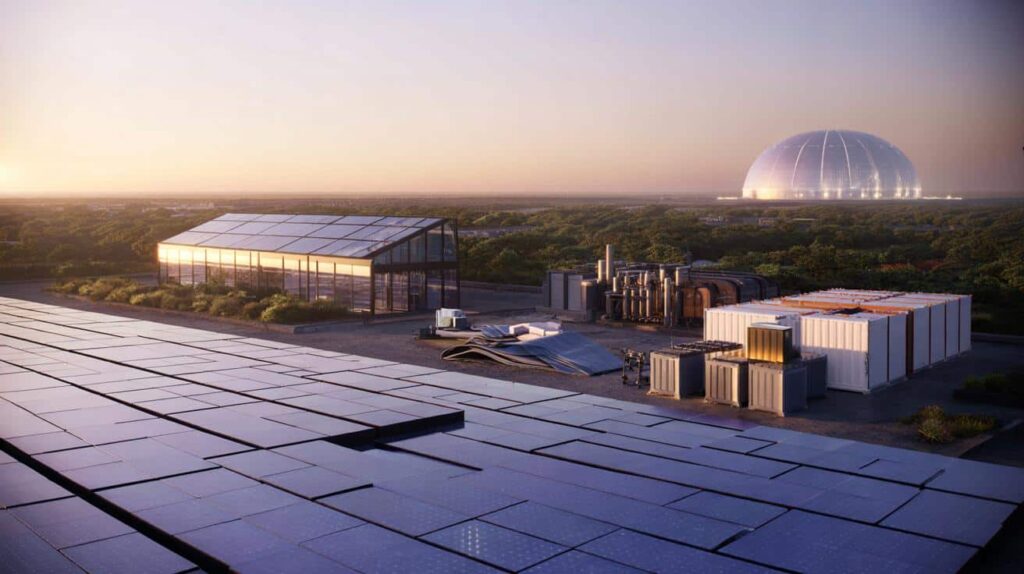
Perovskite solar cells step out of the lab
Solar panels have become cheaper, but their basic recipe has barely changed: slabs of silicon that waste a big chunk of sunlight. Standard rooftop modules rarely top 20–22% efficiency in real conditions. That ceiling comes from a simple physics problem — silicon cannot turn much of the blue and ultraviolet part of the spectrum into electricity.

Perovskite-silicon tandem cells tackle that bottleneck head‑on. They stack two different light‑absorbing layers, each tuned to a different slice of sunlight. The upper perovskite layer grabs high‑energy blue photons, while the lower silicon layer works better with the red and near‑infrared light that slips through.

Researchers have pushed this architecture fast. Peer‑reviewed data published in Nature shows tandem prototypes passing the 34% efficiency mark in ideal conditions — comfortably beyond the long‑assumed silicon limit of around 25%. That jump means a solar park could generate a third more power without needing extra land, foundations or cabling.

From fragile lab sample to commercial product
Perovskites have had a reputation problem. Early cells degraded in weeks under moisture, heat and UV light, which made them great for conference slides but useless on a roof. The real turning point in 2026 is not just efficiency; it is durability and scale.
Several manufacturers in Europe, Asia and North America are now lining up the first commercial tandem modules. Pilot production runs started in 2025; this year, the first premium products are expected on sale for high‑value uses like space‑constrained rooftops, urban facades and portable power.
- New encapsulation methods protect the perovskite layer from humidity and oxygen.
- Improved chemistry cuts toxic lead content and keeps it locked inside stable structures.
- Roll‑to‑roll coating techniques bring production costs closer to standard silicon panels.
For homeowners and businesses, that could translate into a new tier of panels with 25–30% real‑world efficiency, aimed at sites where every square metre counts: shaded city rooftops, refrigerated warehouses or EV charging stations squeezed onto small plots.
Portable and building‑integrated solar
Perovskite layers can be deposited on glass, metal foils or flexible films, using low‑temperature processes. That opens spaces where heavy rigid silicon panels never really worked.
Developers are already testing:
- Solar windows: semi‑transparent modules that double as glazing in offices or homes.
- Foldable chargers: lightweight perovskite mats for camping, disaster relief or remote telecom towers.
- Vehicle skins: curved panels on trucks, buses or boats to power onboard systems.
Rather than pushing solar only onto roofs and fields, perovskite layers can slip into surfaces that already exist — windows, façades, vehicles and even street furniture.
The gains sound modest individually, but at city scale they add up: more small power sources reduce the strain on ageing grids and cut peak demand from air conditioning and data centres.
Long‑duration storage: beyond lithium‑ion
Richer solar output brings a familiar headache: intermittency. The sun sets, clouds roll in, and demand rarely matches production. Lithium‑ion batteries have supported the first wave of renewables, but they are optimised for hours, not days, and rely on metals with tense supply chains.
Iron‑air batteries target the multi‑day gap
US‑based Form Energy is one of the firms trying a very different approach with iron‑air batteries. Instead of shuttling lithium ions between electrodes, these systems “rust and unrust” iron.
During discharge, the battery exposes iron pellets to air; they oxidise, releasing energy. To recharge, the system applies electricity to strip the oxygen back off, returning the pellets to metallic iron. The chemistry is slow, inefficient and bulky compared with lithium‑ion — but it does not need to be nimble.
Iron‑air batteries are designed to fill the awkward 10–100 hour gap when poor weather drags on but seasonal patterns have not yet shifted.
Form Energy reports that its units can store electricity for up to 100 hours. After commissioning its first commercial factory in 2025, the company is now ramping up scale in 2026, targeting grid projects in the US Midwest and beyond. Iron and water are cheap and abundant, which could hold down long‑term costs.
Sodium‑ion edges toward mass production
Another storage contender gaining real momentum in 2026 is sodium‑ion. Sodium sits just beneath lithium in the periodic table, but it is vastly more common and widely distributed, from seawater to salt flats.
Chinese giant CATL has announced mass production of its Naxtra sodium‑ion line. These batteries trade some energy density for other advantages:
- Lower raw material costs, since sodium does not depend on constrained lithium or cobalt supply.
- Improved safety profile, with better tolerance to low temperatures and less fire risk.
- Potential use in stationary storage and low‑cost EVs where range demands are modest.
Sodium‑ion will not replace lithium‑ion in long‑range cars any time soon, but it could undercut it for grid storage and city vehicles.

In practical terms, that means solar farms and wind parks could pair a mix of storage technologies: fast‑responding lithium‑ion for minute‑to‑minute balancing, sodium‑ion for daily shifting, and iron‑air for longer troughs.
| Technology | Typical storage duration | Main strengths | Main limits |
|---|---|---|---|
| Lithium‑ion | Minutes to 4–6 hours | High efficiency, mature, compact | Costly materials, fire risk, limited long‑duration economics |
| Sodium‑ion | Hours to a day | Cheaper materials, safer, good for stationary uses | Lower energy density, early stage supply chains |
| Iron‑air | 10–100 hours | Very low material cost, suitable for long outages | Bulky, slower response, lower round‑trip efficiency |
A critical step toward fusion: solving the tritium puzzle
Against this backdrop, nuclear fusion still sits in a different category: a long‑shot promise for constant, carbon‑free power using the same process that drives the sun. Recent experiments have hit high temperatures, strong magnetic confinement and even brief net‑energy gains. Yet one bottleneck remains largely invisible outside specialist circles — fuel.
Most fusion designs rely on a mixture of deuterium and tritium, both isotopes of hydrogen. Deuterium is easy: it is found in seawater. Tritium is another story. It is radioactive, scarce and mostly produced as a by‑product in a handful of nuclear reactors used for research and medical isotopes.
At present, only tens of kilograms of tritium exist worldwide, with just a few kilograms added each year — far below what commercial fusion fleets would need.
A single 1‑gigawatt fusion plant could consume 50–60 kilograms of tritium annually. That makes fuel supply an existential question rather than a side issue.
Unity‑2 and the closed tritium loop
Canadian nuclear laboratories and Kyoto Fusioneering are now working together on a facility called Unity‑2, due to start operation in 2026. The goal is not to build a power plant, but to crack the fuel cycle.
Unity‑2 focuses on creating and managing tritium within a closed loop. The concept is to surround the fusion core with a “blanket” containing lithium. When high‑energy neutrons from the fusion reaction hit this blanket, they can convert lithium into fresh tritium. That tritium then needs to be captured, purified, stored and fed back into the reactor safely and continuously.
The technical hurdles are big:
- Materials must withstand intense neutron bombardment without crumbling.
- Complex plumbing has to move tritium without leaks, contamination or excessive loss.
- Monitoring systems must track tiny amounts of radioactive gas in real time.
If Unity‑2 proves a reliable closed tritium loop, it would remove one of the main arguments that fusion can work only as a single demonstration, not a repeatable industry.
How these pieces fit together
None of these advances alone reshapes energy systems. Together, they mark a shift from proofs‑of‑concept to integrated planning. A regional grid in the 2030s might lean on high‑efficiency perovskite‑tandem solar for dense cities, backed by layered storage and, later, a handful of fusion units providing steady baseload power.
Policy makers already face practical questions. Should subsidies favour high‑efficiency rooftop solar, or cheaper standard panels with larger surface area? How should grid operators value long‑duration storage that might run only a few times a year, yet prevents blackouts during prolonged calm, cloudy periods?
The debate is moving from “will this work?” toward “where does this fit, who pays, and how fast can it scale?”
Jargon check: perovskite, tritium and long‑duration storage
Some of the terms thrown around can sound like buzzwords. Three are worth unpacking clearly:
- Perovskite is not a single material but a crystal structure that can host many different chemical recipes. By tweaking its composition, scientists tune how it absorbs light, but also how stable it is against heat and moisture.
- Tritium is hydrogen with two neutrons and one proton. It decays with a half‑life of about 12 years and emits low‑energy beta particles. That makes handling it tricky but manageable with the right containment.
- Long‑duration storage usually refers to systems that can deliver power for more than 8 hours at a stretch, sometimes up to several days or weeks. These are different beasts from the short‑burst batteries in phones or laptops.
Risks, trade‑offs and the next decade
Each technology carries its own risks and trade‑offs. Perovskite modules must show they can last 20–30 years outdoors without shedding toxic compounds. Iron‑air and sodium‑ion batteries need thorough lifecycle analysis to check that cheap materials do not hide costly maintenance or recycling problems. Fusion faces the classic danger of shifting timelines and growing budgets, even as the science moves forward.
On the other hand, combining these tools could soften individual weaknesses. Distributed high‑efficiency solar cuts reliance on any single big power station. Diverse storage options can keep critical systems running through storms, cyberattacks or fuel shortages. A mature fusion sector, if it arrives, would complement rather than replace renewables, smoothing out long winter nights and industrial loads that never sleep.
For now, 2026 looks less like a sudden revolution and more like a hinge year: the point where once‑distant ideas finally acquire factories, product numbers and grid‑connection dates. That shift from promise to presence is what will shape energy debates through the rest of the decade.
