
The first time I saw chia pudding, it looked like something that had fallen behind the fridge and fermented. A grey, trembling blob in a mason jar, crowned with three heroic raspberries. Next to me in the café, a young woman in leggings was explaining to her friend that chia “literally talks to your brain and kills cravings”. She spooned it in with missionary zeal. Her friend, eyeing the jelly, did not look convinced. Around us, phones came out, photos were snapped, and somewhere an algorithm took notes. Superfood, brain food, miracle seed, anti-inflammatory bomb. The labels keep piling up on those tiny black dots. Nutritionists themselves don’t quite agree. Some swear by chia’s fibers and omega-3s. Others roll their eyes and call it another Instagram fad with good PR. The spoon hovered in the air.
Something deeper is going on with our hunger.
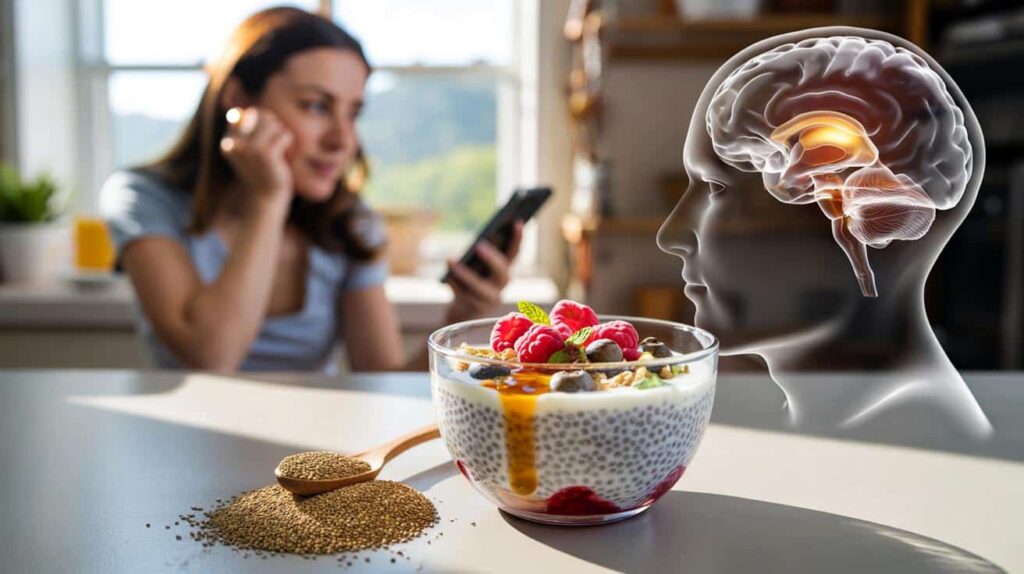
Why chia seeds suddenly ended up in everyone’s breakfast bowl
Scroll TikTok for five minutes and you’ll probably see at least one “what I eat in a day” featuring a thick glass of white chia pudding. The line is always the same: it fills you up, calms your brain, crushes cravings. That promise of brain-controlled appetite hits a nerve in a world where many of us feel constantly pulled by food. Chia seeds, once a niche product in health-food stores, are now stacked in supermarket aisles, slapped with glowing labels. Behind that boom, there’s a clever mix of science snippets, influencer culture and our collective hunger for something that finally “works”.

A few years ago, Solange, 39, an office manager in Lyon, couldn’t go through an afternoon without raiding the vending machine. Then a colleague handed her a jar of homemade chia pudding. “Eat this at 10 a.m., you won’t need chocolate at 4,” he promised. The result stunned her. “I wasn’t thinking about food non-stop,” she recalls. “It felt like my head was… quieter.” Stories like hers multiply on Reddit threads and wellness blogs. Some talk about fewer mood swings. Others say it helped them step off the blood-sugar roller coaster that usually sends them from croissants to cookies to late-night pizza.

Nutrition experts who take chia seriously usually point to one thing first: fiber. In contact with liquid, the seed builds a gel that slows digestion. That thicker, gloopier texture means the stomach empties more slowly, which nudges satiety signals in the brain. On paper, that could explain why some people feel a steadier, more “controlled” appetite. Chia also carries plant omega‑3s and polyphenols, both linked to inflammation pathways in the body. The catch is that most studies are small, short, and often tangled with other diet changes. So the evidence flickers somewhere between “promising mechanism” and “relax, it’s still just a seed”.

Between genuine brain benefits and the risk of overhyping another ‘miracle’
If you want to test chia’s famous appetite-calming power, the method many dietitians suggest is brutally simple: pick one meal, not your whole life. Add 1–2 tablespoons of chia seeds to that meal, soaked in a liquid for at least 20 minutes. Then just watch what happens for three days in a row. Do you reach for snacks later than usual? Is your head less occupied by food? Do you feel too heavy or bloated? That small experiment tells you more than any slogan on a glossy package. Start low, go slow, and always soak. Dry chia plus your throat is a bad combo.

This is where expectations quietly sabotage everything. Some people toss chia onto a sugary smoothie bowl and wonder why their cravings are still wild. Others replace half their lunch with a seed pudding and end up starving by 5 p.m., then binge. We’ve all been there, that moment when a “healthy hack” turns into another cycle of guilt. Chia isn’t a hunger switch, it’s just one more tool. If your breakfast is a sugar bomb, your brain will still get that fast spike and crash, seeds or not. Let’s be honest: nobody really does this every single day. Real life is messy, and that’s fine.
“Chia can help with satiety and inflammation markers, but only inside an overall pattern,” says Dr. Léa Dubois, a French nutrition researcher. “On its own, it’s a garnish, not a cure.”
- Soak first – At least 20–30 minutes in water, milk, or yogurt so the seeds fully swell and don’t clump in your throat.
- Add some protein – Greek yogurt, skyr, cottage cheese, or a scoop of plant protein if you want that longer-lasting fullness.
- Watch quantities – Around 1–2 tablespoons per day suits most people; jumping straight to 4–5 can mean gas and belly pain.
- Mind your teeth – Those tiny seeds love hiding between molars; rinse or brush after eating.
- Check your meds – If you’re on blood thinners or have gut issues, talk to a professional before loading up.
So, superfood or overhyped fad? Why the answer sits somewhere in the grey area
The strange thing about chia is that it holds both truths at once. On one side, you have a genuinely nutrient-dense seed: fiber, minerals, plant omega‑3s, all wrapped in a form that can nudge appetite signals and maybe cool a bit of low-grade inflammation for some people. On the other, there’s a marketing story that inflated those qualities into magic. *The gap between what chia can realistically do and what we hope it will fix says a lot about our relationship with food.* We crave a clean, simple solution that will quiet our brain and body in one spoonful. A seed cannot carry that weight.
| Key point | Detail | Value for the reader |
|---|---|---|
| Chia can support satiety | Soaked seeds form a gel that slows digestion and may steady appetite signals | Understand why chia sometimes “kills cravings” and when it’s just hype |
| Inflammation claims are early-stage | Contains omega‑3 ALA and antioxidants, but human data is still limited and mixed | Avoid overpromising on anti-inflammatory effects while still using potential benefits |
| Context beats any “superfood” | Results depend on the whole meal, regularity, and your own digestion and lifestyle | Use chia as a tool, not a cure, and adapt it to your reality instead of chasing perfection |
FAQ:
- Question 1Do chia seeds really help control appetite through the brain?
- Answer 1They can support satiety because the gel slows digestion and may lead to more stable hunger signals, but they don’t “hack” your brain. The effect varies from person to person and depends a lot on the rest of the meal.
- Question 2Are chia seeds actually anti-inflammatory or is that just a buzzword?
- Answer 2Chia is rich in ALA, a plant omega‑3, and polyphenols that are involved in inflammation pathways. Animal and small human studies suggest potential benefits, yet it’s not comparable to medical treatment or a full anti-inflammatory lifestyle.
- Question 3Is there a best time of day to eat chia seeds?
- Answer 3Many people like them at breakfast to avoid mid-morning crashes, or in an afternoon snack to curb evening grazing. The “best” time is the one when you usually feel least in control of your hunger.
- Question 4Can chia seeds cause bloating or digestive issues?
- Answer 4Yes, especially if you jump to large amounts or eat them dry. Start with 1 tablespoon a day, always soak them, and drink water. If you have gut conditions, speak with a health professional first.
- Question 5Are chia seeds worth buying, or are cheaper seeds just as good?
- Answer 5Chia is useful, but flax and sunflower seeds are also great, often cheaper, and sometimes better absorbed. You don’t need chia to be healthy. If you enjoy the texture and it helps your routine, then it earns its spot in your kitchen.
