Many of us drift off with the bedroom door half-open, lulled by habit or the need to hear what’s going on at home. Yet firefighters, sleep specialists and even insurance assessors have been quietly saying the same thing for years: the way you leave that door at night can change the outcome of an emergency and the quality of your rest.
Why the bedroom door has become a safety issue
Modern homes are packed with flammable materials, electronics on charge and lightweight furniture that burns fast. At the same time, open-plan layouts and hollow-core interior doors can either slow or accelerate a fire.
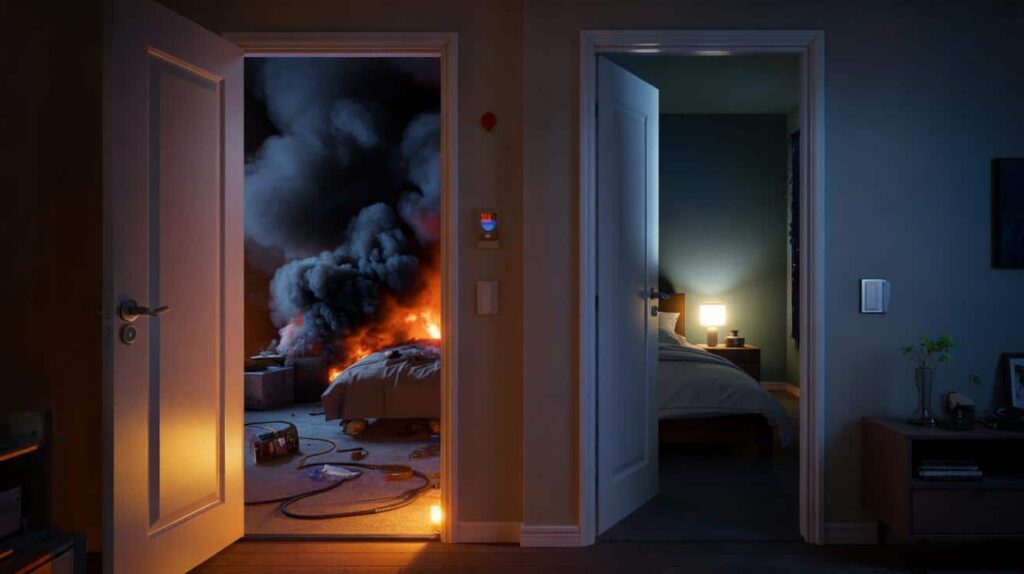
Closing the bedroom door at night can buy you crucial minutes in a house fire, often the difference between escape and tragedy.
Fire tests carried out in the US and Europe repeatedly show the same pattern. A closed bedroom door keeps out thick smoke, delays heat build-up and can hold back flames long enough for firefighters to reach occupants. An open door, by contrast, allows smoke and toxic gases to fill a room in a matter of minutes.
In many incidents examined by fire brigades, the rooms with closed doors were still recognisable after a blaze, while neighbouring open-door rooms were gutted. Survivors often describe waking up because smoke alarms triggered outside the bedroom, not because smoke was already inside.
How a closed door changes a fire
The basic physics behind that simple habit
A typical bedroom door, even a cheap one, acts as a barrier. It slows down the movement of:
- Smoke and poisonous gases such as carbon monoxide
- Heat radiating from other parts of the property
- Oxygen feeding a growing fire elsewhere in the home
When a door stays open, a fire in the hallway or living room can “see” straight into the bedroom. The hot gases and smoke rush towards the cooler space where you are sleeping. With a closed door, that path is blocked, at least for a while.
Firefighters often say: give us time. A closed door does exactly that.
In simple terms, a shut door:
| With the door open | With the door closed |
|---|---|
| Smoke enters the bedroom quickly | Smoke is largely kept out at first |
| Temperature rises sharply | Heat builds up more slowly |
| Escape routes may become unusable in minutes | Occupants often have time to assess and react |
| Higher risk of breathing toxic gases while asleep | Better chance of waking before exposure becomes critical |
Night-time safety: more than just closing the door
Fire professionals talk about a “night routine”. The idea is simple: before going to bed, reduce the chances of a fire starting and improve your odds if one does. The bedroom door is part of that routine, not the whole story.
A quick pre-sleep checklist
Specialists tend to recommend a few basic actions before you turn off the light:
- Switch off unnecessary appliances and avoid leaving devices charging under pillows or on beds.
- Keep corridors clear of clutter that could trip you or block an escape.
- Close internal doors, especially bedroom and lounge doors.
- Check that smoke alarms are working and not covered by dust or paint.
- Agree on a simple escape plan with other members of the household.
Closing the bedroom door works best alongside working alarms. If a detector in the hallway goes off, sound travels through the door even when it is shut, so you are warned while your room remains protected for longer from smoke.
What about fresh air and comfort?
Many people sleep with the door open because they feel they breathe more easily that way, or because the bedroom feels less claustrophobic. Others want to hear children, elderly relatives or pets during the night.
Indoor air experts note that a closed door does not automatically mean poor ventilation. The real issue is overall air exchange in the home. Trickle vents in windows, slightly open windows where safe, or mechanical ventilation systems can keep air moving even when the door is closed.
A closed door can coexist with decent airflow; the key is how you ventilate the room as a whole.
If you are worried about stuffiness, you can:
- Open a window slightly, provided security and weather allow.
- Use a quiet fan to circulate air within the bedroom.
- Keep the door closed but not sealed, so a small amount of air still moves underneath.
Parents often worry they will not hear a child with the door closed. Baby monitors, intercoms or simply placing both bedroom doors near each other can reduce that anxiety. In many households, people find they actually sleep better once they get used to the closed-door routine.
Sleep quality: noise, light and a sense of safety
The position of your bedroom door also interacts with the way you sleep. Sleep researchers point out that sound and light leaking in from hallways, televisions or kitchens can fragment your sleep cycle. A closed door blocks a chunk of that disturbance.
Lower noise levels are linked with more time in deep sleep, the stage that leaves you feeling restored the next morning. Less light filtering through the crack of an open door also helps your body maintain a stable melatonin rhythm, especially in areas where street lighting is bright.
A small shift such as closing the door can both protect you from hazards and create a calmer sleep environment.
There is also a psychological side. Some people report a greater sense of security with the door locked or firmly closed, which can reduce bedtime anxiety. Others feel trapped if every door is shut. In those cases, a compromise, such as closing the door but leaving a window or curtain slightly open, can help.
Balancing risks: security, pets and personal habits
Not everyone sleeps in the same setting. In shared accommodation or busy city flats, people sometimes keep doors open to hear if something is wrong. In rural areas, some leave doors ajar for pets to move freely in and out.
Security advisers generally consider a locked or at least closed bedroom door as an extra barrier against intruders. It slows down access, gives you time to react and may deter opportunistic crime inside multi-occupancy buildings.
For pet owners, the idea of shutting an excited dog or wandering cat out of the room can feel harsh. One option is to settle the pet inside the bedroom before closing the door, provided you are comfortable with that. Another is to train them to sleep in a designated area away from hazards like dangling charging cables or open flames.
Real-world scenarios: what actually happens at 3 a.m.
Imagine a small electrical fault starting in the living room while you are sleeping. With the bedroom door open, hot smoke has a clear path towards you. Within minutes, the air you breathe turns toxic. You may not wake at all, because smoke inhalation can dull consciousness.
Now picture the same fault, but this time your bedroom door is fully closed. Smoke swirls in the hallway, triggers the alarm, and begins to cool against the closed door. You wake up to the alarm sound while the air in your room is still breathable. You have time to touch the door with the back of your hand, decide whether it is safe to open, and move towards a window or an alternative exit if needed.
Those extra three to five minutes are what fire officers keep talking about when they ask residents to close internal doors.
This type of scenario is not rare. Incident reports from various countries repeatedly highlight bedrooms that remained relatively intact behind closed doors, contrasted with severely damaged spaces just a few metres away.
Key terms and small changes that add up
Two phrases often appear in safety leaflets: “compartmentation” and “means of escape”. Compartmentation simply refers to breaking up a property into smaller sections so a fire does not spread as quickly. A closed bedroom door is a basic form of that. Means of escape covers the routes you can use to leave the building, and whether they remain usable under stress.
Thinking about these terms at home does not require specialist training. You might ask yourself: if my usual exit is blocked, where else can I go? Does the bedroom door buy me time to reach a window, balcony or another safe point? Are there obstacles in the hallway that would slow me down in the dark?
Small adjustments stack up: moving a charging station away from fabric, fixing that old extension lead, keeping keys in a known place, testing alarms once a month and, yes, pulling the bedroom door closed each night. None of these actions feels dramatic, yet together they reduce risk while barely changing your daily life.