
The wind hits first. Dry, thin, almost whistling as it slides over the vast plateau above Peru’s Sacred Valley. You’re standing on a rocky ledge, the sky brutally blue, and at your feet something that looks almost glitchy in the landscape: thousands of small holes, identical and relentless, carved into the stone like a giant egg carton stretching along the hillside.
A guide lowers his voice as if the rock itself were listening. “They say it was used for sacrifices,” he shrugs, then laughs. “Or maybe aliens.” Tourists smile, snap photos, and move on.

But a Peruvian archaeologist, notebook in hand, doesn’t laugh. She stares at the 5,200 cavities of Band of Holes, or Puchuchoco, and sees something else entirely.

She doesn’t see a mystery.
She sees an economic system.

The day the “alien code” turned into an ancient spreadsheet
From above, Band of Holes looks like someone took a giant hole-punch to the hillside. Row after row of cavities, some shallow, some deep, all lined up with obsessive precision. For decades, nobody could agree on what this strange formation really was.
Some said a military formation space, others a ceremonial site, a kind of stone calendar aligned with cosmic cycles. The more photos circulated online, the more wild theories emerged, feeding YouTube channels and late-night TV segments.
On the ground, though, the place feels less like a temple and more like a workplace. You can almost imagine people moving between the holes, measuring, counting, carrying loads on their backs.
The new research comes from a group of Peruvian and international archaeologists who decided to do something surprisingly rare: treat Band of Holes not as a riddle for tourists, but as infrastructure.
They mapped each of the 5,200 cavities in detail. Measured diameters, depths, orientations. Compared them with nearby Inca and pre-Inca sites, and with old routes that connected highland farmers to lowland markets.
When they overlaid the holes with known trade paths and ancient settlements, the pattern revealed itself. The band followed a logistical line, not a sacred one.
The emerging conclusion is both simple and mind-blowing: those 5,200 holes functioned like a vast pre-Inca accounting and storage system. A kind of physical spreadsheet carved into stone.
Each cavity could represent a counted unit: a basket of maize, a portion of quinoa, a tribute from a village, a checkpoint in a redistribution chain. Scientists found subtle clusters and series that look less like random pits and more like tallies.
The site lies at a strategic point between the coastal desert and the Andean highlands. That’s textbook location for an intermediate storage and counting hub, used by officials long before the Incas built their famous road network. The mystery didn’t vanish, but it changed shape. It became logistics.
How a hillside of holes became one giant pre-Inca ledger
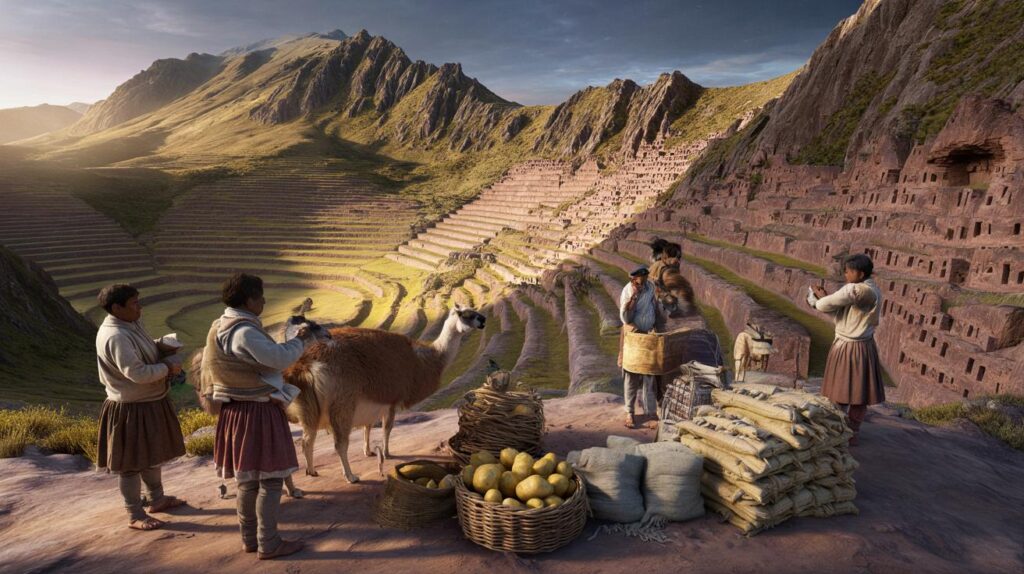
Picture a caravan of llama herders arriving at the site, breath visible in the cold morning air. They’ve walked for days, bringing sacks of dried potatoes, maize, or coca leaves from upland communities. Local administrators greet them, not with laptops or ledgers, but with these oddly practical stone cavities.
Each group unloads its tribute. Goods are sorted, portioned, and placed temporarily in specific holes. One cavity per unit. Ten here, twenty there, a hundred arranged in neat, countable runs.
No ink, no paper. Just stone, memory, and a strict sense of order.
Archaeologists noticed something curious: the holes aren’t all the same. Some are shallow, others deeper, and a few are wide enough to hold larger containers. That variation strongly suggests different “denominations” or categories, like the ancient equivalent of coins and bills.
Researchers cross-referenced this with what we know about quipus, the knotted-string devices used in the Andes for accounting. When they aligned the typical values coded in quipus with standardized counts you could make using rows of holes, a shared logic appeared.
One Peruvian scholar described it bluntly during a field visit: “This is where numbers met food.”

The genius lies in the simplicity. Stone doesn’t rot, fade, or blow away. In a society without metal coins or written ledgers, carving a hillside into thousands of reusable counting units was a radical act of economic engineering.
Band of Holes sits near what would have been a supply corridor feeding both coastal populations and highland centers. Goods likely arrived here, got broken into known units, counted, and then sent off to other storage facilities or state-run warehouses.
Seen through that lens, the site stops being a sacred “mystery” and becomes something more intimate and familiar: the nervous system of an ancient supply chain, capable of feeding villages and armies long before spreadsheets were a thing.
What this changes in the way we look at ancient “mysteries”
Once you accept Band of Holes as an economic system, a quiet shift happens in your head. The aliens exit the room. Everyday life walks in.
You start to see administrators arguing over quantities, runners carrying messages, apprentices learning where each type of crop should be placed. You imagine seasonal rhythms: harvest surges, lean months, years of scarcity when every cavity mattered.
The past stops looking like a puzzle for Netflix documentaries and starts sounding like work, negotiation, stress. Almost like looking at the back office of a supermarket, but chiseled into the mountainside.
A lot of us secretly love the idea of ancient secrets and lost technologies. It feels more glamorous to think in terms of portals and star maps than in kilos of potatoes and tax in kind. Yet that attraction can blind us to what’s actually breathtaking: the capacity of pre-Inca societies to design robust, low-tech systems that functioned for centuries.
We’ve all been there, that moment when the mythical version of a story is more seductive than the real, human one. Band of Holes forces us to flip the script.
Let’s be honest: nobody really does this every single day — pause in front of a viral mystery and ask, “Where’s the logistics?”
One archaeologist I spoke with in Cusco said something that stayed with me:
“Every time we choose aliens over administrators, we erase the intelligence of the people who were really here.”
That line hits hard when you walk between the cavities and picture hands, sweat, planning.
What Band of Holes teaches, in a very raw way, is that infrastructure can be poetic too. That a spreadsheet can be a landscape.
- Pre-Inca societies didn’t need writing to count, tax, and redistribute at scale.
- The “mystery” was partly our own refusal to see economics as worthy of wonder.
- By decoding this hillside, we gain not only data about trade, but respect for a system that held thousands of lives together.
A hillside of holes, and what it says about us today
Once you’ve seen Band of Holes as an enormous carved ledger, it’s hard to look at modern infrastructure the same way. That spreadsheet on your laptop, the barcode on your package, the QR code at the market — all of it feels like an echo of those stone cavities in the Peruvian sun.
There’s something humbling in realizing that centuries before banking apps and inventory software, people had already solved the same basic problem: how to count, control, and share resources fairly enough to keep a society standing. *The technology changed, the anxiety behind it didn’t.*
Next time a “mysterious” site goes viral, maybe the first question isn’t “What ritual is this?” but “What work did this support?” What if half of the wonders we label as spiritual were actually brilliant, unglamorous tools built to survive droughts, wars, and bad harvests?
Band of Holes doesn’t just solve a riddle in Peru. It gently asks us what we choose to admire: the legend, or the logistics that made life possible.
| Key point | Detail | Value for the reader |
|---|---|---|
| Band of Holes as economic system | 5,200 rock cavities used as a physical ledger for goods, tribute, and redistribution | Changes how we interpret “mysterious” sites and highlights real human ingenuity |
| Location and logistics | Site placed along ancient trade routes between coast and highlands | Helps readers visualize pre-Inca supply chains and long-distance organization |
| From myth to everyday life | Shift from alien/ritual theories to infrastructure and administration | Invites a more grounded, respectful view of ancient cultures and their systems |
FAQ:
- Question 1What exactly is Band of Holes in Peru?
- Question 2How many holes are there, and who carved them?
- Question 3What evidence supports the economic-system theory?
- Question 4Was this site built by the Incas?
- Question 5Can visitors see Band of Holes today, and what should they look for?
