
On a grey morning in Toulon, the Charles de Gaulle looks almost shy. The giant hull sits quiet at its berth, a floating city that has spent two decades at the sharp end of French power, now slowly slipping toward retirement. Sailors in blue coveralls walk the deck with that mix of routine and reverence you see around old champions. The paint is chipped in places, the lines less crisp than on the posters in the recruitment offices.
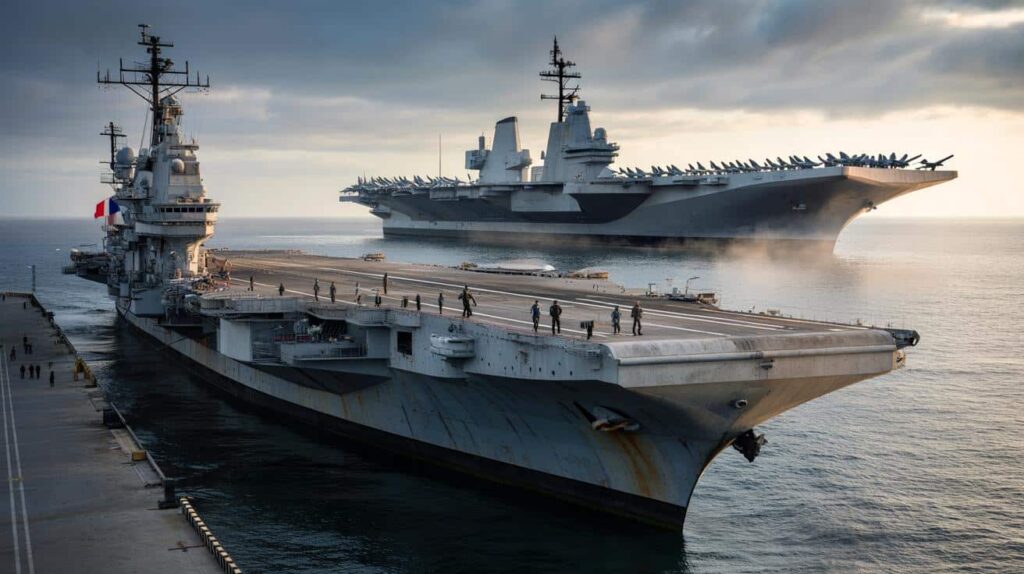
Somewhere inside, its twin nuclear reactors are humming, as they have through Afghanistan, Libya, Syria, the Sahel.

Soon, this sound will stop.

France’s nuclear colossus on borrowed time
The Charles de Gaulle is not just a ship. It’s a symbol that France still sees itself as a country able to project power far beyond the Mediterranean, a European state that didn’t outsource its deterrence to Washington. When it first went to sea in 2001, the nuclear-powered carrier looked like a bold bet in a continent trimming defense budgets and talking about “peace dividends.”
Now, as it enters the twilight of its career, the same ship feels like the bridge between two worlds: the post–Cold War optimism and a much tenser, contested planet.
Walk down the quayside and you’ll hear the stories. Old-timers remember the early hiccups: the too-short flight deck, the famous propeller cracks, the endless jokes from British sailors about “the French carrier that can’t keep up.” Then came the operations that silenced those laughs. In 2015, French Rafale jets roared off its deck toward ISIS targets in Iraq and Syria.
For a few intense months, this 42,000-ton slab of steel was the heart of France’s response to terror. The country had been attacked at home, and suddenly this ship wasn’t just a budget line, it was a lifeline.
France’s bet on a single nuclear carrier always looked risky on paper. One ship means no backup. When the Charles de Gaulle goes into maintenance, the French Navy loses its most visible tool of power projection. Yet the nuclear choice gave it range, endurance, autonomy that few navies can dream of.
That trade-off is now hitting a wall. By the mid-2030s, the aging systems, the weight limits, and the design compromises of the 1990s will simply be too tight for next‑generation aircraft and drones. The warship that once looked oversized now risks being outgrown by the missions it’s asked to perform.
The quiet birth of Europe’s most advanced carrier
In a nondescript design office near Paris, engineers bend over screens showing a ship that doesn’t quite exist yet. They call it PANG – Porte-Avions de Nouvelle Génération – the new generation aircraft carrier set to replace the Charles de Gaulle. No grand hull yet, no towering island, just lines and numbers on monitors, mock-ups on tables, and models in gray plastic.
This is how a “most advanced carrier in Europe” begins: less Top Gun, more CAD software and coffee cups.
The outline is already clear. PANG will be bigger – around 75,000 tons, almost U.S. Navy size. It will be nuclear again, powered by two brand‑new K22 reactors developed by France’s nuclear industry. The French Navy wants to launch it around 2038, timed so the Charles de Gaulle can sail into retirement without leaving a power gap.
At the future center of this floating airbase: electromagnetic catapults similar to those on America’s latest Ford‑class carriers. That alone is a quiet revolution. It means France is designing a deck that can launch heavier aircraft, stealth jets, and eventually swarms of drones at a tempo Europe has never seen from the sea.
The logic is cruel but simple. To stay a serious naval power by mid-century, France needs a ship built for a world where Russia is unpredictable, China is a blue-water navy, and the Mediterranean is no longer a quiet backyard. The Charles de Gaulle was engineered around classic fighters carrying bombs and missiles. PANG is being sketched around stealth, data, electronic warfare, and networked swarms.
Behind the political speeches about “strategic autonomy,” there’s a plain truth that doesn’t fit nicely into press releases: **without a cutting-edge carrier, Europe’s military voice shrinks to a whisper once you leave its coasts.** PANG is France’s answer to that uncomfortable thought.
A new way to fight from the sea
On board the Charles de Gaulle, operations still feel very physical. You smell the jet fuel, you hear the catapults slam, you see sailors on deck using hand signals in the wind. The future carrier will keep some of that, but the real revolution will be much quieter, hidden in its sensors, software, and the aircraft it launches.

Think of PANG as a moving server farm wrapped in armor and radar. It won’t just send planes into the sky. It will manage data wars.
The Rafale M – France’s current carrier fighter – will likely be joined or replaced by the next-generation European fighter being developed under the FCAS program with Germany and Spain. Alongside those crewed jets, the navy is planning for “remote carriers” – loyal wingman drones that extend the reach of each pilot. From the deck of PANG, a single sortie could mean one fighter and several semi-autonomous drones radiating out like fingers.
We’ve all been there, that moment when technology suddenly changes the rules of a game you thought you understood. On a carrier, that shift is dramatic: missions that once needed four or six jets might be handled by one pilot and a cloud of machines sharing data at machine speed.
This kind of setup needs space, power, cooling, and bandwidth. That’s why the new carrier’s increased size isn’t just about prestige. Bigger hangars for drones, more room for maintenance, larger command centers for cyber and electronic warfare teams. Nuclear power gives near-limitless electricity for sensors, lasers one day, and high-demand systems that don’t exist yet.
Let’s be honest: nobody really designs a 2038 warship only for 2038. The French Navy wants something it can still upgrade in 2060, maybe even 2070. *PANG is less a ship for today’s crises than a bet on the next unknown storm.*
There’s still anxiety in the ranks. Young officers talk privately about the risk of putting so many eggs in one basket, especially when hypersonic missiles and long‑range drones are spreading. One hit, they say, and you lose not just a ship, but your main tool of pressure and presence. Older captains shrug and remind them that navies have lived with that risk since the first carrier.
The French admiralty’s unofficial mantra could be summed up like this: “If you want to count in world politics, you don’t do it with press releases. You do it with a runway at sea.”
- Larger nuclear powerplant – More energy for radars, EM catapults, and future weapons – Value: a ship that doesn’t age as fast technologically.
- EMALS-style catapults – Gentler launches, heavier and stealthier planes – Value: compatibility with future fighters and drones.
- Expanded flight deck and hangar – More aircraft, including uncrewed systems – Value: higher sortie rate and more flexible missions.
- Advanced command-and-control suites – Designed around data fusion – Value: faster decisions in crowded, confused battlespaces.
- French-led but European in scope – Possible cooperation with allies’ aircraft – Value: a true European power-projection hub.
A flagship that asks awkward questions
Stand again on the dock at Toulon and you feel the weight of time. The Charles de Gaulle will be dismantled piece by piece, its nuclear heart carefully removed, its steel recycled or buried. For many French sailors, it’s like saying goodbye to the ship that defined their generation. For a lot of Europeans, they never quite realized this quiet giant was carrying part of their security on its deck.
The next carrier will be louder politically, larger physically, and more visible to potential rivals watching from Moscow, Beijing, or Tehran.
There’s a paradox here. A single massive carrier makes headlines and sends strong signals. Yet it also concentrates risk, cost, and political controversy in one hull. French taxpayers will be asked to fund a program running into the tens of billions, in a time when hospitals, schools, and climate adaptation all shout for money. Critics will say PANG is a “prestige toy.” Admirals will answer that you can’t escort merchant ships, evacuate citizens, or deter aggressors with prestige alone.
Somewhere between those two positions lies the messy truth of power in the 21st century.
The burial of the Charles de Gaulle and the birth of PANG are not just a French story. They touch on a bigger European question: does the continent want to be a strategic actor or a strategic spectator? A single floating airbase will not answer that on its own. Yet the choice to build or not build such a ship says a lot about how a country sees its future place in the world.
Whether you see this new nuclear monster as necessary insurance or as a dangerous temptation, it forces a conversation that Europe often dodges. What do we really expect our militaries to do, far from home, on dark seas, when nobody is filming with a smartphone?
| Key point | Detail | Value for the reader |
|---|---|---|
| Retirement of Charles de Gaulle | France’s only carrier will be phased out by the mid‑2030s after over three decades of nuclear-powered service | Helps understand why a replacement is not a luxury but a timetable reality |
| PANG’s advanced design | Nuclear propulsion, EM catapults, larger deck, space for drones and next‑gen fighters | Shows how future sea power will mix crewed jets, data warfare, and uncrewed systems |
| European strategic stakes | France’s carrier underpins Europe’s ability to project force independently of the U.S. | Clarifies why this French program matters to anyone following European security |
FAQ:
- Is the Charles de Gaulle being scrapped because it failed?Not at all. The carrier had teething problems early on, but it has been heavily used in real operations from Afghanistan to the Middle East. It’s being retired because its design limits, age, and maintenance cycles no longer match the missions and aircraft planned for the 2040s.
- Why is France sticking with nuclear propulsion for PANG?Nuclear power gives huge range, high sustained speed, and a lot of electrical capacity for future systems. France already has deep nuclear expertise through its submarines and civilian reactors, so it’s building on an existing industrial and military ecosystem.
- Will PANG carry American F‑35 jets?Current plans focus on French Rafale M fighters and the future Franco-German-Spanish next‑generation combat aircraft. PANG’s EM catapults and arresting gear should, in theory, be compatible with other NATO aircraft, but there is no official plan to base U.S. F‑35s on it.
- How much will the new carrier cost?Estimates run into the tens of billions of euros over its full lifecycle, from design and construction to decades of operation. The exact figure is still evolving as the design is refined and contracts are negotiated.
- Could Europe build a joint EU carrier instead?Politically, that’s extremely hard. Navies, nuclear policy, and power projection touch the core of national sovereignty. PANG is funded and operated by France, though it will regularly work with European partners and, practically speaking, serve as a major European asset at sea.
