
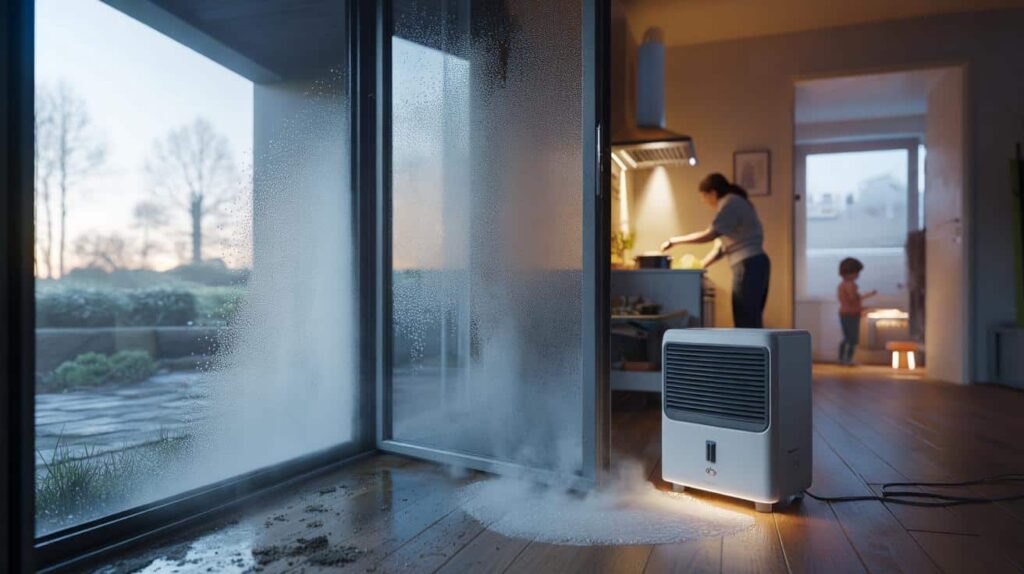
Those innocent droplets on your windows can signal a bigger problem building in your walls, furniture and lungs. Understanding why it happens – and how to tackle it properly – can stop condensation turning into mould, damage and health issues for your household.
Why your windows are suddenly soaked
Condensation on windows is not a mystery, it’s physics playing out in your living room. Warm air can hold more water vapour than cold air. When that warm, moist air hits a cold surface, such as a windowpane on a frosty morning, the vapour turns into liquid water.

Persistent condensation is usually a sign that the air in your home is carrying more moisture than the building can safely cope with.

Everyday life constantly feeds that moisture. Showers, cooking, drying clothes indoors, even breathing and sleeping all release water into the air. In modern, well-sealed homes, that damp air has fewer escape routes than older, draughtier buildings. The result: wet glass, soggy frames and, sooner or later, mould growth on walls and seals.

The real risk: from fogged glass to mould and health problems
Moisture on the windows is only the visible part. The same condensation effect can be happening on colder walls, behind furniture or inside cupboards where you never look.
Where moisture lingers, mould spores flourish – and those spores do not stay politely on the wall, they float in the air you breathe.
Repeated exposure to mould spores links to respiratory irritation, coughing, asthma flare-ups and more frequent colds, especially in children, older adults and people with existing lung or heart conditions. Black mould around window frames and on silicone seals is often the first warning sign people notice.
There is also a financial cost. Damp timber swells and rots. Plaster crumbles. Paint peels. Window frames can degrade far faster than their expected lifespan when constantly wet.
The golden rule: control moisture, not just temperature
Many people try to “heat their way out” of condensation. That only tackles half the problem. The aim is to reduce the humidity in your indoor air and keep surfaces slightly warmer.
Think of moisture management in three steps: create less, remove more, and warm surfaces just enough that water can’t cling to them.
Ventilate smartly without freezing yourself
Short, sharp ventilation works far better than leaving a window on a tiny crack all day. It also wastes less energy.
- Open windows wide for 10–15 minutes once or twice a day, ideally morning and evening.
- Create a cross-breeze by opening windows on opposite sides of the home when possible.
- Keep internal doors shut while airing damp rooms so moisture doesn’t travel.
- Use trickle vents on windows if you have them, and keep them unclogged.
This rapid exchange throws out moisture-laden air while the building structure stays relatively warm, so you don’t lose all the heat you paid for.
Heating: avoid the “off all night” trap
Bedrooms often show the worst morning condensation. During the night, two people in a double room exhale a surprising amount of water vapour while the room cools down. If the heating is completely off, the temperature drops, the glass gets cold and the vapour becomes water droplets.
Keeping a low, steady night-time temperature usually leads to less condensation than extreme cycles of heat and cold.
Instead of switching the heating off entirely, many energy advisers recommend a modest set-back temperature at night – just enough to keep surfaces from becoming icy cold. It won’t remove all condensation on its own, but it makes moisture easier to manage.
Room-by-room strategies that genuinely work
Bedroom: where you breathe for eight hours
Bedrooms deserve particular attention because you spend long stretches there with the door often closed. To cut moisture build-up:
- Air the room each morning right after you get up, when humidity is highest.
- Avoid drying laundry on radiators or racks in the bedroom.
- Leave a small gap between your bed and external walls to let air move.
- If possible, keep curtains slightly off the glass so air can circulate around the window.
Kitchen: steam central
Boiling pasta, simmering stews and kettles all contribute large volumes of water vapour.
The simplest test: if you can see steam hanging in the kitchen, you are feeding tomorrow’s condensation.

Useful habits in the kitchen include:
- Switch on the extractor hood every time you cook on the hob, not just for frying.
- Choose the “vented to outside” setting where possible, rather than recirculating filters.
- Use pan lids so less steam escapes into the room.
- Open the window slightly during and after cooking, and keep the kitchen door shut.
Bathroom: short showers, fast extraction
Hot showers create dense clouds of steam that travel rapidly around the home if not contained.
- Run the bathroom extractor fan during your shower and for at least 15 minutes afterwards.
- Check the fan’s performance: hold a tissue near the grille; it should cling firmly.
- Wipe down wet tiles, glass and sills with a squeegee or towel to remove standing water.
- Open the window wide for a few minutes once you finish, if you have one.
Dehumidifiers: when the basics are not enough
In some homes, especially on ground floors, in basements or very airtight properties, background humidity stays high even with good habits. This is where a dehumidifier becomes a powerful ally.
| Type of dehumidifier | Best suited for | Main benefit |
|---|---|---|
| Refrigerant (compressor) | Warmer rooms, general use | Efficient at typical indoor temperatures |
| Desiccant | Cooler spaces, garages, lofts | Performs better in colder environments |
| Portable mini-units | Small rooms or targeted problem spots | Easy to move and cheaper upfront |
A decent domestic unit can pull several litres of water from the air each day. Position it in the dampest area, away from walls and furniture, and keep doors ajar so air can circulate through the machine.
Protecting the windows themselves
While tackling humidity, you can also make windows less welcoming to condensation. Good double or triple glazing keeps the inner pane warmer than old single glass, which discourages droplets from forming.
For existing windows, some people apply transparent anti-condensation films. These create a thin insulating layer and raise the surface temperature slightly. Others use liquid anti-fog or anti-condensation treatments, similar to those for bathroom mirrors or car windscreens. These don’t fix humidity but help stop water collecting and running down into frames.
Think of window treatments as a shield; the real battle is still won by reducing the moisture in the air.
When moisture hints at bigger building problems
Not all wet windows are harmless. In some properties, heavy condensation accompanies structural damp from leaking gutters, cracked render, failed seals or rising damp. Indicators that something more serious might be happening include:
- Persistent damp patches on walls that feel cold and clammy.
- Peeling paint, bubbling wallpaper or salty white deposits on masonry.
- Mould appearing in the middle of walls, not just in corners or on windows.
In such cases, reducing indoor humidity helps, but you may need professional advice to identify and fix the underlying defect.
Key terms worth understanding
Two phrases come up again and again in discussions about damp homes: “relative humidity” and “dew point”. They sound technical, but they explain most condensation problems.
- Relative humidity is the amount of moisture in the air compared with the maximum that air could hold at that temperature, expressed as a percentage. Indoor levels between roughly 40% and 60% are generally considered comfortable.
- Dew point is the temperature at which air becomes saturated and can no longer hold all its water vapour, so droplets start to form. When a surface is at or below the dew point, condensation appears.
On a chilly evening, the air in a cosy living room might be warm but very humid. If that air touches a window cooled by the outside night air, the glass drops below the dew point and moisture appears instantly.
A realistic day in a “condensation-prone” home
Picture a small flat with two adults and a child. Breakfast involves kettles boiling and toast grilling. Nobody opens a window because it feels cold. Leaving for work, washing hangs on a rack in the hallway, dripping moisture into already damp air. Heating stays off until the family returns in the evening, so surfaces cool significantly. By the time everyone showers after dinner, humidity peaks. As the night temperature drops, water coats the windows, and by morning, black spots are creeping across the silicone in the corners.
Changing that routine only slightly – lids on pans, a few minutes of proper ventilation, a low, steady heating level and perhaps a small dehumidifier running in the hallway – can transform that same flat into a much drier, healthier environment.
Condensation on windows is not just a winter annoyance; it is feedback from your home about how you live in it.
By listening to that signal and adjusting habits, equipment and sometimes the building fabric, you protect not only your frames and paintwork, but also the lungs and long-term health of everyone who lives there.
