
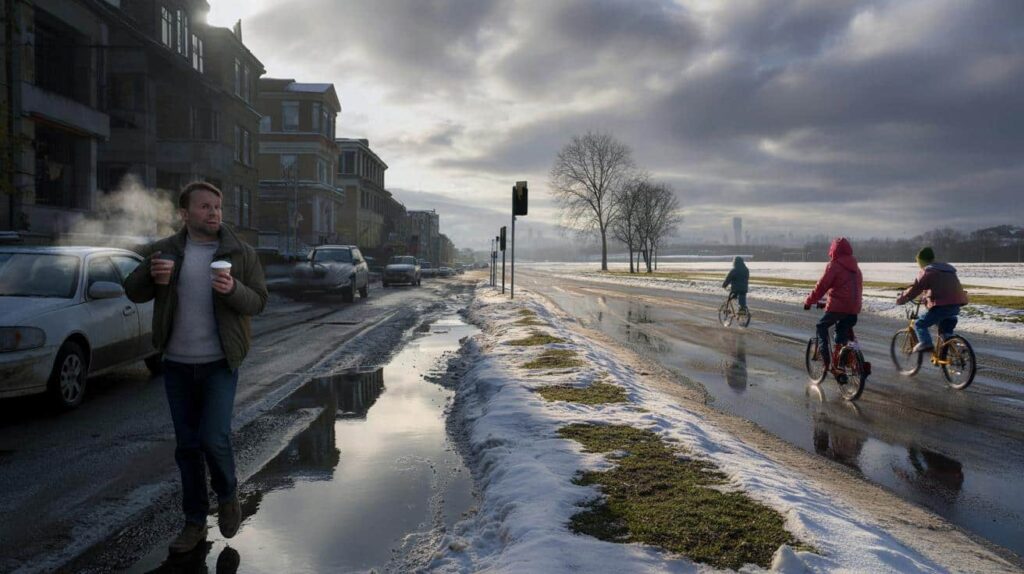
The text alert popped up just after breakfast: “Arctic breakdown accelerating toward February.” You glanced outside, half expecting a blizzard. Instead, the street was wet, the sky low and grey, and the temperature felt more like late March. A neighbor walked by in a light jacket, coffee in hand, shrugging at the weirdly soft air. On the radio, the host joked about “fake winter” while the traffic reporter mentioned black ice hiding under surprise puddles.
Up north, thousands of kilometers away, the polar night is quietly unraveling.

The line that used to separate your winter from the Arctic’s is slipping.

What an “early Arctic breakdown” really looks like on your street
Meteorologists have been watching the polar vortex wobble like a drunk spinning top since early January. The cold air that usually stays locked above the Arctic is leaking out in waves, breaking earlier and more chaotically than seasonal models expected. On the maps, it shows up as twisted tongues of blue plunging south, then yanking away.

On the ground, it feels like whiplash. One week you’re scraping ice off the car in the dark. Five days later, kids are biking in hoodies and the snowbanks have collapsed into dirty slush. You start to wonder if your winter coat is suddenly obsolete.
Take the recent pattern across North America and Europe. In parts of the U.S. Midwest, January started with wind chills near -30°C, frozen pipes, and school closures. Within days, that brutal Arctic air retreated north, replaced by temperatures up to 15°C above normal, rain on top of snow, and fog rolling across half-melted fields.
In Germany and Poland, meteorologists logged record-breaking January highs while still warning of a return of deep cold in February as the vortex fragments. People shared side-by-side photos: one of snow-covered parks, another of green grass and joggers in T‑shirts taken just ten days apart. The weather apps felt like they were glitching, flipping between snowflakes and sun icons every few hours.
This isn’t just seasonal mood swings. When specialists talk about an “unusually early Arctic breakdown,” they mean the structure of cold, dense air circling the pole is weakening sooner than typical. That breakdown lets cold spill south in blasts while pulling warmer air into the Arctic itself.
Those rapid exchanges disturb long, sweeping jet stream patterns that used to be more stable. The result is stubborn extremes: prolonged rain where snow used to fall, sudden warm-ups that eat away at ice, and late-season cold snaps that hammer crops and power grids. It feels random from your window. In the upper atmosphere, it’s a messy, accelerating reorganization.

How to live with a winter that keeps changing its mind
One of the most practical moves right now is to stop planning winter like it’s a single, stable season. Think of it as a sequence of “weather chapters” that can flip fast. That means layering your wardrobe and your habits. Keep gloves and a hat in your bag even on those fake-spring days, and don’t stash the snow shovel just because the lawn reappeared once.
For your home, small rituals help. Clear drains before mild spells, so rain and meltwater don’t pool and refreeze. Check weather alerts more than once a day when temperatures hover around zero. A morning thaw can turn into treacherous evening ice with barely a warning.
Many people feel a little foolish reacting to forecasts that keep changing. You’re not alone in thinking, “Maybe I’m overreacting, it’s just winter.” The emotional fatigue is real when you go from storm prep to sunglasses in 72 hours.
The trick is to treat volatility as normal, not as an exception. That means avoiding one of the most common mistakes: assuming that a warm spell means winter is “over” for good. The early Arctic breakdown actually raises the odds of late, sharp cold intrusions into February. Let’s be honest: nobody really checks the detailed forecast every single day. But on those weeks when meteorologists talk about polar air “sliding” or “dropping south,” it’s worth pausing and looking twice.
Scientists are starting to describe this kind of winter as “weather with a shorter memory” — patterns form, intensify, then flip before communities have fully adapted, stretching both infrastructure and people’s nerves.
- Watch the pressure, not just the temperature
Rapid pressure drops ahead of Arctic blasts can signal stronger winds and dangerous wind chills, even if the numbers on your app don’t look dramatic yet. - Keep a flexible “just‑in‑case” kit
A small stash of non-perishable food, backup power for your phone, and a battery lantern can bridge those surprise outages during freeze‑thaw storms. - Think in 10‑day windows
When meteorologists warn of a vortex disruption, plan travel, outdoor work, and medical appointments with a 7–10 day margin, not 2–3. - Talk about it with kids and older relatives
Explaining that “winter is getting jumpier now” helps reduce anxiety when the snow vanishes then returns in one violent night. - Protect the small things that depend on stable cold
From backyard rinks to winter crops, planning backup dates or covers can save effort and money when the next warm pulse rushes in.
The deeper shift behind this strange February rush
Beneath the daily noise of forecasts and phone alerts, something quieter is changing in the background. Arctic sea ice has been shrinking in extent and thinning in depth for decades. That lost ice acts like removing the lid from a pot: more heat escapes from open water into the atmosphere, disrupting the temperature contrast that once helped lock the polar vortex in place.
Meteorologists aren’t all in perfect agreement about the exact chain of cause and effect. *But the pattern of more frequent, earlier, and more chaotic Arctic breakdowns is getting harder to dismiss as coincidence.* When February now feels like a roulette wheel of slush, storms, and springlike sunshine, that’s the atmospheric story writing itself in real time.
| Key point | Detail | Value for the reader |
|---|---|---|
| Early Arctic breakdown | Polar vortex weakens and fragments weeks ahead of traditional timing | Helps explain why winter feels unstable and why forecasts seem to flip |
| Whiplash weather | Rapid swings between deep cold, thaw, and heavy rain or snow | Signals when to prepare home, travel, and health plans for sudden shifts |
| Living with volatility | Layered habits, flexible planning, local alerts, and short planning windows | Reduces stress and risk when February weather no longer follows old patterns |
FAQ:
- Question 1What exactly is an “Arctic breakdown” that meteorologists are talking about?
- Question 2Does an early Arctic breakdown mean this winter will be warmer overall?
- Question 3Why are we seeing both record warmth and dangerous cold in the same month?
- Question 4Is this directly linked to climate change, or just natural variation?
- Question 5What can an ordinary person realistically do about such unstable winters?
