
The device is not a secret weapon, at least not in the military sense. It is the central piece of Iter, a vast nuclear fusion experiment that aims to turn star power into a reliable energy source for life on Earth.
A magnet so strong it rewrites the rulebook
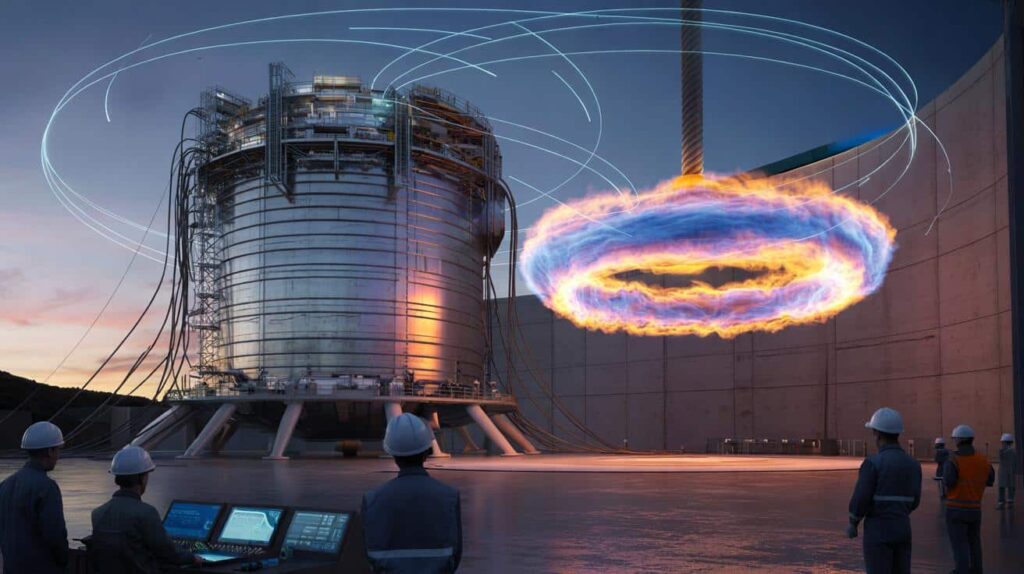
At the Iter site in Cadarache, north of Marseille, a towering cylinder of metal and superconducting coils has taken its place at the centre of a future fusion reactor. This component, called the Central Solenoid, is 18 metres tall, weighs around 1,000 tonnes, and can generate a magnetic field of 13 teslas.
 Michael Schumacher, the new separation
Thirteen teslas is about 280,000 times stronger than the magnetic field that naturally surrounds our planet. Engineers like to say that, in theory, such a magnet could lift an entire aircraft carrier off the ground. In practice, it will lift something else: a seething, electrically charged gas hotter than the Sun’s core.

The Central Solenoid is powerful enough to yank a 100,000-tonne warship, yet its real target is a ring of hydrogen plasma.
The magnet is built from stacked modules, each one weighing as much as a commercial airliner. These modules must be aligned with millimetre precision. A slight misalignment could destabilise the fragile conditions needed for fusion and put years of work at risk.
Despite its intimidating numbers, the Central Solenoid is not designed to show off brute strength. Its real role is to sculpt and control invisible magnetic fields with astonishing finesse, keeping a plasma at extreme temperature suspended in mid-air, never touching the metal walls around it.
Why such a monstrous magnet is needed
Fusion energy tries to copy what happens in stars. Under extreme pressure and heat, light atoms such as hydrogen fuse together, releasing tremendous amounts of energy. Iter follows this idea using a device known as a tokamak: a doughnut-shaped chamber surrounded by magnets.
The “starter motor” of a star in a bottle
The Central Solenoid acts like an enormous starter motor. By rapidly changing its magnetic field, it drives an electric current through the gas inside the tokamak, turning it into plasma. In this state, electrons break free from their atoms and the gas begins to conduct electricity and respond strongly to magnetic forces.
Inside Iter, this plasma must reach temperatures of around 150 million degrees Celsius. That is several times hotter than the Sun’s core. No known material could directly contain such heat without vaporising. So the only option is to hold the plasma in place using magnetic fields alone.
Magnetic confinement lets Iter keep a miniature “star” hovering inside a ring, never touching solid matter.
Holding fire with magnetism
The Central Solenoid works with a network of other magnets to form a kind of three-dimensional cage for the plasma. The challenge is not only strength, but stability and precision. Any wobble or ripple in the magnetic field can cause the plasma to leak away or crash into the walls.
Researchers working on magnetic confinement list several key technical challenges:
- Keeping the plasma stable at temperatures hotter than the Sun’s core.
- Managing the massive mechanical forces that the magnets exert on one another.
- Maintaining superconductivity at cryogenic temperatures close to absolute zero.
- Synchronising all magnetic systems so they respond in microseconds to changes in the plasma.
The Central Solenoid itself is a superconducting magnet. That means its coils, when cooled to extremely low temperatures, can carry huge electric currents with virtually no resistance. This is the only practical way to generate such intense magnetic fields without burning through absurd amounts of electricity.
A rare example of global cooperation that actually works
Beyond the engineering feat, the story of this magnet is also political. Iter is one of the largest scientific collaborations ever attempted. It brings together 35 nations, including the European Union, the United States, the United Kingdom, China, India, Japan and Russia.
The Central Solenoid was manufactured in segments by General Atomics in the United States, then shipped across oceans and through narrow French roads to reach Cadarache. Each segment required a carefully planned route, special convoys, temporary roadworks and an army of technicians and planners.
From California factories to a pine forest in Provence, each movement of the magnet’s modules resembled a slow-motion space mission on land.

At a time when geopolitics is often defined by rivalry and distrust, Iter represents a different bet: that nations can pool knowledge, share enormous costs and take a long-term view on energy and climate.
| Project | Goal | Key feature |
|---|---|---|
| Iter (France) | Prove large-scale fusion is technically feasible | Central Solenoid, 13 T magnetic field |
| National labs (UK, US, EU, etc.) | Develop fusion materials and control systems | Smaller tokamaks, high-speed diagnostics |
| Private fusion start-ups | Fast-track commercial reactors | Compact devices, alternative magnet designs |
Could this actually change our energy future?
If Iter works as planned, it will not feed electricity directly into the grid. Its goal is more basic: to show that sustained, net-positive fusion reactions are possible at large scale. The real power plants would come later, built by a new generation of reactors that copy and refine Iter’s design.
The potential impact is hard to overstate. Fusion reactors would rely mainly on isotopes of hydrogen, such as deuterium, which is found in seawater, and tritium, which can be bred from lithium. These fuels are far more abundant than uranium and do not create long-lived highly radioactive waste.
A single bathtub of seawater and a few kilograms of lithium could, in theory, match the lifetime energy output of thousands of tonnes of coal.
Fusion plants would emit no carbon dioxide during operation, and the risk of runaway chain reactions, like those feared in fission reactors, is essentially absent. If something goes wrong, the plasma simply cools and the reaction stops.
Energy strategists see three main benefits if fusion scales up during the second half of this century:
- Ending dependence on fossil fuels for baseload electricity.
- Reducing air pollution and greenhouse gas emissions.
- Softening geopolitical tensions linked to oil and gas reserves.
What these terms actually mean
Fusion, superconductors and solenoids in plain language
Nuclear fusion is the process where two light atomic nuclei, typically forms of hydrogen, merge to form a heavier nucleus, releasing energy. It is the opposite of nuclear fission, where heavy atoms are split apart.
Superconductors are materials that, when cooled to very low temperatures, allow electric current to flow with almost no resistance. For magnets like the Central Solenoid, this means they can generate enormous magnetic fields without turning into a hot, smoking mess of wasted energy.
A solenoid is simply a coil of wire, usually wrapped around a cylinder. When current flows through it, it generates a magnetic field. A “central solenoid” is the main coil sitting in the middle of a larger magnetic system, where it plays a controlling role.
What could go wrong, and what might go right
Fusion is not risk-free or guaranteed. The projects are long, complex and expensive. Construction delays, technical failures or political shifts could all slow progress. There is also the question of public trust: even if fusion is safer than fission, anything involving “nuclear” tends to raise concerns.
On the technical side, engineers still need to prove they can manage intense neutron bombardment, handle tritium safely, and build materials that can survive years in such an extreme environment. The Central Solenoid itself must perform flawlessly for decades while switching intense currents on and off.
On the positive side, progress in one area tends to ripple into others. Advances in superconducting magnets could improve MRI scanners in hospitals or boost the efficiency of particle accelerators. Better control algorithms for plasma could find uses in other high-tech industries that depend on ultra-fast feedback and automation.
For younger scientists and engineers, Iter is also a training ground. The people learning to handle this aircraft-carrier-lifting magnet today may be the ones designing compact fusion plants near cities or industrial hubs in the 2050s and 2060s.
If that happens, the huge cylinder now standing in a construction pit in Provence will be seen not just as an engineering curiosity, but as the moment humanity started learning how to hold a tiny star steady, using nothing more than invisible lines of magnetic force.
