As Chinese cities race upward, the simple act of delivering a takeaway has become a logistical puzzle. Between security gates, endless lifts and 60th-floor flats, a whole new link has appeared in the delivery chain: “relay couriers” who serve other couriers.
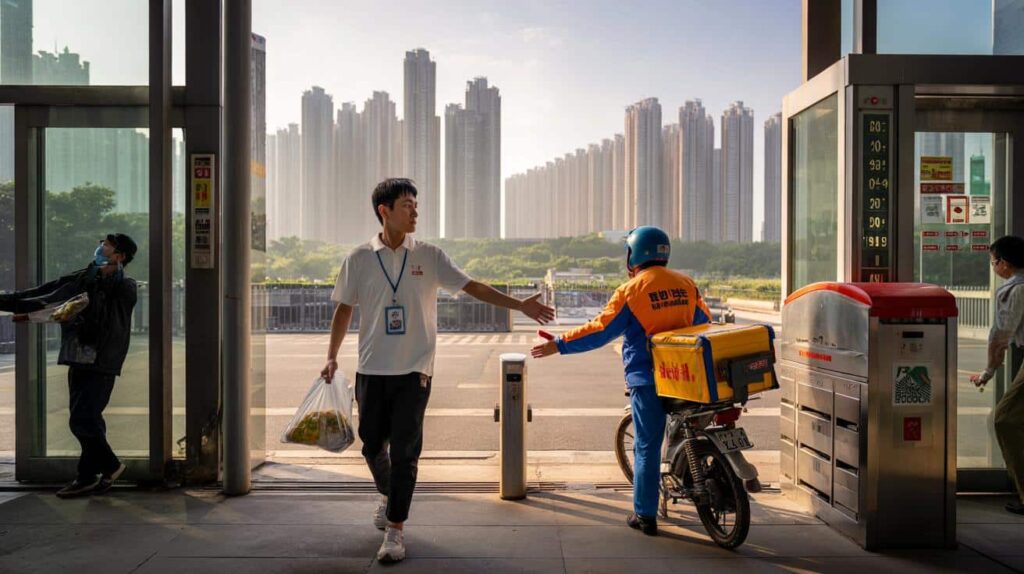
A job born in the vertical maze of Shenzhen
Shenzhen, the tech megacity neighbouring Hong Kong, has turned into a forest of skyscrapers. Many residential compounds have several towers, each stretching 40, 50, sometimes 80 storeys high. Traditional food couriers, already under huge time pressure, struggle to navigate this vertical landscape.
Instead of knocking on doors at dizzying heights, they now hand off orders at the base of these towers or at designated collection points. From there, a new kind of worker takes over: the relay courier. Their task is simple on paper yet demanding in practice—carry the food all the way to the recipient’s front door up in the clouds.
Relay couriers are, in effect, delivery workers for delivery workers, created by buildings that just refuse to stop rising.
This role barely existed a few years ago. It began informally, with residents or security guards offering to help for a small tip. It has since evolved into a semi-organised micro-job, often coordinated via apps or private chat groups.
How a relay courier’s day actually works
Relay couriers usually stay inside a single residential complex or a small cluster of towers. They know the layout, security codes and lift systems by heart. That local knowledge saves time for riders who would otherwise get stuck at barriers or spend minutes calling customers.
A chain of three people for one burger
A typical delivery in a 60-storey tower now involves three distinct steps:
- The platform courier collects food from the restaurant and rides across town.
- They hand it to a relay courier at the building entrance or lobby.
- The relay courier takes lifts and stairwells to drop the meal at the customer’s door.
Each step is timed. Delivery apps in China already rate riders brutally on punctuality. By offloading the “vertical” part, riders can complete more orders across a wider area, which raises their earnings—at least in theory. Relay couriers, paid per trip or tipped per delivery, try to make enough volume within a small space.
The boom in relay couriers shows how platforms keep optimising seconds, even if that means splitting one low-paid job into two even lower-paid ones.
Why skyscrapers made this job almost inevitable
China’s major cities have grown upward faster than public services and labour rules can adapt. Dense housing, strict security and mixed-use towers all add friction to delivery work.
The obstacles hiding inside tall buildings
For a courier, the “last 200 metres” can be harder than the previous five kilometres. Common obstacles include:
- Security checkpoints requiring ID or resident codes
- Smart turnstiles that only open with building apps or QR codes
- Separate lifts for residents, offices and service staff
- Long queues at lifts during rush hour
- Complicated numbering systems for flats in mega-compounds
Every delay threatens delivery times and ratings. So platforms quietly encourage handover points, sometimes marking lockers or shelves in building lobbies. Relay couriers position themselves there, phones in hand, waiting for orders to pop up.
Micro-jobs, macro-precarity
The job might sound like an easy side hustle: stay indoors, walk between lifts, carry bags. The reality is tougher. Earnings fluctuate, and there is no guaranteed minimum. Many relay couriers are students, migrant workers’ spouses, or older residents trying to supplement a low pension.
They often work without contracts, health insurance or legal protection. A twisted ankle on the stairs, a confrontation with an angry resident, or a dispute over a missing order can quickly become a serious problem.
These new workers sit in the blind spot of labour law: too small to notice individually, yet vital for making the city function.
The phenomenon also reveals the pressure imposed on traditional food couriers. Platforms already treat riders as independent contractors. Now, part of their income goes straight to someone else, just to keep up with impossible delivery targets inside ever-higher buildings.
What customers gain—and what they lose
For residents, relay couriers bring convenience. No need to rush down 30 floors. The food comes to the door, sometimes even late at night. In some complexes, regular relay couriers become familiar faces, almost like concierge staff.
Yet the extra hand in the chain raises questions. Who is responsible if food goes missing? Who pays if it arrives cold? Some platforms allow relay fees to be added directly to the customer’s bill, while others leave it to riders to negotiate shared tips.
| Actor | Main task | Main pressure |
|---|---|---|
| Restaurant | Prepare food quickly | Avoid app penalties for slow prep |
| Rider | Transport food across the city | Beat tight deadlines and traffic |
| Relay courier | Deliver inside tall towers | Handle volume with little pay security |
| Customer | Place and receive order | Balance convenience and extra fees |
A glimpse into tomorrow’s city jobs
Relay couriers in Shenzhen may be a preview of what dense cities elsewhere will face. As more countries build taller and pack people into multi-use towers, the last metres of any service become more complex. Groceries, parcels, laundry, even medicine will all need human hands to bridge the gap between lobby and living room.
Tech companies are testing robots and smart lockers, but those solutions struggle inside unpredictable, crowded towers. Lifts break down, access systems change, and residents move. For now, human flexibility wins.
Risks and possible evolutions
If this model spreads, two major risks stand out. First, a growing class of ultra-fragmented workers with overlapping responsibilities and weak protections. Second, rising tension between residents who want doorstep service and building managers trying to control access and security.
Some urban planners argue for clearer delivery zones inside towers: shared shelves on certain floors, “delivery corridors” or dedicated service lifts. Others propose that platforms pay a fixed fee to building management, which then hires official in-house runners instead of relying on informal relay couriers.
This debate touches on a broader term increasingly used by researchers: “platform urbanism”. It describes how apps, rating systems and data-driven logistics slowly reshape how people move inside cities. The appearance of relay couriers shows that this reshaping doesn’t stop at the front gate; it continues inside lifts, stairwells and corridors.
For now, in the high-rise canyons of Shenzhen and other Chinese megacities, a simple meal can require a tiny relay team. One rider races through traffic. Another quietly rides the lift, plastic bag in hand, climbing yet another tower built so high that it created a brand-new job just to reach its inhabitants.