
She was standing in front of the hair salon mirror, glasses slightly fogged, turning her head right and left. “I don’t want to look like I’m trying to be 30,” she told the hairdresser, “but I also don’t want the haircut that every ‘grandma with glasses’ gets.” The stylist laughed, grabbed a lock of her silver hair, and positioned her frames with a practiced hand. “We’re going to let the glasses do part of the work,” she said, “and your haircut will do the rest.”
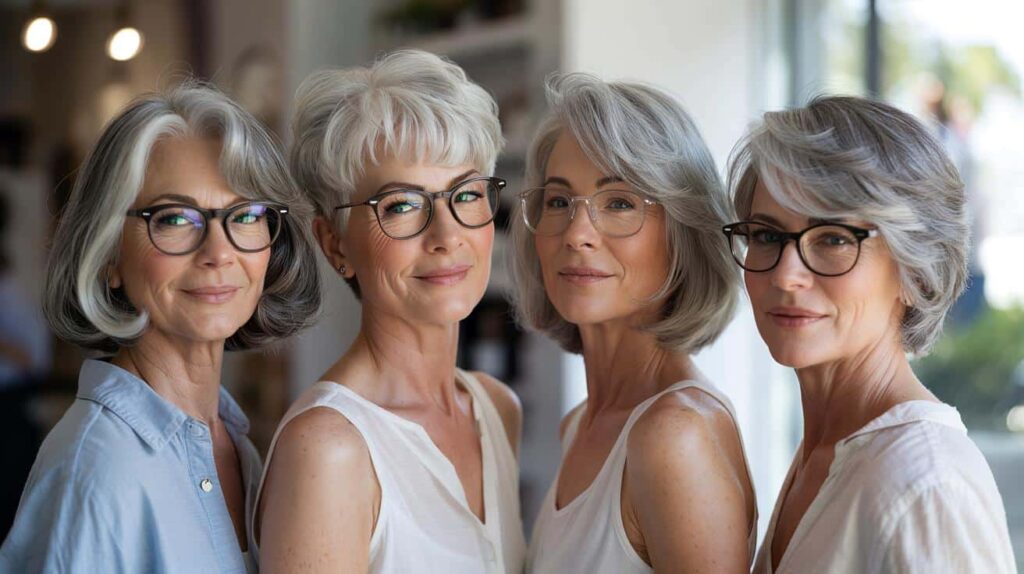
Ten minutes later, just with a new shape around her temples and cheekbones, her face already seemed softer. Lighter. Less tired.

That’s the quiet magic of the right cut when you wear glasses after 70. It doesn’t scream “anti-aging.” It just whispers.

The soft layered bob: the safe bet that hugs your glasses
The most flattering cut for many women over 70 who wear glasses is not radical at all. It’s a soft, slightly layered bob that falls around the jaw or just below, with movement around the temples. This length frames the glasses instead of fighting with them. The hair follows the curve of the frame and gently opens up the cheekbones.

Seen from the side, it’s this cut that stops the face from “falling downwards.” The ends are airy, not blunt, which breaks up the vertical lines that can harden features. Lightness around the ears lets the arms of your glasses disappear instead of cutting the profile. It’s discreet, but your whole expression changes.
One Parisian stylist tells the story of Jeanne, 74, who came in with a short, helmet‑like cut and rectangular, dark frames. Everything on her head formed a square: the glasses, the fringe, the bottom line of the hair. “I feel like a block,” she confided.
They grew her hair to a jaw‑length bob, sliced in soft layers, and brightened a few strands around the face. Suddenly, the glasses looked like a chic accessory, not a barrier. The bob skimmed her jaw and lifted toward the back, slightly exposing the nape. Jeanne didn’t look “younger” in a fake way. She just looked awake. Friends asked if she’d changed her glasses. She hadn’t. Only the haircut.
There’s a simple explanation. Glasses already draw a square or oval on the face. A harsh, one‑length cut around that geometric shape doubles the effect and accentuates fine lines and sagging. A layered bob softens everything.
By breaking the “frame within a frame”, you create diagonals: a slightly angled line at the front, lighter ends toward the neck, a few strands grazing the temples. Our brain reads these diagonals as movement, and movement reads as vitality. The cut doesn’t erase wrinkles, it shifts where the eye lands. *Instead of seeing tired eyelids, we notice sparkling eyes behind the lenses and a gentle curve of hair that makes the mouth lift.* Subtle, but powerful.
The airy pixie: short, feminine, and bright around the lenses
For women who like short hair, the airy pixie is the best ally for glasses after 70. Not the stiff, ultra‑short crop that can harden the face. A modern pixie keeps softness on top, lightness at the sides, and a little volume at the crown. It kisses the frame of the glasses without hiding the eyebrows.
The trick is to keep some length at the front and on top, so the hair can be swept to the side or slightly up. This creates a light “cloud” above the frames that draws the gaze upward. The temples and around‑the‑ear area stay clear, which instantly freshens the profile and lets the glasses sit comfortably. With the neck uncovered, the posture looks straighter. Less weight, more presence.
A retired teacher from Lyon, 79, once described her transformation with a pixie cut as “taking off a heavy hat I didn’t know I was wearing.” She had shoulder‑length thinning hair, pulled into a loose bun, and small round glasses. Her hair dragged her features down, and the bun hid the natural lift at the back of her head.
After her stylist suggested a softly layered pixie, her first reaction was fear: “Won’t I look severe with glasses?” The opposite happened. The short sides made her frames stand out in a chic, almost artistic way. The longer top, styled slightly upwards, opened up her eyes. She looked like the lively, curious person she felt she still was inside. Her grandchildren said, “You look like yourself again.” Not younger. Herself.
Visually, the airy pixie reduces “visual clutter” around the face. Fine, thinning hair that hangs at the sides often sticks to the lenses or ears and creates shadows on the skin. By clearing that area yet keeping softness on top, the pixie tidies the outline of the face. The jawline is more visible, the neck elongates, the eyes and glasses become the main focus.
This kind of cut also plays well with age spots and texture on the skin. Shorter sides reflect more light onto the cheeks and under the eyes. With a bit of lift at the crown, the skull’s natural curve is emphasized, which the brain associates with energy and good health. Let’s be honest: nobody really styles their hair every single day with a round brush after 70. That’s why a pixie that falls into place with a few fingers through the top is such a quiet ally.
The side‑swept fringe: the soft “filter” that works with every frame
If there is one gesture that transforms both haircut and glasses, it’s adding a side‑swept fringe. A long, diagonal fringe that skims the top of the eyebrows and merges into the rest of the cut acts like a soft filter over the upper face. It slightly hides forehead lines without covering the whole forehead. And it draws a diagonal line that crosses the straight bar of the glasses.

Cut too short, a fringe fights with the frame. Cut too heavy, it hides the eyes and can touch the lenses. The sweet spot is a light, feathery fringe that can be pushed to the side and that follows the curve of your glasses rather than sitting on top of them. This suits a bob, a pixie, and even a mid‑length cut.
Many women confess they gave up on fringe after a disastrous attempt in their forties. Choppy, straight, too dense, it felt like a curtain. Past 70, the goal is almost the opposite: transparency and softness. Imagine a veil, not a wall. A woman I met in a village salon in Spain, 72, with fine white hair and tortoiseshell frames, had always worn her hair straight back.
Her stylist suggested a side fringe, just grazing the brow and thinning out toward the temple. The result was almost cinematic: her blue eyes suddenly looked bigger, her glasses felt “anchored” in the face instead of floating. She said she finally recognized the woman who laughs in old photos of herself. Not because the wrinkles disappeared. Because they were no longer the first thing you saw.
“When you wear glasses, the fringe is like the bridge between your hair and your eyes,” explains Italian hairdresser Marta L., who works almost exclusively with clients over 65. “Done right, it connects everything and softens the story your face tells.”
- Choose a diagonal fringe, never a rigid horizontal one.
- Ask your stylist to cut it dry, with your glasses on, so the lengths match the frame.
- Keep it lighter toward the temples, to avoid too much weight over the lenses.
- Trim regularly, but slightly – a micro‑touch every 6–8 weeks is enough.
- Use just a hint of cream or spray, so the fringe stays mobile, not stuck on the forehead.
The soft mid‑length cut: movement that balances big frames
For women who feel more “themselves” with hair on the shoulders, a soft, mid‑length cut can work beautifully with glasses after 70. The key is movement. The hair shouldn’t form two heavy panels on each side of the face. Instead, light layers start at cheekbone level, opening just enough space around the frames.
The bottom of the hair can touch the shoulders, but it needs a slight inward or outward bend to avoid dragging the whole silhouette down. *Think of it as a very gentle wave that keeps the hairstyle alive, even on a lazy day.* When the hair moves, the glasses stop being the only structured element on the face. Everything breathes together.
This type of cut suits women with larger, statement frames especially well: round, cat‑eye, or colored glasses. A widowed psychologist I interviewed, 76, had bold red cat‑eye frames and long, straight hair to the middle of her back. People remembered the red glasses, but not her face. She looked “hidden” behind the hair.
When she finally agreed to a shoulder‑length, lightly layered cut with a few bright strands around the face, the balance shifted completely. The red frames still drew attention, but now they echoed with the movement in her hair. Her shoulders looked less burdened, her neck more visible, and her smile more obvious. She didn’t lose her style. She gained a frame for it.
Why does this mid‑length approach gently rejuvenate? Because it respects reality. Volume naturally decreases with age. Extremely long hair tends to look thinner, especially from the back. Cutting just to the shoulders concentrates what you have, giving the impression of thicker hair without any trick. Combined with layers that start no higher than the cheeks, it avoids adding width where gravity already adds it.
This kind of cut also adapts easily to daily life. Tied in a low, loose ponytail with a few strands out around the face, it keeps that softness around the glasses. Worn down, it looks “done” even when you only dried the front. When we talk about flattering haircuts after 70, we’re really talking about peace treaties: between the hair and the frames, between the mirror and the person who looks into it.
Hair, glasses, and age: a quiet art of balance
What all these flattering haircuts for women over 70 with glasses have in common is not a specific length, but a shared philosophy. Hair frames the glasses, glasses frame the eyes, and together they sketch a story on the face. The more that story is fluid, with curves and light, the less the lines of age dominate.
There is no universal recipe, only agreements to be found: how much forehead to reveal, how much neck to uncover, how much movement to add near the temples. Some will feel reborn with a pixie. Others will only feel safe with mid‑length softness. The right cut is the one that makes you stop apologizing for your glasses or your age.
We’ve all been there, that moment when you try on a pair of frames you love, and something feels “off” without knowing if it’s the glasses or your hair. Often it’s both, slightly out of sync. Bringing them into harmony doesn’t require a radical change, just a series of tiny, well‑placed decisions: one extra layer here, a lighter fringe there, half a centimetre off the back.
These choices don’t erase time, they refine it. They say: yes, I’m 70‑plus, I read with lenses, my hair is whiter or finer. And here I am, adjusting it all so that my face tells the story I want to tell today. Maybe the next time you’re at the salon, you’ll keep your glasses on in the chair and ask your hairdresser to look at you as a whole. That’s often where the most beautiful “before/after 70” really begins.
| Key point | Detail | Value for the reader |
|---|---|---|
| Bob with soft layers | Jaw‑length, light movement around temples and jaw | Softens features and integrates glasses for a fresher expression |
| Airy pixie | Short sides, volume on top, clear around ears | Opens the face, lifts the gaze, reduces the “weight” of hair and frames |
| Side‑swept fringe | Light, diagonal, cut with glasses on | Filters forehead lines and connects hair, eyes, and glasses in one line |
FAQ:
- Should women over 70 still wear long hair with glasses?Yes, but slightly shortened, mid‑length cuts with movement tend to flatter more than very long, heavy lengths, especially with frames that already structure the face.
- Do bangs work with progressive or bifocal lenses?Yes, as long as the fringe is light, diagonal, and doesn’t touch the lenses, so your field of vision stays clear and the shape doesn’t compete with the frame.
- Which haircut is best for thinning hair and glasses?A layered bob or a soft pixie concentrates volume where hair is still dense and opens around the temples, which keeps glasses from disappearing under fine strands.
- Can curly or wavy hair be flattering with glasses after 70?Absolutely, as long as curls are slightly shaped around the temples and cheeks, so they frame the glasses instead of covering them completely.
- How often should I trim my hair after 70 to keep the shape with glasses?Every 6–8 weeks for short cuts and fringes, and around every 8–10 weeks for mid‑length styles, just enough to keep the lines clean around the frames.
