The first thing you notice in Margaret’s kitchen is the noise.
The kettle chattering on the hob, the radio humming low, the thud of a wooden spoon on the edge of a saucepan as she stirs porridge with small, precise movements.
She is 100 years old, standing without a cane, cardigan sleeves pushed up, lipstick slightly crooked.
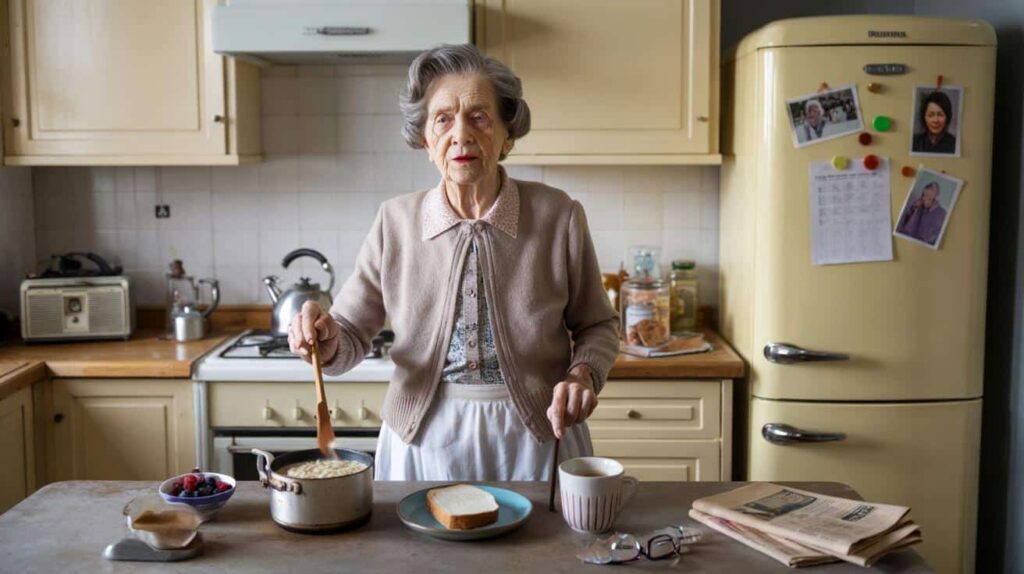
“I refuse to end up in care,” she says, almost cheerfully, wiping her hands on a tea towel.
Outside, the street is waking up slowly; inside, her day has already started.
Her life is not the glossy version of “healthy aging” you see on posters.
The fridge is a little too full, there’s a pile of letters on the table, and she sometimes forgets where she’s put her glasses.
But every corner of this small house tells the same quiet story: daily habits stacked on top of each other, year after year, like bricks in a very long wall.
She leans closer, almost conspiratorial.
“You want to know how I stayed out of those homes?” she asks.
Then she begins to list the tiny choices that, over a century, changed everything.
The quiet discipline behind a noisy long life
Margaret wakes up at 6:30 a.m. “Out of bed before my bones remember my age,” she jokes.
She sits on the edge of the mattress, flexes her ankles, circles her wrists, rolls her shoulders.
It doesn’t look like exercise.
It looks like someone gently checking that all the lights are still working.
Then she walks to the kitchen without touching the wall, a small personal test she repeats every day.
She eats the same breakfast she has eaten for decades: porridge with a handful of berries, one slice of brown toast, strong tea with a splash of milk.
No fancy powders, no rigid rules, just real food and regularity.
This calm, predictable routine is her quiet rebellion against the fragility that people expect from someone her age.
At 10 a.m. sharp, Margaret puts on her coat and steps outside, no matter the weather.
“It’s just a twenty-minute lap around the block,” she says.
On good days, the lap mysteriously becomes forty minutes.
Her neighbors know the sight of her: small frame, bright scarf, determined stride.
Sometimes she stops at the local corner shop to buy two apples and a newspaper.
Sometimes she just walks, silently counting lampposts like old friends.
She rarely misses this outing.
Once, during a winter flu, she stood at the front door, annoyed at her own weakness, and opened the window just to feel cold air on her face.
“I need to remember the world is still there,” she says.
That one habit, repeated thousands of times, has kept her legs stronger than most people decades younger.
Doctors who see Margaret are surprised by her numbers.
Blood pressure steady, heart still stubbornly regular, muscle tone better than many in their seventies.
Of course, genetics play a role, and she doesn’t pretend otherwise.
Her mother lived to 94, her aunt to 98.
But when you listen carefully, another pattern appears.
She has accidentally built what researchers describe as a “protective routine”: regular sleep, light daily movement, simple meals, constant social micro-contacts.
Her habits keep inflammation down, balance up, and her mind anchored to reality.
*Longevity, in her case, isn’t one miracle choice — it’s hundreds of tiny, almost boring ones, quietly stacked over time.*
And yes, she has days she skips the walk or eats nothing but toast.
Let’s be honest: nobody really does this every single day.
What matters is that her default setting nudges her back to these simple anchors, again and again.
“I live at home because my body knows the drill”
For Margaret, staying out of a care home begins with what she calls “the basics”.
Morning stretches on the bed.
Standing up and sitting down from a chair ten times without using her hands.
She keeps a glass of water in every room so she remembers to drink.
Her bathroom has a rubber mat and a grab rail she actually uses.
At lunchtime, she always sits at the table instead of eating on the sofa.
None of this is glamorous.
But these small rituals protect the two things she values most: balance and independence.
“If my legs go, I go,” she says simply, tapping her knee with a bony finger.
So every day, in her own way, she trains for the marathon of getting through the week alone.
She laughs when younger people talk about “optimizing their health” with apps and trackers.
Her health plan fits on the back of an envelope.
She avoids what she calls “the sleepy traps”: long afternoons slumped in front of the TV, too much sugar, heavy dinners late at night.
She still enjoys cake on Sundays and a small glass of sherry at Christmas, but those are treats, not habits.
In the early evening, while many people scroll in silence, she picks up the phone.
She calls her niece.
She rings a neighbor who recently lost her husband.
Sometimes she just asks about someone’s dog.
This constant low-level social contact is not an accident.
She’s seen too many people fade when the house gets too quiet.
“We’ve all been there, that moment when you realize you haven’t spoken out loud all day,” she says softly.
That’s when she forces herself to pick up the receiver.
One thing about Margaret: she doesn’t romanticize old age.
She knows the risks, names them out loud, and then negotiates with them.
“People think you end up in care because you get old,” she says. “Often, you end up in care because you stop doing the little things you don’t notice keeping you alive.”
She boils those “little things” down to a simple list she keeps on her fridge:
- Walk every day, even if it’s just to the end of the street and back.
- Eat something fresh and something with fiber at every meal.
- Stand up without using your hands at least a few times a day.
- Talk to at least one person, voice-to-voice, every afternoon.
- Go to bed at more or less the same time, phone out of the bedroom.
These are not magic rules.
They are the scaffolding that keeps her living where she wants to live: at home, among her own things, on her own terms.
Longevity as a daily choice, not a distant dream
Listening to Margaret, you start to realize that living to 100 at home is less about chasing youth and more about respecting your tomorrow self.
She doesn’t talk about “anti-aging”.
She talks about being a decent roommate to the person you will be in ten years.
Every glass of water, every short walk, every early night is like putting a small coin in a savings jar you won’t open for a long time.
Most of us only notice that jar when it’s already empty.
She started paying attention decades earlier, without really calling it anything special.
Her habits are surprisingly forgiving.
She allows herself lazy Sundays, takeaway dinners, afternoons of nonsense TV.
What she protects fiercely is the rhythm underneath: move, nourish, connect, rest.
Those four verbs repeat through her days like a heartbeat.
| Key point | Detail | Value for the reader |
|---|---|---|
| Daily movement | Short walks, simple strength moves like standing from a chair without hands | Reduces fall risk, preserves independence, keeps you in your own home longer |
| Simple, regular meals | Porridge, fiber, fresh fruit, light dinners, occasional treats | Supports stable energy, heart health, and long-term weight balance without strict diets |
| Social micro-contacts | One real conversation a day, checking on neighbors, calling family | Protects mental health, reduces loneliness, keeps the mind sharp with age |
FAQ:
- Question 1What are the most realistic daily habits to copy from a centenarian like Margaret?
- Answer 1Start with three: a short daily walk, standing up from a chair without using your hands a few times a day, and one real conversation (voice, not text) each afternoon or evening.
- Question 2Do you need perfect genetics to live independently at 100?
- Answer 2Genetics play a role, but consistent habits around movement, food, sleep, and social life can dramatically improve your chances of staying active and at home for longer.
- Question 3Is it too late to start these habits if I’m already over 60?
- Answer 3No. Research shows that even in later life, adding daily movement, improving diet slightly, and staying socially engaged can boost strength, mood, and autonomy within months.
- Question 4How can I reduce my risk of ending up in a care home?
- Answer 4Focus on fall prevention (leg strength, balance, home safety), manage chronic conditions with regular check-ups, maintain a social circle, and keep a steady daily rhythm that supports both body and brain.
- Question 5What if I don’t have family or close neighbors to call every day?
- Answer 5Look for small, reliable connections: local clubs, community centers, volunteer hotlines, online groups that meet by video or phone. Even one or two steady contacts can make a big difference.