
On a grey Tuesday morning, the city square looks almost gentle. A woman in a red coat stops by the fountain, pulls a crinkled plastic bag from her handbag, and begins to scatter crumbs in a slow, practiced arc. Within seconds, pigeons appear from nowhere, feet slapping on the stone, wings slicing the air, necks shimmering green and purple. She smiles, visibly softening, like this small ritual makes the city a little less hard.
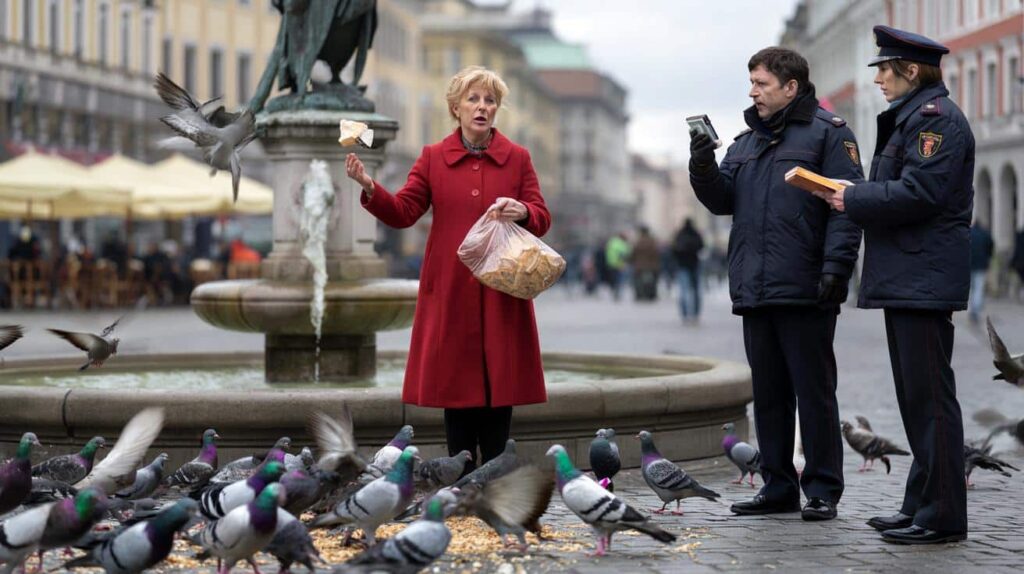
Two municipal officers appear just as quietly. No drama, no raised voices. One of them speaks, she frowns, laughs nervously, then freezes when she hears the amount: a steep fine for feeding “urban wildlife”. Her hand, still full of bread, hangs in midair. Around her ankles, the pigeons keep pecking.

Compassion is colliding with public health policy, right there on the pavement.

From tender gesture to “offense”: when feeding pigeons turns costly
Walk through any big city and you’ll spot them almost immediately. The regulars with plastic bags, the older man on the bench with his stale baguette, the teen sharing bits of sandwich during lunch break. For some, tossing crumbs to pigeons is a habit picked up from childhood. For others, it’s the only daily interaction that feels kind and uncomplicated.

Suddenly, this soft scene has a new price tag. Many cities now slap serious fines on people who throw food to pigeons, sometimes up to several hundred euros or dollars. What used to be dismissed with a shrug is now treated like a real offense, one that officials track, tally and publicize.
Ask city authorities and they’ll show you the folders of complaints. Balconies caked in droppings. Statues so corroded they need regular restoration. Outdoor cafés where chairs, once wiped, are dirty again in minutes. Maintenance departments count the cost in disinfectant, repairs and man-hours. Public health units track bacteria and parasites carried by the birds.
In Paris, fines for feeding pigeons can reach €450. In parts of the UK, councils hand out £100 penalties on the spot. New York, Rome, Barcelona, Singapore: the trend is the same. As pigeon populations balloon, so does the political pressure to do something – and “something” often lands on the shoulders of the kind-hearted feeder on the corner.
Behind these rules sits a simple logic. More food means more pigeons. More pigeons mean more droppings, more noise, more nesting in air vents and under roofs. Those droppings aren’t just ugly; they’re acidic, they damage stone and metal, and they can carry pathogens that worry public health experts. City hall doesn’t see a sweet moment of connection. It sees an uncontrolled food subsidy to a species that thrives far too well in concrete jungles.
So the fine becomes a blunt tool to cut that food supply. The message: kindness isn’t the point, consequences are.
“I’m just being kind”: what to do if you love birds in a no-feeding city
For people who genuinely care about animals, this crackdown feels brutal. You’re not vandalizing, you’re not shouting at strangers. You’re tossing a few crumbs to a bird with ragged feathers. If that’s you, one first gesture changes everything: lift your kindness out of the shadows of the street and move it somewhere structured. That might mean supporting local wildlife groups, city-run bird feeding stations, or rescue centers.

Many cities now encourage controlled feeding in specific areas, with proper seed, monitored quantities and regular cleaning. The same impulse that sends you to the square can take you to a community garden with bird-friendly hedges, or a suburban park where feeders are allowed. The feeling doesn’t change much. The setting does.
Part of the tension comes from a quiet misunderstanding. People who feed pigeons often think, “They’re hungry, I’m helping.” Urban ecologists see birds that are already well-fed by overflowing trash bins and food waste. Bread, chips and leftover pastries don’t just swell pigeon numbers. They also distort local ecosystems, pushing out more fragile species that can’t compete.
Let’s be honest: nobody really reads municipal wildlife policies page by page. That’s how many well-meaning people end up breaking rules they didn’t know existed. If you care deeply about animals, taking ten minutes once to check what your city allows can save you a lot of stress, guilt and unexpected bills later.
“I don’t feel like a criminal,” says Lara, 67, fined twice for feeding pigeons near her block. “I grew up in a village. We always put out scraps for animals. The city tells me I’m dirtying public space. I feel like they’re asking me to harden my heart.”
- Swap crumbs for seed in private spaces where feeding is allowed: your garden, a friend’s yard, or community spaces with feeders.
- Support local bird charities that focus on injured or endangered species rather than boosting already-strong pigeon populations.
- Join neighborhood clean-up days that deal with droppings and litter, so compassion doesn’t ignore the people living under balconies and ledges.
- Talk to your council or building manager about humane pigeon control: spikes, netting, and birth-control feed, not culling.
- Teach children that caring for animals also means protecting public health and respecting rules, not just handing over bread.
Between disgust and tenderness: living with city birds in the grey zone
Pigeons are experts at lighting up human contradictions. On one hand, they’re dismissed as “rats with wings”, blamed for stained sidewalks and ruined facades. On the other, they’re the first wild thing a city child can touch with their eyes, a bit of nature that comes close without fear. One person sees a nuisance, another sees a small soul surviving in the same harsh streets they walk every day.
We’ve all been there, that moment when the city feels cold and someone kneeling to feed a bird creates a brief island of gentleness. The new wave of heavy fines lands right on that fragile island. It says: your private moment has public consequences. *That’s a hard pill to swallow when your only “crime” is a plastic bag of crumbs.*
The truth is messy. Feeding pigeons really does help their numbers explode. Droppings really do damage buildings and carry risks for people with fragile immune systems. At the same time, cracking down without offering alternatives turns kindness into a problem without giving it anywhere to go. Between those two poles, there’s room for cities that talk honestly about hygiene and health, bird lovers who shift their habits, and shared spaces where compassion doesn’t have to be punished, just redirected.
| Key point | Detail | Value for the reader |
|---|---|---|
| Know the rules | Many cities now issue hefty fines for feeding pigeons in public areas | Avoid unexpected penalties and legal trouble |
| Redirect your kindness | Support controlled feeding spots, gardens and bird charities instead of street feeding | Help animals without worsening public health issues |
| Think ecosystem, not just one bird | Excess food boosts pigeon numbers and harms other species and city infrastructure | Act in a way that protects both birds and your neighborhood |
FAQ:
- Question 1Can I really get a big fine just for feeding a few pigeons?
- Question 2Why are cities suddenly so strict about this?
- Question 3Is bread actually bad for pigeons and other birds?
- Question 4How can I help city birds without breaking the law?
- Question 5What if I see someone being fined and it feels unfair?
