
Those old smartphones, dead laptops and tangled chargers stacked in cupboards might look like worthless junk. In reality, they form the surface layer of what researchers now describe as a vast urban “mine” of precious metals that could reshape both the gold market and the recycling industry.
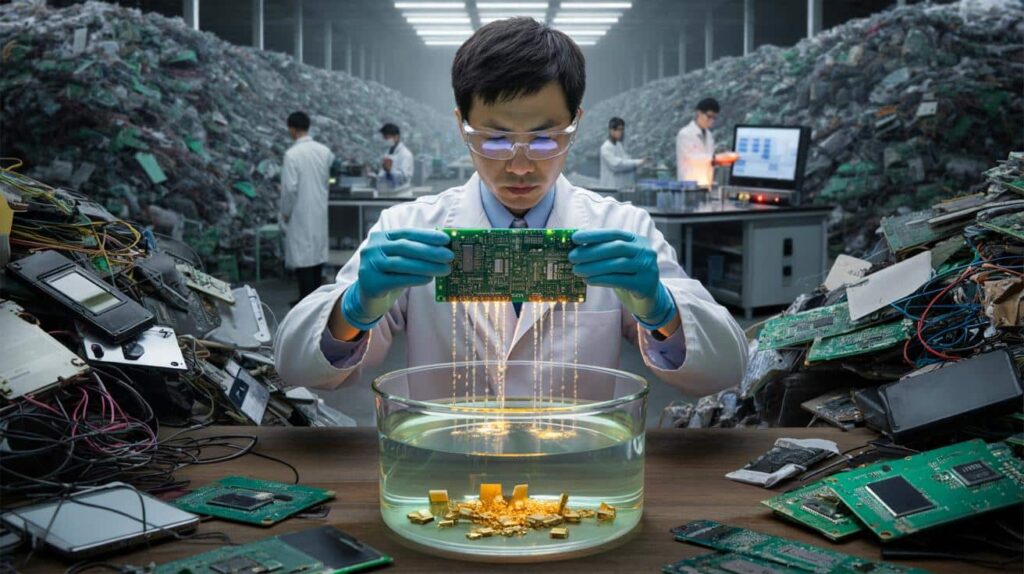
An invisible mine in every home
Inside every smartphone, computer and circuit board, manufacturers use microscopic layers of gold. The metal does not shine on the outside, but it sits on connectors, chips and contacts because gold conducts electricity reliably and does not corrode.

Individually, the numbers look tiny. A typical circuit board only contains a fraction of a gram of gold. One phone might hold just a few milligrams. That feels negligible when you drop a cracked handset into a drawer and forget about it.

Scale changes everything. According to UN-backed data, global electronic waste should reach around 82 million tonnes per year by 2030. Printed circuit boards make up roughly 5% of that mass. Those boards are studded with tiny traces of gold, palladium and other valuable metals.

From a distance it looks like rubbish, but the global e‑waste stream hides gold worth close to €70 billion a year.
Until recently, this potential bonanza sat mostly out of reach. The gold was visible on paper, in theory and in lab tests. In practice, turning that dispersed metal into a profitable and safe resource proved difficult.
Why traditional methods failed to unlock the jackpot
Recyclers did try to extract gold from old electronics. The methods were often brutal. Many involved melting components at high temperature or soaking them in harsh chemical baths.
One common technique used cyanide solutions to dissolve gold from crushed circuit boards. The process works, but it carries serious health and environmental risks. Mismanaged sites have leaked toxic substances into soil and rivers, poisoning workers and nearby communities.
These traditional processes were also costly and energy-hungry. High temperatures demand a lot of power. Complex chemical handling raises safety and compliance costs. For many recycling companies, the economics simply did not add up, especially in countries with strict environmental rules.
As a result, vast quantities of e‑waste either ended up in landfills or were shipped to regions with lax regulation, where informal workers burned and dissolved components in uncontrolled conditions. The “mine” existed, but most of the gold stayed locked in the rubble.
A Chinese team rewrites the chemistry
A domino-style reaction at room temperature
Researchers from the Guangzhou Institute of Energy Conversion at the Chinese Academy of Sciences and South China University of Technology have now proposed a different route. Their method uses an aqueous solution of potassium peroxymonosulfate and potassium chloride. On paper, that mixture looks unremarkable.
The clever twist lies in how the reaction unfolds on the metal surface. When the solution touches gold or palladium, the metal effectively turns into its own catalyst.
That contact triggers a chain of reactions, a bit like a line of dominos falling. Highly reactive oxidants form right at the surface, including singlet oxygen and hypochlorous acid. These species nibble away at the metal atoms, detaching them one by one.
Once detached, the atoms bind with chloride ions in the solution and move into the liquid phase. The gold is no longer trapped in the solid board; it floats in the solution, ready for recovery.
The process recovers about 98.2% of the gold from e‑waste in under 20 minutes at room temperature, with no giant furnaces and no cyanide.
Recovery rates that change the equation
Tests on used processors and circuit boards showed striking numbers:
- About 98.2% of the gold was recovered.
- Roughly 93.4% of the palladium was captured.
- The entire leaching step ran at ambient temperature and finished in around 20 minutes.
Ten kilograms of discarded circuit boards can yield about 1.4 grams of gold using this technique. The researchers estimate that the full treatment costs sit near €65 for that batch, which equates to roughly €1,350 per troy ounce of gold recovered. In early January, the market price of gold hovered above €3,800 per ounce.
That gap between cost and market price opens a realistic margin for industrial players, even after factoring in logistics, labour and purification.
Environmental and energy gains
Less energy, fewer toxic leftovers
The team calculates that their approach cuts energy use by about 62% compared with conventional processes. Chemical costs drop by over 93% relative to cyanide-based methods. Those figures matter as much as the gold yield itself.
Lower energy needs mean smaller carbon footprints. Reduced reliance on toxic reagents means fewer hazardous by‑products. The process still generates waste, but the volume and danger level fall sharply compared with legacy operations.

After the leaching step, the dissolved metals can be recovered by standard reduction and purification steps. The final product is high‑purity gold, suitable for resale into electronics, jewellery or investment markets.
By shifting from brute-force smelting and cyanide baths to targeted room‑temperature chemistry, e‑waste recycling starts to look like a mainstream industry rather than a dirty side business.
A €70 billion question: how much gold is really at stake?
The big number comes from adding up global flows. If e‑waste reaches around 82 million tonnes per year by 2030, and printed circuit boards represent about 5%, that leaves roughly 4.1 million tonnes of potentially treatable boards annually.
Industrial data suggest that one tonne of these boards holds on average about 140 grams of gold. Multiply that by 4.1 million tonnes and you get a theoretical 574 tonnes of gold per year.
Apply the 98.2% recovery rate reported by the Chinese team, and the figure drops slightly, to around 564 tonnes of gold actually extracted. One tonne of gold equals 32,150.7 troy ounces, so 564 tonnes translate into about 18.1 million ounces.
| Step | Approximate value |
|---|---|
| Annual e‑waste (2030 projection) | 82 million tonnes |
| Share as circuit boards (5%) | 4.1 million tonnes |
| Gold per tonne of boards | 140 g |
| Potential gold before losses | 574 tonnes |
| Gold recovered at 98.2% | 564 tonnes |
| Market value at €3,840.41/oz | ~€69.6 billion per year |
That is how analysts reach the often-quoted figure of roughly €70 billion in gold annually, not dug from the ground but reclaimed from discarded gadgets.
From lab bench to industrial line
According to the research team, the process should scale without exotic equipment. It does not require extreme pressures, rare catalysts or complex reactor designs. In principle, compact treatment lines could sit next to sorting centres, where e‑waste already arrives.
Such localisation would cut transport distances and emissions. It would also allow countries that currently export their electronic waste to build domestic industries around collection and recovery, creating jobs in the process.
Still, the step from demonstration to full‑scale deployment carries risks. Companies must manage reagent supply, waste handling and safety. Regulators will want to see independent assessments of emissions and long‑term impacts before approving large plants.
What this could mean for consumers and cities
If this type of process spreads, the ordinary act of keeping or discarding a phone starts to look different. A forgotten handset in a drawer no longer represents just lost money for the buyer; it also locks away a micro‑fraction of a global resource stream.
Cities may treat their stockpiles of obsolete electronics as a strategic asset. Municipal collection campaigns could shift tone, emphasising financial returns for local authorities and reduced reliance on mining in fragile ecosystems.
Some scenarios are already being discussed by industry analysts:
- Retailers offering higher trade‑in prices, funded by the value of recovered metals.
- Local councils sharing recycling revenues with households that return devices.
- Manufacturers designing products with easier disassembly to maximise recovery rates.
Key terms worth unpacking
The scientific paper describing the process uses the term “autocatalytic leaching”. In plain language, “leaching” means dissolving a solid material into a liquid to separate valuable components. “Autocatalytic” means that the target material itself speeds up the reaction, without needing a separate catalyst.
Another central idea is “urban mining”. This expression covers techniques that reclaim metals and minerals from buildings, infrastructure and consumer goods instead of natural ore deposits. Urban mining does not remove the need for traditional mining, but it can reduce pressure on new extraction, especially for metals used in electronics.
Risks, trade‑offs and long‑term questions
Even cleaner processes come with trade‑offs. Scaling up this technique will still generate chemical effluents that must be treated correctly. Poorly regulated operators could cut corners to save money, exporting environmental costs to vulnerable communities as has happened in past recycling booms.
There is also a geopolitical layer. If China becomes the first country to commercialise high‑yield, low‑cost recovery of precious metals from e‑waste at large scale, it strengthens its hand in global technology supply chains. Other regions, including Europe and North America, may feel pressure to fund competing research or form partnerships to avoid dependence.
For investors and policymakers, the new chemistry does not just promise a lucrative revenue stream. It also poses practical questions about how to regulate, tax and share the benefits of this newly accessible “mine” that has been sitting, in plain sight, in kitchen drawers and city dumps for decades.
