
The first drops hit the freshly raked bed, darkening the surface like coffee seeping into a sponge. For a second it looks promising. Then, almost on cue, the water beads up, skitters sideways, and races toward the path, leaving the soil itself nearly dry. The gardener steps back, frustrated, because they spent an hour flattening that surface to “look clean”.
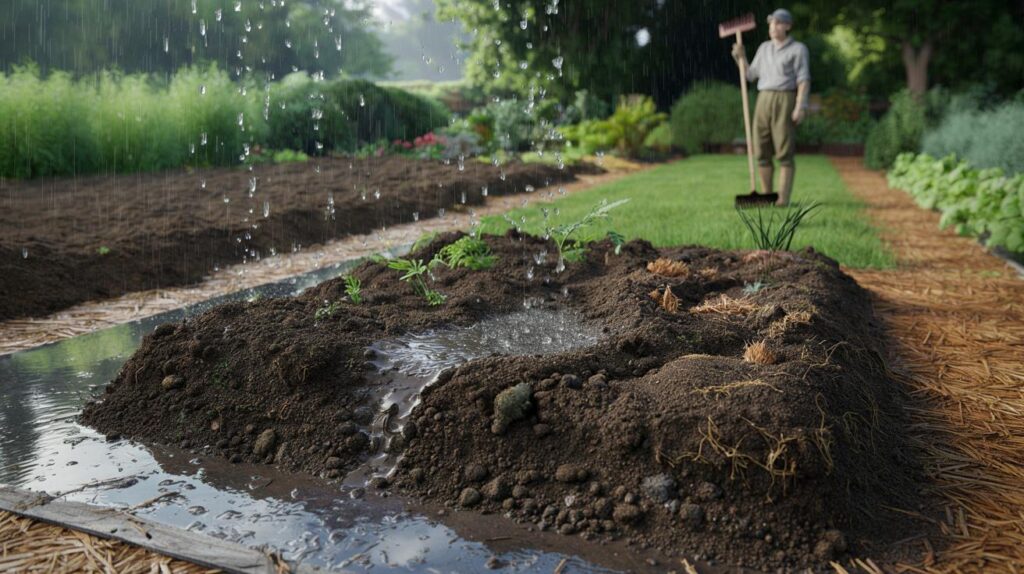
Two months later, that same bed is lumpy, dotted with old root channels, half-rotten mulch and worm casts. Nobody bothered to level it this time. The next rain? The water just slides into all those little hollows and disappears with a soft, smug silence.

Something almost magical happened.

When you stop ironing your soil like a carpet
Spend five minutes watching a tidy, perfectly flat vegetable bed during a hard rain. You start to see the problem right away. The water has nowhere special to go. It sits, it puddles, it moves sideways in thin sheets, eroding the finest particles and sealing the surface like a crust.

Now look at an “ugly” bed, the kind that would never appear in a glossy gardening catalog. Tiny bumps, old footprints, bits of leaf litter somewhere between messy and charming. On that relief map of a surface, drops fall into micro-hollows, settle into old root channels, and quietly slide down. What looks neglected is often just… working.
On a small suburban plot outside Leeds, a retired teacher noticed this almost by accident. She stopped flattening her beds one spring because her knees were acting up. No rake, no heel-stamping, just a light fork to loosen and a layer of compost.
By the following autumn, she began to see something strange. After a week of almost nonstop rain, there was standing water on her neighbor’s billiard-table lawn, complete with small reflective lakes. Her “lazy” beds, with their uneven skin and thin mulch, had no puddles at all. The soil crumbled instead of clumping. She could sink her hand in up to the wrist. The only real change was the one she hadn’t planned: she simply stopped pressing everything flat.
What changed is not magic, it’s physics and biology holding hands. When you flatten soil, you squeeze out air pockets and break the fragile tunnels made by roots, insects and worms. The surface becomes denser and smoother, so water tends to run off instead of sinking in.
Leave the surface somewhat rough and those little irregularities act like mini reservoirs and entry points. Water slows down, drops into cracks, and follows existing channels deeper. Microorganisms thrive where there is air and organic matter, gluing soil particles into stable crumbs. *That crumb structure is what turns hard ground into something that drinks instead of drowns.*
The simple act of stepping back from the rake
If you want to see this effect in your own garden, the first “technique” is actually to do a bit less. Next time you prepare a bed, stop after loosening the soil with a fork or broadfork. Add a light layer of compost or well-rotted manure, spread roughly by hand, and resist the urge to smooth it to perfection.

Plant directly into that uneven surface. For tiny seeds, you can create just a narrow, shallow groove with your finger or a stick, instead of flattening the whole area. Water gently once, ideally with a rose head or drip hose, so you don’t smash the structure you just protected. Then let the rain and life underground do the rest.
Many gardeners flatten from a place of care and habit, not ignorance. We were taught that clean lines and level beds are a sign of good work. The problem is that the soil doesn’t read garden magazines. It reads pressure, compaction, and whether roots can breathe.
One common mistake is walking repeatedly on the same growing surface, then “fixing” the damage by raking it flat. That’s a bit like ironing a shirt while wearing it. Better to create clear paths and stay on them, leaving the bed itself as a no-go zone for your boots. Let’s be honest: nobody really does this every single day. But even trying 70% of the time gives your soil a chance to rebuild its hidden plumbing.
“Once I stopped obsessing over flat beds, I realized my biggest irrigation problem had been my own rake,” laughs Marco, a city gardener who grows tomatoes on a windy rooftop. “The water infiltration improved in one season, and I didn’t buy a single gadget. I just stepped away from the soil a little.”
- Leave a rough surface – After loosening, keep small clods, worm casts and plant residues. These break up the flow of water and invite infiltration.
- Protect with organic cover – A thin mulch of straw, shredded leaves or grass clippings softens raindrop impact and feeds soil life from the top.
- Create stable paths – Concentrate your footsteps on wood chips, stepping stones or permanent rows so the growing zones stay loose and airy.
- Observe after heavy rain – Watch where water lingers, where it disappears fast, and adjust your pathways or bed edges instead of attacking the surface.
- Trust natural structure – Roots, worms and fungi are constantly reshaping the underground. Your main job is to stop fighting their architecture.
Letting the soil look “wrong” so it can behave right
Once you’ve seen water slip into a lumpy, living bed, it’s hard to unsee it. You start noticing how different parts of your garden react: the compacted lawn versus the crumbly border, the flat, bare spot under the swing versus the mulched herb corner. You start noticing how much of gardening is just not getting in the way.
There’s also a small emotional shift that sneaks in. When you stop chasing perfectly flat, you start accepting a bit more wildness in how your space looks. That can feel like a relief. A bed with tiny hills and valleys, bits of mulch, and the odd worm cast tells a story of processes happening on their own. Water infiltration improving “by itself” is just the visible part of that story. Underneath, it’s roots exploring deeper, microbes multiplying, earthworms putting in a night shift.
Some readers will try this and see results within a season. Others might live with heavy clay and need a couple of years of organic matter and patience. The pattern stays the same: less stomping, less flattening, more cover, more life. The ground gets darker, softer, and more generous. The hose comes out less often. And on the evening of the next big storm, you might catch yourself at the window, not worrying about flooding, but quietly cheering for every uneven patch of soil that’s ready to drink.
| Key point | Detail | Value for the reader |
|---|---|---|
| Stop flattening soil surfaces | Leave a slightly rough, irregular texture with clods, channels and micro-hollows | Encourages rainwater to slow down and infiltrate instead of running off |
| Protect living structure | Use light tools, organic mulch and permanent paths to reduce compaction | Builds long-term soil health with better drainage and root growth |
| Observe after rain | Watch where water puddles or disappears quickly and adjust practices | Allows simple, low-effort tweaks that improve infiltration without expensive gear |
FAQ:
- Question 1Will my seeds still germinate well if the soil surface isn’t perfectly flat?
- Question 2Is this method suitable for heavy clay soils that already drain badly?
- Question 3Won’t an uneven surface make watering by hand more difficult?
- Question 4How long does it take to notice better water infiltration after I stop flattening?
- Question 5Can I combine this approach with raised beds or containers on a balcony?
