
A climate crunch pushes aviation to reinvent itself
Aviation sits in a tough spot. Air travel connects remote regions and underpins business, but it also carries a heavy climate bill.
Airlines and manufacturers are already turning to sustainable aviation fuels, or SAF, as a short-term fix. These drop-in fuels cut lifecycle CO₂ emissions while using existing pipelines, tanks and aircraft.

At the same time, flight operations are being reworked. Airlines now lean on advanced route optimisation, better air traffic management and smarter flight paths to trim fuel burn and contrails, which can rival CO₂ in warming impact.

Against this backdrop, a small French startup is betting that the next leap will not come from fuel tweaks, but from a complete redesign of the aircraft itself.

The French startup that wants regional air travel to go fully electric
The company is called Eenuee, founded in 2019 in the Rhône-Alpes region. Its flagship project, dubbed Gen-ee, targets one of aviation’s most stubborn problems: how to keep thin regional routes alive without the costs and emissions of conventional aircraft.
Gen-ee is planned as a 100% electric, 19-seat regional aircraft with a range of about 500 km. That distance covers many short hops between mid-sized cities or remote communities, where rail is slow, scarce or requires massive new infrastructure.
The startup aims for certification under Europe’s CS-23 category, which governs small aircraft up to 8.6 tonnes at takeoff. Gen-ee is projected at just 5.6 tonnes, a big weight cut that helps energy efficiency and maintenance costs.
According to the team, the aircraft is designed to consume roughly eleven times less energy than comparable regional planes.
Why Eenuee calls it “impossible” – and why it might work
On paper, the goal sounds almost unreal: a quiet, electric aircraft serving remote territories, with no need for heavy new infrastructure.
Yet the concept hinges on three levers that engineers know well: aerodynamics, propulsion efficiency and mass reduction.
A blended wing body that turns the fuselage into a lifting surface
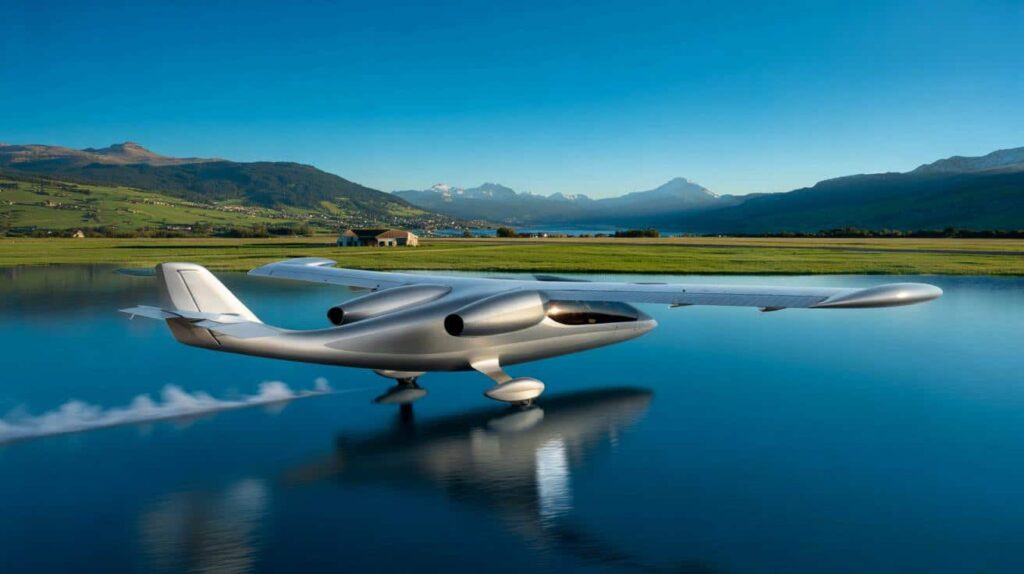
Unlike traditional tube-and-wing planes, Gen-ee uses what engineers call a “blended wing body” (BWB) or lifting fuselage. Seen from the side, the fuselage itself has the profile of a wing, and the transition between wings and fuselage is smooth and continuous.
This layout, already studied by major aerospace players for larger jets, can cut drag dramatically. Eenuee’s engineers say their aircraft should reach a lift-to-drag ratio, or “fineness”, of 25 – well above many current regional aircraft.
The design also replaces conventional tailplanes with control surfaces known as elevons, similar to those used on some military aircraft. That brings fresh challenges in stability and control, but offers more freedom to optimise performance.
Electric propulsion with minimal energy loss
In a conventional turboprop or jet, a large chunk of energy from fuel is lost as heat. An electric drivetrain can reach efficiencies near 90%, meaning far more of the stored energy becomes useful thrust.
For a short-range aircraft, where battery weight is a limiting factor, that efficiency is critical. Every percentage point of loss avoided translates into extra range or payload.
Cutting weight with composites and a non-pressurised cabin
Gen-ee will largely be built from carbon-fibre composites and high-performance aluminium. This combination allows thin, strong structures with fewer parts than traditional metal airframes.
The aircraft is also designed without a pressurised cabin, keeping typical operating altitudes lower. That choice slashes structural demands on the fuselage and can reduce mass by around 40% for the same mission profile, according to the team.
Less mass means less energy per flight, lower lifecycle CO₂ emissions and simpler maintenance regimes.
Landing on lakes: the hydrofoil twist
Beyond the airframe, Eenuee is experimenting with something that sounds closer to yacht racing than aviation: hydrofoils.
The company is developing a version of the aircraft capable of operating from water surfaces such as lakes and wide rivers. Instead of relying on bulky, draggy floats like a classic seaplane, it would use underwater wings – hydrofoils – to lift the fuselage above the water as it accelerates.
At higher speeds, the foils dramatically reduce drag from the water. That lowers the power needed for takeoff and could open up operations from remote areas that lack runways altogether.
- Conventional floatplane: floats stay in contact with the water, causing constant drag.
- Hydrofoil aircraft: foils lift the aircraft above the surface, reducing drag during the takeoff run.
- Gen-ee concept: switch between runway operations and water operations without reconfiguring the aircraft.
Eenuee argues this approach can create a true “multisurface” aircraft suitable for countries dotted with lakes and rivers, such as Canada, parts of Scandinavia or coastal regions in Asia.
Target markets: light, clean, and cheap to operate
Many small communities have lost air services because regional routes are hard to operate profitably. Aircraft are expensive to run, ticket prices climb, and passengers turn to cars or buses.
Gen-ee aims at this gap. With low energy requirements, modular charging similar to electric vehicle infrastructure, and no need for long paved runways, the business case shifts.

Potential operators could include:
| Operator type | Use case |
|---|---|
| Regional airlines | Short-hop passenger routes between secondary cities |
| Local authorities | Public-service connectivity for isolated areas |
| Emergency services | Medical evacuation and disaster relief where roads or runways are limited |
| Cargo operators | Small freight loads to rural communities and islands |
The company also hints at defence and humanitarian roles, where a quiet, low-operating-cost aircraft that can touch down on water could prove valuable.
From wind-tunnel models to real passengers: the long road to 2029
The timeline is ambitious. Eenuee is working with French composites specialist Duqueine Group to accelerate development and industrialisation.
Current work includes flying demonstrators at 1:7 scale and then at 1:4 scale. These reduced prototypes let engineers validate aerodynamics, control laws, hydrofoil behaviour and structural concepts without committing to a full-scale build too early.
Certification in Europe will rely on CS-23 rules, which cover design safety, structural integrity, systems reliability and flight performance. The company plans to launch its Design Organisation Approval (DOA) process around 2027, a prerequisite for certification.
The team’s strategy is to “de-risk continuously” – test early, adjust quickly, and scale only once the main technical questions are closed.
What will airports and operators actually need?
Eenuee emphasises that no heavy new infrastructure is needed, yet some changes are inevitable.
Airports and aerodromes would require:
- Passenger facilities on small airfields: basic terminals, boarding and safety zones.
- Charging stations: high-power connections, broadly similar to fast chargers for electric buses or trucks.
- Maintenance hubs: at least a few dedicated centres to handle composite repairs and electric systems.
The company notes that much of the ground charging infrastructure could be shared with service vehicles already operating on airfields, reducing upfront costs for operators and local authorities.
Key concepts behind the “11 times less energy” claim
For non-specialists, some of the terms around Gen-ee can sound abstract. Three ideas matter most.
Lift-to-drag ratio
This metric expresses how much lift an aircraft generates for a given amount of drag. A higher ratio means the plane glides further for the same loss of altitude, or needs less energy to stay airborne.
Moving from a typical regional aircraft ratio to the 25 targeted by Gen-ee is a big step. That shift alone can cut required power at cruise by a large margin.
Non-pressurised operations
Most commercial jets fly high and maintain comfortable cabin pressure. The fuselage must then withstand substantial pressure differences, adding weight and complexity.
Gen-ee instead focuses on lower altitudes where cabin pressure is closer to outside conditions. That eases structural loads, reduces component count, and simplifies inspections – all valuable in regions where maintenance capacity is thin.
Composites and lifecycle emissions
Carbon-fibre composites are energy-intensive to produce, yet they allow aircraft structures that are both light and durable. Over thousands of flights, a lower operating mass can more than offset the initial manufacturing footprint in terms of CO₂-equivalent emissions.
For a 19-seat aircraft flying multiple legs per day over a decade or more, using lighter materials can significantly cut total energy use across its life.
What happens if the “impossible” plane actually takes off?
If Eenuee delivers on its goals by 2029, the knock-on effects could extend past regional aviation.
The blended wing body, lifting fuselage and hydrofoil ideas are scalable. Larger versions could appear on cargo aircraft or military transports, where efficiency and access to rough or aquatic landing sites matter.
There is also a policy angle. A practical, certifiable electric regional aircraft would give regulators new tools. They could set stricter emissions limits on short flights, knowing that a cleaner alternative exists.
For passengers, the experience would change too. Flights might be shorter, quieter and closer to home, operating from small fields or lakes near towns instead of large hub airports many kilometres away.
Risks remain: battery progress may slow, certification could drag, or operators might hesitate to switch fleets. Yet even partial success – such as proving a reliable 12–15 seat variant – could reshape how remote regions think about mobility in a warming climate.
