
You wake up with your heart racing, eyes wide open, convinced you just heard something. A door? A step in the hallway? A notification from your phone? The room is calm, the street is silent, your partner is breathing deeply beside you. And still, your whole body feels like it’s bracing for an emergency that never comes.
Some nights, it’s almost funny. You know you’re technically “asleep,” yet your mind behaves like the night guard of a high-security building. Every creak, every change in temperature, every vague feeling in your chest rings an internal alarm. You fall back asleep, then wake up again, half-rested, emotionally exhausted, wondering why your brain refuses to fully let go.
There’s a name for that strange state where sleep never feels completely safe.
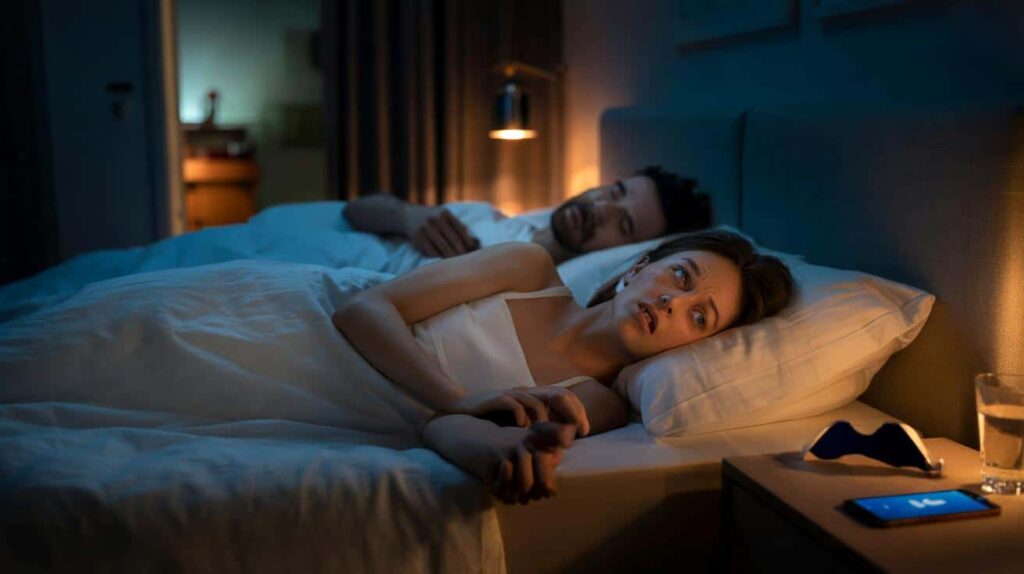
When your brain stands guard all night long
Psychologists call this hyper-vigilance: a state where your nervous system stays on alert, even when nothing is happening. At night, it can feel like your mind is sleeping with one eye open. Your body is in bed, but some inner radar is scanning the room nonstop.
You don’t drop into that heavy, trusting sleep other people describe. Instead, you float on the surface of rest, listening, anticipating, preparing. It’s like your brain has decided the world is a place where you can’t afford to fully unplug. And it keeps acting accordingly, night after night.

Picture Lena, 32, who swears she “hears everything” in her apartment building. The neighbor’s keys in the lock, the elevator door, a bottle rolling in the recycling bin downstairs. Each noise pulls her to the surface of sleep as if someone shook her shoulder.
She scrolls on her phone at 3:17 a.m., half annoyed, half resigned: “Why can’t I just be like those people who fall asleep in a minute and wake up eight hours later?” she writes in a group chat. No big trauma, no insomnia diagnosis, just this constant emotional readiness. Her sleep tracker shows seven hours in bed, but she feels like she never truly left the day behind.

Under that kind of night-time alertness, there’s often a nervous system trained to expect “something bad” at any moment. Past experiences, family dynamics, burnout, or years of subtle stress can teach the brain that relaxing fully is risky. So it keeps the emotional alarms partially on, even in sleep.
You don’t always have a dramatic backstory. Sometimes it’s a childhood in a noisy home, a parent with unpredictable moods, or a job where one email can blow up your day. Over time, your body learns one core rule: stay ready. *Even when the lights are off.* That rule doesn’t magically disappear just because you closed your eyes.

How to gently lower the night-time alarm system
The goal isn’t to “knock yourself out,” it’s to teach your body that, at night, it can step out of survival mode. One simple starting point is a pre-sleep landing ritual. Not a perfect routine with a thousand steps. Just 15–20 minutes where you deliberately switch from external alertness to internal presence.
That might look like dimming the lights, putting your phone out of reach, and focusing on a few cycles of slow breathing. Four seconds in, six seconds out, as if you were telling your nervous system: the shift is changing, the day guard can go home. Over time, this small ritual becomes a cue. The body recognizes it. The emotional sirens soften, even a little.
Many people in hyper-alert mode go to bed straight from a screen, a conflict, or a burst of work. Emotionally, they slam on the brakes at 120 km/h and expect to sleep like a stone. That jarring transition feeds the feeling of being “on duty” all night. Your thoughts keep scanning for the next problem, replaying conversations, anticipating tomorrow’s stress.
Let’s be honest: nobody really does this every single day, but creating even two or three calmer nights per week can change the general tone of your sleep. And if you wake up in a panic at 2 a.m., you’re not failing. You’re just a system that’s learned to expect storms, trying to learn a new kind of weather.

Psychologist and sleep specialist Dr. Ana Ruiz likes to tell her clients: “Your brain is not broken, it’s over-protective. Hyper-vigilance is what kept you safe at some point. Now we need to show it that safe also exists in slowness, in darkness, in silence.”
- Identify one evening triggerLate-night emails, doomscrolling, or heavy conversations can keep your inner alarm switched on.
- Choose a small nightly signalA candle, a specific playlist, or stretching sequence that tells your body: the danger scan is off for now.
- Work on daytime safety tooThe more safe moments you experience while awake, the easier it becomes to release control at night.
- Limit self-judgmentCalling yourself “crazy” or “broken” only adds another layer of stress to an already tense system.
- Ask for backup if neededTherapy, support groups, or medical advice can help untangle long-standing hyper-vigilance.
Living with a sensitive radar without letting it run your life
Hyper-vigilance at night often goes hand in hand with a certain personality in the daytime. You notice tiny changes in people’s tone. You sense tensions in a room before anyone speaks. You anticipate logistics, reactions, potential conflicts. It’s exhausting, but it’s also a form of sensitivity that once protected you, or helped you navigate complex environments.
The challenge isn’t to “switch it off forever.” The real shift is learning where that radar is useful…and where it’s simply draining you. Sleep is one of those places where constant scanning stops helping and starts hurting. That’s where conscious practice, therapy, or body-based work can draw new boundaries for your nervous system.
You might also realize you’re not the only one living like this. Talk to people who grew up in unstable homes, high-pressure jobs, or countries where safety was never guaranteed. Many will describe the same phenomenon: sleeping lightly, jumping at sounds, waking up already tense. There’s a quiet solidarity in saying, “Oh, you too?”
This kind of sharing doesn’t erase sleepless nights, but it breaks the loneliness around them. The experience shifts from “what’s wrong with me” to “my body adapted to something, and now it’s struggling to adapt back.” That nuance changes the tone of healing. You’re not fixing a defect. You’re re-educating a loyal, overworked guardian.
You may find that certain small shifts act like invisible levers: eating a bit earlier, reducing evening caffeine, learning a body scan, talking about old fears you never fully voiced. Bit by bit, the nights become less like a watchtower and more like a harbor. Some dreams feel deeper. Some mornings arrive without that familiar emotional hangover.
There will still be rough patches, nights where your inner alarm flares up for no clear reason. You’ll have setbacks, and some seasons of life will naturally crank vigilance higher again. Yet once you’ve felt even a handful of truly safe nights, you know another version of yourself is possible. And that alone can soften the constant need to be alert, even in sleep.
| Key point | Detail | Value for the reader |
|---|---|---|
| Hyper-vigilance has a story | Often linked to past stress, unstable environments, or emotional overload | Gives meaning to your reactions instead of seeing them as random “problems” |
| Small rituals change the tone of the night | Short, repeated pre-sleep cues help your nervous system shift gears | Offers a realistic way to ease alertness without drastic life changes |
| You don’t have to do this alone | Therapy, medical support, and shared experiences can ease the process | Reduces shame and opens practical paths toward calmer sleep |
FAQ:
- Why do I wake up at every little noise?Your nervous system is likely stuck in a state of heightened alert. Past stress, anxiety, or a long period of “being on call” can train your brain to respond strongly to minor stimuli, even in sleep.
- Is being emotionally alert during sleep the same as insomnia?Not exactly. You may fall asleep and stay in bed for hours, but your sleep is shallow and easily disrupted. It’s a form of fragmented or non-restorative sleep tied to emotional hyper-vigilance.
- Can hyper-vigilance during sleep be treated?Yes. Approaches like cognitive-behavioral therapy, trauma-focused therapy, body-based practices, and lifestyle adjustments can all lower night-time alertness over time.
- Should I take sleeping pills for this?That’s a discussion to have with a doctor. Medication can sometimes help in the short term, especially in intense phases, but it doesn’t address the emotional and nervous-system roots on its own.
- When is it time to seek professional help?If you feel constantly exhausted, anxious, or on edge, or if your sleep issues impact your work, relationships, or mood, talking to a mental health professional or sleep specialist is a smart next step.
