
The first hint wasn’t a headline on a weather site. It was the sound outside your window. Traffic a bit quieter, snowplows arriving earlier than they should, the air suddenly sharper on your skin when you stepped out to grab a coffee. The forecast had called for “seasonal chill,” yet the cold felt heavier, as if it had drifted from a different continent altogether.
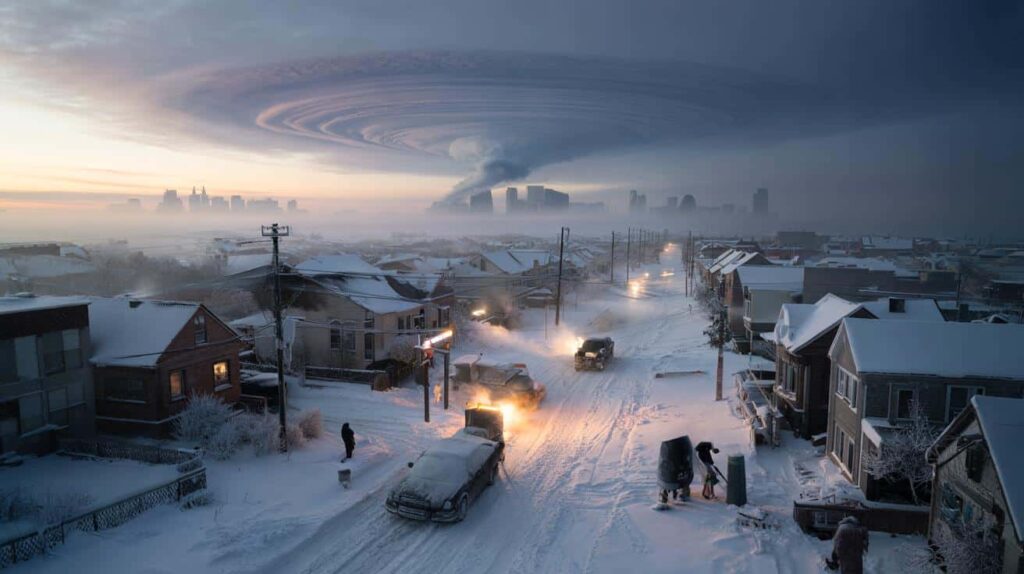
Meteorologists have a name for the invisible engine that controls these strange lurches in winter weather: the polar vortex.
A polar vortex that won’t sit still
Look at a satellite map of the Arctic right now and you don’t see a neat, tidy swirl of cold air locked over the North Pole. You see something stretched, twisted, tugged off center. High above our heads, around 30 kilometers up, the polar vortex – a whirl of frigid, fast-moving winds – is getting disrupted.
 Turning the heating down when you go out: experts reveal the trap that wrecks comfort and savings
For most people, that’s just a phrase on a TV graphic. For forecasters watching the stratosphere, it’s the early warning light on the dashboard.

Across Europe, Asia, and North America, long-range models have been quietly flashing red. Several agencies, from the U.S. National Weather Service to the European Centre for Medium-Range Weather Forecasts, are tracking a sudden stratospheric warming event – a rapid temperature spike high over the Arctic that tends to knock the polar vortex off balance.
Past episodes triggered some of the wildest winter outbreaks of recent decades: the 2010 “Big Freeze” in Europe, the 2018 “Beast from the East,” the crippling Texas cold of February 2021. Each time, February turned into a month people still talk about years later.
Why does a temperature jolt 30 kilometers up matter to your street, your pipes, your heating bill? When the stratosphere warms like that, it can weaken or even split the polar vortex. The once-tight ring of icy air starts to wobble, sending arms of Arctic cold sliding south like spilled paint.
Not every polar vortex shake leads to disaster at ground level. The atmosphere is a slow, tangled machine. Still, when experts warn that February could bring **unusually extreme winter conditions**, this is the chain reaction they have in mind.
What this could mean right where you live
Short of owning your own weather balloon, what can you actually do about a misbehaving polar vortex? Surprisingly, a lot – and it starts with shifting how you think about “just cold weather.” Look at the next few weeks like you’d look at a possible power outage or major travel disruption.
Scan your home the way a firefighter scans a room: where are the weak points against deep cold? Drafty windows, exposed pipes, a forgotten extension cord powering a space heater in the garage.
We’ve all been there, that moment when you wake up at 3 a.m., hear the radiators clicking strangely, and suddenly wonder when you last checked the boiler. During the February 2021 Texas freeze, many households learned in one brutal week how fragile their everyday systems really were. Pipes burst in homes that had never seen such low temperatures. People queued at neighbors’ houses just to charge phones and warm up.
A rare polar vortex disruption doesn’t automatically mean a repeat of that. Yet the lesson is clear: regions “not used” to intense cold can be hit just as hard, or harder, than places that deal with it every year.
Meteorologists talk about probabilities, not certainties. Right now, those probabilities tilt toward more blocking patterns in the atmosphere – stubborn high-pressure systems that can lock cold air in place for days or weeks. That’s when you see double-digit negative wind chills, powdery snow that never melts, urban ice rinks forming on side streets.
Let’s be honest: nobody really reads a seasonal outlook and then calmly retools their life. Yet this is one of those times when a little early action – topping up heating fuel, checking insulation, planning flexible travel dates – can turn an “extreme event” into a tough, but manageable, stretch of winter.
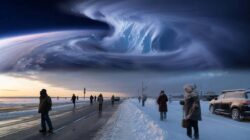 Meteorologists warn early February may bring an Arctic disruption outside historical norms
How to prepare without panicking
Think of February as a stress test. Not for you, so much as for the infrastructure around you. Start with three simple moves: protect heat, protect water, protect movement.
Protect heat by confirming now that your main heating source actually works under strain. Run it hard for a day on purpose. Listen, smell, pay attention. If something sounds off, you want to know before a vortex-disrupted cold snap, not during it.
Protect water by finding every pipe that runs through an unheated space – basements, crawl spaces, garages. Wrap them or add temporary insulation. Leave cabinet doors open during cold nights so warm air reaches the plumbing along exterior walls.
Protect movement by treating your car like it might have to spend a night outdoors in sub-zero temps. Winter windshield fluid, a scraper, a cheap blanket in the trunk, a backup battery pack for your phone. Small stuff, but when roads glaze over and the temperature plunges, that small stuff feels big.
There’s also the emotional side, the part forecasting models don’t show. The dread when you refresh the app for the fifth time in an hour. The guilt when you realize elderly neighbors might be facing the same forecast with far fewer resources. *Cold snaps expose the gaps in our communities as much as in our insulation.*
Climatologist Judah Cohen, who has spent decades studying the polar vortex, once put it simply: “When the vortex is disturbed, winter weather becomes less predictable and more extreme. It’s not about one storm, it’s about a pattern that can stay locked in.”
- Check on people, not just pipes: A quick text to relatives, neighbors, or co-workers can be as vital as wrapping a faucet.
- Plan “low-tech warmth”: layered clothing, extra blankets, hot water bottles in case power flickers or fails.
- Stock simple, heat-optional food: canned soups, nuts, bread, fruit – things that don’t depend on a fully working kitchen.
- Prepare for boredom as much as for cold: books, offline movies, games. Long, icy evenings feel harsher when you’re just scrolling the same three apps.
A winter that says something bigger
Stepping back from the forecast maps, this looming polar vortex shift feels like one more piece in a larger, messier puzzle. As the planet warms, the contrasts that drive our weather are changing. Some scientists argue that a weaker, wobblier jet stream and more frequent polar vortex disruptions are part of that story. Others are more cautious, warning against pinning too much on one mechanism.
What’s hard to ignore is the lived reality: winters that swing from rain to blizzard to rain again, ice on streets that never used to freeze, snowstorms battering cities that once joked they “never get real winter.”
If February does bring those unusually extreme conditions, the stories that come out of it will be local, specific, painfully concrete. A frozen bus stop where kids wait in the dark. A farmer wondering how to keep livestock watered when everything turns to ice. A parent wrapping an old towel around a drafty door because the hardware store ran out of proper seals.
These small scenes add up to something bigger than a rare weather anomaly. They reveal who has backup plans and who doesn’t, who gets protected and who’s left literally out in the cold. The polar vortex sits high above the planet, yet the real drama unfolds at ground level, house by house, street by street.
The next few weeks will answer some big questions. Will the disrupted vortex send a true Arctic blast your way, or will it fizzle out before it reshapes your skyline in white and ice? Will this be another winter we remember as “that time it got scary,” or just a near miss that fades into a blur of chilly mornings?
Either way, the conversation has already shifted. Extreme winter is no longer a once-in-a-generation outlier tucked neatly into old photos and family stories. It’s something we now prepare for, argue about, learn from – and quietly hope, this time, passes us by.
| Key point | Detail | Value for the reader |
|---|---|---|
| Polar vortex disruption | Sudden stratospheric warming can weaken or split the vortex, sending Arctic air south | Helps you understand why February forecasts may suddenly turn extreme |
| Local impacts | Long-lasting cold, heavy snow, and infrastructure stress in regions not used to it | Gives context for possible power cuts, travel chaos, and price spikes |
| Practical preparation | Focus on heat, water, and movement, plus community support | Concrete steps to stay safer, calmer, and more resilient during a severe cold spell |
FAQ:
- Is this polar vortex event definitely going to bring extreme cold to my area?Not definitely. A disrupted vortex raises the odds of severe cold in mid-latitudes, but local impacts depend on how the jet stream sets up over the next 1–3 weeks.
- Does a polar vortex mean climate change is getting worse?The polar vortex itself isn’t new. The debate is whether a warming Arctic is making disruptions more frequent or stronger. Many researchers see a possible link, others say the evidence is still mixed.
- How far ahead can experts really predict these events?Signs of a stratospheric warming can be seen 10–20 days ahead, yet translating that into ground-level weather is tricky. Confidence grows only within about a week of the cold hitting.
- What’s the simplest thing I can do this week to prepare?Test your heating, find and insulate vulnerable pipes, and build a small “cold snap kit” with blankets, food, water, and a flashlight where you can grab it quickly.
- Should I cancel February travel plans because of the polar vortex?No automatic need to cancel, but book with flexible policies, watch forecasts closely for your route, and prepare for delays if your destination is in a potential cold-risk zone.
