
Just after dawn, the town sounds wrong. No commuting hum, no distant truck brakes, no schoolyard voices. Only the low cough of a snowplow somewhere on the next hill, pushing through drifts that have swallowed cars whole. In the half-light, traffic lights blink uselessly over an empty intersection, their poles crusted in white like frozen bones. The forecast app on a cracked phone screen updates again: another 60 centimeters expected. “Roads likely impassable for days.” The coffee on the table is already cold. The firefighter scrolling through the alerts won’t drink it anyway. His shift ended last night. He’s still here.
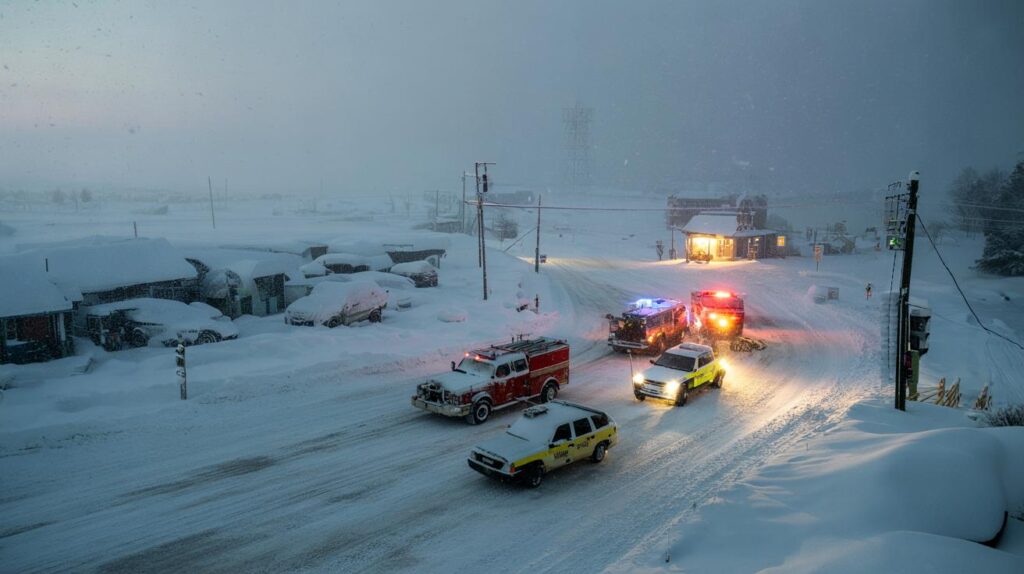
Outside, the snow keeps falling in slow, deliberate sheets. Good intentions feel small in weather like this.
When the snow doesn’t stop and the system starts to creak
The first thing that breaks isn’t usually a power line or a highway. It’s the sense that someone, somewhere, still has control. Meteorologists talk about “snow events” and “bands of heavy precipitation”. On the ground, paramedics talk about which streets they have to abandon. A few hours into a major snow emergency, maps on the wall turn from helpful to embarrassing. Routes that looked clean the night before are now heavy with red crosses and handwritten notes: BLOCKED, BURIED, DO NOT ATTEMPT.

You can feel the shift in the room when the calls start outnumbering the vehicles.
 When kindness becomes isolating: 7 reasons “nice women” have fewer friends as they get older
In upstate New York, a volunteer ambulance crew recently logged more than 40 calls in a single night while half their fleet sat trapped behind three-meter drifts. Dispatchers rerouted an asthma case twice because the first two roads became impassable within minutes. In the end, a snowmobile club ferried medication to the patient as plows carved a narrow tunnel behind them. That story sounds dramatic until you talk to crews in rural Canada or the mountain West, where snow totals expected “once in a decade” now show up every few winters.
A small town on the edge of the Alps watched its only access road vanish under a series of avalanches. Helicopters couldn’t fly. The grocery store ran out of bread by day two, baby formula by day three.
When meteorologists warn that snow accumulation could isolate entire regions within days, emergency services hear something different: cascading failure. One buried transformer knocks out power to a cell tower. No cell tower, no calls. No calls, no accurate picture of who’s in danger. Plows stuck or diverted mean ambulances sharing the same fragile corridor. That fragile corridor crosses a bridge the city never fully reinforced. Snow loads build on roofs, then on the expectations of neighbors who assume someone will “come check on us if it gets bad”. Let’s be honest: nobody really does this every single day.
Under deep snow, the weakest link is rarely the one officials predicted on paper.
How responders quietly prepare for the worst week of the year
Months before the first headline about “historic accumulation”, there’s a quieter ritual inside emergency operations centers. Maps get spread on tables. Old-timers trace their fingers along forgotten logging roads and farm tracks, arguing about which ones stay plowed “no matter what”. Crews pre-stage fuel, cots, and chains for ambulances in unlikely places: a church basement, the back of a public works garage, the small airport that rarely sees a plane. The goal is simple. If the main road goes, there’s still a thread of access left.

The best-prepared regions don’t rely on one plan. They rely on three decent ones that overlap.
We’ve all been there, that moment when you realize the storm on TV is now the storm on your street. For emergency planners, that moment happens earlier, when model runs start to agree. That’s when they call school districts, nursing homes, dialysis centers. They ask annoying, specific questions: How many days of oxygen do you have on-site? Who has a generator, and who only thinks they have a generator? A lot of the job is unglamorous chasing of details. *The heroic rescues get the cameras; the tedious spreadsheets quietly save far more lives.*
The biggest mistake locals make is assuming those behind-the-scenes calls cover everyone.
Inside a suburban firehouse last winter, Captain Lea Tan pinned a list to the bulletin board: “UNREACHABLE ADDRESSES AFTER 30CM”. It wasn’t meant to scare the crew. It was meant to remind them where the clock runs faster. Older hillsides, dead-end cul-de-sacs, single-lane farm tracks.
“We don’t like the word ‘stranded’,” she said. “We prefer ‘delayed response’. But when the snow stacks up beyond what the town can push, that delay can be a day long. People need to know that before we’re on the evening news.”
- Pre-identifying fragile roads helps crews know where to send the first plow blade, not the closest one.
- Staging backup teams in neighboring towns creates **extra depth** when a local station gets cut off.
- Sharing simple checklists with residents turns passive worry into small, concrete actions they can control.
What isolation really means when the forecast stops being abstract
There’s a moment in every long snow emergency when the conversation shifts from “how do we get in?” to “how do people inside cope until we can?”. That’s the uncomfortable reality of regional isolation. For families, it’s not a Hollywood survival movie. It’s recalculating insulin doses to stretch supplies, it’s heating one room instead of five, it’s neighbors quietly knocking on each other’s doors with extra batteries and a thermos. For emergency services, it’s learning to say, “We can’t reach you yet” without that sounding like abandonment.
The regions that ride out these events best tend to be the ones where that sentence is already on the table long before the snow starts falling.
| Key point | Detail | Value for the reader |
|---|---|---|
| Know what “isolated” really looks like | Roads blocked for days, patchy communication, slower emergency response times | Helps set realistic expectations and reduce panic when conditions worsen |
| Local plans matter more than national promises | Small, specific agreements between neighbors, clinics, and local crews | Shows where your own influence is strongest when systems start to strain |
| Preparation is shared, not individual | Simple coordination: shared snow blowers, medication lists, welfare checks | Transforms a vague threat into practical steps you can take with others |
FAQ:
- Question 1What do emergency services fear most during extreme snow events?
- Question 2How long can a community realistically function if it’s cut off by snow?
- Question 3Is it safe to assume an ambulance will always reach my home?
- Question 4What can ordinary residents do that actually helps first responders?
- Question 5Are these “once-in-a-generation” snowfalls really becoming more common?
