
The first sign wasn’t a headline, it was a silence.
On a Tuesday morning that should have felt ordinary, the world outside many kitchen windows looked oddly still, like the sky was holding its breath. Forecast apps flashed red alerts where there were usually gentle icons: “Major Arctic disruption possible.” People scrolled, frowned, and moved on to emails. The dog still needed walking, the kids still had to get to school.
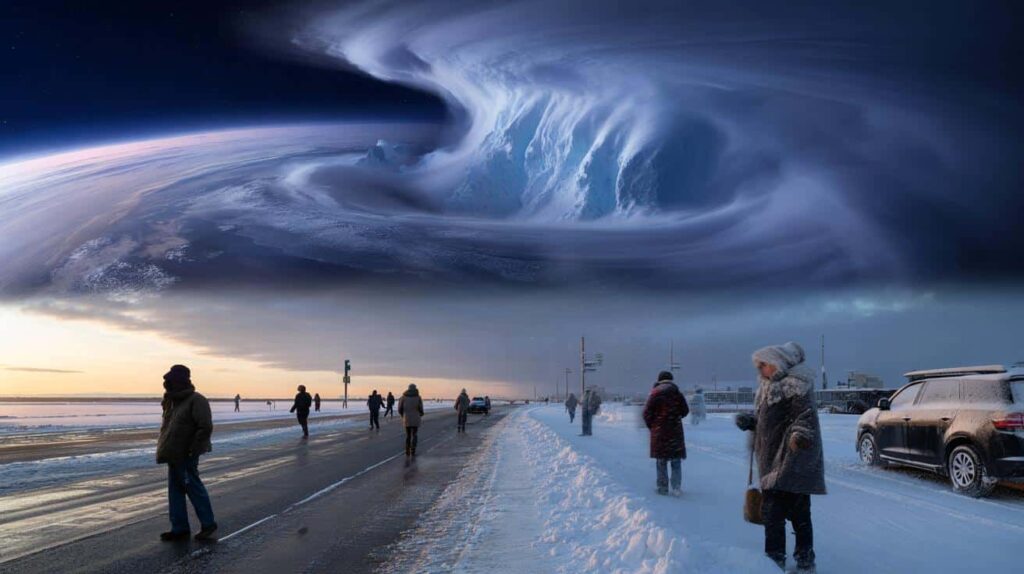
Somewhere between the second coffee and the school drop-off, though, a quieter thought appeared.
What if this time, the cold really is different?

When the Arctic refuses to stay put
On the maps lighting up meteorologists’ screens right now, the Arctic is behaving like a restless guest who no longer respects the seating plan.
Instead of staying locked over the polar region, a massive dome of frigid air is wobbling, stretching, and threatening to spill far south as early February approaches.

For years, “polar vortex” was tossed around like a meme. But this winter, experts watching the upper atmosphere are using more careful words.
“Outside historical norms.”
“Anomalous disruption.”
Phrases you don’t hear every year, even from people whose job is literally to worry about the sky.

There’s a scene playing out in weather offices across the Northern Hemisphere.
Two forecasters lean over a glowing ensemble chart, watching blues and purples ooze over North America and Europe in simulation after simulation. One zooms in on early February, clicks forward, and quietly whistles. The other scrolls through historical data, trying to find a year that looks similar.
They don’t quite succeed. 1985 shows up. 2010. The brutal snap of 2021 in Texas. Each offers pieces of the puzzle, but this winter’s setup seems to twist the pattern.
Jet streams swerving harder. Warm blobs near Greenland. Pressure anomalies over Siberia.
It’s like someone shuffled the atmospheric deck halfway through the game.
So what’s actually going on?
Meteorologists point to the stratosphere, around 30 km above our heads, where a sudden warming event has disrupted the usual tight spin of cold air over the pole. That spin – the polar vortex – acts like a fence. When it weakens or splits, the cold doesn’t just escape, it wanders.
Climate change doesn’t stop the cold from existing; it bends the rules of where and when it appears. Warmer oceans, less sea ice, and altered temperature gradients are giving the jet stream new habits, sometimes looping deeper south, lingering, or snapping back in strange ways.
That’s why an “Arctic outbreak” now feels less like a one-off freak event and more like a recurring guest with increasingly bad timing.
Preparing for a cold that doesn’t play by old rules
If early February does bring an Arctic disruption beyond what the models usually expect, preparation stops being a boring checklist and starts feeling like self-defense.
Think in layers, both for your body and your home.

For people in regions that usually see only mild winters, it’s not overreacting to act like you’re temporarily living 1,000 kilometers farther north.
Wrap exposed pipes, bleed radiators, test space heaters before you actually need them.
Do the small, tangible things today that your shivering future self will quietly thank you for.
We’ve all been there, that moment when the forecast suddenly downgrades from “light snow” to “life-threatening wind chill” and the grocery store shelves are already stripped of bread and batteries.
The pattern is always the same: we laugh at the early warnings, we postpone small tasks, then rush in a panic when the cold is already on our doorstep.
There’s a gentle way to break that cycle.
Instead of prepping like a doomsday hobby, treat it like tidying your winter life.
One bag for candles, chargers, and power bank. One mental plan for who you’ll check on – the older neighbor, the colleague who lives alone, your own parents.
Let’s be honest: nobody really does this every single day.
But doing a bit of it once, before the Arctic decides to visit, changes how the whole episode feels.
This early February, meteorologists are trying to walk a narrow line between alarm and clarity.
They’ve seen what happens when people tune out repeated warnings, then feel blindsided anyway.
“Statistically, what we’re watching is rare,” says a European forecaster who’s been tracking the upper-air patterns for weeks. “Not unprecedented, but clearly outside the comfortable range we like to call ‘normal winter volatility’. The risk isn’t just cold; it’s cold hitting places and infrastructures that weren’t built for it.”
- Watch local forecasts, not just viral maps
Big Arctic headlines are dramatic, but your local meteorological office knows your grid, your roads, your weak spots. - Build a 72-hour resilience kit
Water, shelf-stable food, basic meds, power banks, warm blankets. Think “prolonged outage”, not apocalypse. - Plan for remote work or school
Charge laptops, download key files, clarify with your employer what happens if travel becomes unsafe. - Protect your weakest links
Insulate pipes, check car antifreeze, locate manual window coverings or draft stoppers for heat loss. - Map your human safety net
Write down who you’ll call and who might call you if the cold turns from “inconvenient” to dangerous.
The bigger chill behind the forecast
There’s something quietly unsettling about needing a new vocabulary for winter.
When meteorologists start saying that a pattern is “outside historical norms”, they’re also saying our memories are no longer a reliable guide. The childhood winters we compare everything to – the snow days, the frozen ponds, the “worst cold I ever felt” – belong to a climate that’s already fading in the rearview mirror.
*That doesn’t mean every February will be catastrophic.*
It does mean that when the atmosphere misbehaves, the swings can feel sharper, stranger, harder to slot into categories like “just another bad year.”
| Key point | Detail | Value for the reader |
|---|---|---|
| Arctic disruption is not business as usual | Meteorologists are tracking a weakened, distorted polar vortex and unusual jet stream paths for early February. | Helps you treat upcoming cold as a serious, time-limited risk rather than background winter noise. |
| Small actions reduce big stress | Basic home prep, gear checks, and communication plans turn a potential emergency into a difficult but manageable episode. | Lowers anxiety, increases safety for you and those around you. |
| Weather volatility is part of a longer story | Shifts in Arctic sea ice, ocean warmth, and atmospheric circulation are making rare patterns more likely. | Gives context so you’re not just reacting to this event, but adapting to a new kind of winter reality. |
FAQ:
- Question 1What does “Arctic disruption outside historical norms” actually mean?
- Answer 1It means the usual circulation of cold air over the Arctic has been disturbed in ways that are rare in the available data. The cold pool is more prone to break off and move south, affecting regions that don’t often see that level of chill, or bringing more intense cold to areas that are used to winter but not to these extremes.
- Question 2Which areas are most at risk from this early February cold?
- Answer 2Models point mainly to mid-latitude regions in North America, Europe, and parts of Asia. The exact zones shift with each update, which is why local forecasts matter so much. Even if you’re not in “deep freeze” territory, neighboring regions can face power grid and transport issues that ripple into your daily life.
- Question 3Is this directly caused by climate change?
- Answer 3Scientists are still debating the exact links, but many point to warmer Arctic conditions, reduced sea ice, and altered temperature contrasts as factors that can weaken or destabilize the polar vortex more often. The simple version: a warming world can still produce brutal cold snaps, just in more erratic and surprising ways.
- Question 4How long could an Arctic outbreak like this last?
- Answer 4Serious cold waves linked to polar vortex disruptions often last from a few days to a couple of weeks in any one location. The overall pattern can shuffle around the hemisphere for longer. The key is to be ready for several days of hazardous conditions, even if the exact timing is still fuzzy.
- Question 5What’s the single most useful thing I can do before it hits?
- Answer 5Combine information and action: follow your national meteorological service closely for the next two weeks, and spend one focused hour preparing your home and basic supplies. That small window of effort now can turn a frightening, chaotic cold snap into a demanding but survivable story you’ll tell, not a crisis you barely escaped.
