The goats started climbing the hill before the sky even changed color.
No thunder. No wind. Just a slow, stubborn line of animals leaving the valley, as if someone had whispered a secret in their ears.
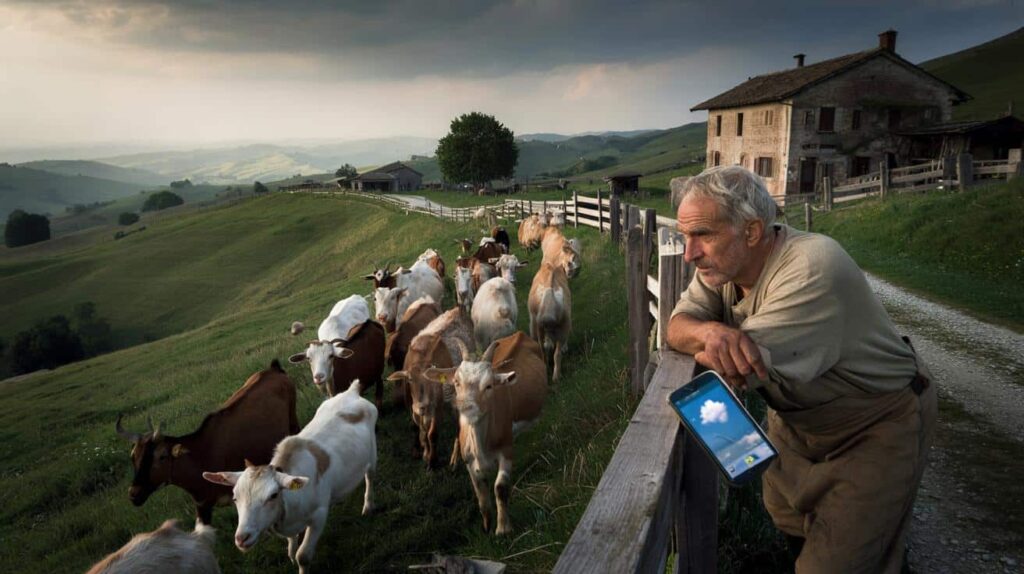
An old farmer in the Italian Apennines watched them in silence, leaning on his fence. His weather app still showed a calm gray icon. The forecast said “light showers”. His animals said something else entirely.
Three hours later, the storm that “wasn’t on the radar” ripped tiles off roofs and turned paths into rivers.
Stories like this pop up after every big disaster. Dogs that refuse to go outside. Birds that vanish from gardens. Cows that won’t settle.
Once you’ve seen it, you keep asking the same question.
Is this really just luck?
What animals sense long before we open the weather app
Talk to people who live close to the land and they’ll shrug, half amused, when you bring this up.
They’ve seen swallows fly low hours before a violent downpour. They’ve watched cats pacing the house, tails twitching, the day a storm ripped through town.
Scientists used to smile politely at these stories. They sounded like folklore, like something you told kids to explain why grandpa always knew when rain was coming.
That comfortable skepticism began to crack when cameras, GPS collars and seismic sensors started to tell the same tale.
Animals were not only moving.
They were moving early.
One of the most striking examples came from a quiet patch of countryside in central Italy.
In 2016, a team of German researchers put GPS collars on cows, sheep and dogs living near a fault line, just to see how their daily routine looked.
For months, the animals mostly did what animals do. Grazed. Slept. Bothered each other. Then, on several days before a strong earthquake, something changed.
Several hours before seismic activity, the herds became restless and left their usual areas, as if pushed by an invisible hand.
The pattern repeated often enough that it no longer looked like chance.
Movement spikes matched the most intense shifts underground, long before any human felt a tremor or saw storm clouds bunching on the horizon.
So what are they picking up?
Researchers now talk about a kind of “multi-sensory early warning system” that many species carry around in their bodies.
Some animals feel tiny pressure changes in the air long before a front hits. Others react to very low-frequency sounds that roll across the landscape before a storm or quake.
Birds sense shifts in the magnetic field. Elephants pick up vibrations through the pads of their feet.
Our own senses filter out a lot of this “noise”.
Theirs don’t.
*From their point of view, the world is a constant murmur of clues we barely notice.*
When those clues cross a certain threshold, instinct does the rest: flee, climb, hide.
How to really “read” your pets and local wildlife before a violent storm
You can’t suddenly grow an elephant’s feet or a goat’s inner ear.
You can, though, learn to treat animal behavior as a living weather alert.
Start with a simple habit: watch for changes from each animal’s normal baseline.
A dog that’s usually lazy becoming glued to your legs, panting in a quiet room. Birds leaving feeders full of seed and vanishing from the yard. Bees staying strangely close to the hive on a warm afternoon.
Those “off” moments are often more telling than a dramatic outburst.
They’re the animal version of a push notification.
The mistake many of us make is to look for big movie scenes.
We expect horses rearing, flocks screaming, dogs throwing themselves against the door, or nothing.
Real life is less theatrical.
A cow staring in one direction for far longer than usual can matter. A cat that normally roams suddenly refusing to leave the sofa can matter too.
Let’s be honest: nobody really logs these little signals in a notebook every single day.
Still, simply deciding to trust your discomfort when “everyone feels weird” in the house before a heat storm or squall line gives you an extra layer of safety.
If it feels off, you close windows, move things off the floor, check your emergency kit. Small, boring steps.
“We used to laugh when my grandmother said the chickens ‘knew first’,” says climatologist Giulia Mainardi, who now works with disaster-preparedness teams in southern Europe. “Now, when farmers call saying their animals are acting strange before a storm, we actually listen and log it. It’s not magic, it’s another data point.”
- Keep an eye on patterns
Notice how your pets behave on calm days, windy days, and before regular rain. You’ll spot what “normal restless” looks like versus that rare, unnerving agitation. - Use animals as a second opinion
You don’t need to panic every time a dog barks. But if your forecast mentions possible severe weather and wildlife goes silent or erratic, treat the threat more seriously. - Respect refusal
If a usually eager animal firmly resists going outside or staying in a low area before a storm, don’t force it “to be reasonable”. Their body may be picking up cues your apps don’t see. - Talk to locals
Older neighbors, fishers, farmers, hikers often know the subtle animal signs tied to your region’s storms and floods. That oral knowledge is quietly priceless. - Combine instincts and tech
Weather radar, alerts, barometers plus the behavior of animals around you form a more complete picture than any single source. One confirming the other is your cue to act.
Why this “isn’t random at all” changes how we face extreme weather
Once you hear enough of these stories, they’re hard to shake.
The dog that went frantic hours before the 2004 tsunami and dragged its owners uphill. The seabirds that left a coastline days before a cyclone. The frogs that disappeared from a rice field the week before a historic flood.
Scientists now talk less about superstition and more about probability.
On any single day, an animal acting odd doesn’t “predict” anything.
Look across many storms, many quakes, many species, and a pattern starts to emerge.
We’ve all been there, that moment when the sky still looks harmless but your body whispers, “Something is wrong.”
Knowing that other species are running their own, much older early-warning systems in parallel can be both unsettling and strangely comforting.
| Key point | Detail | Value for the reader |
|---|---|---|
| Animals sense subtle signals | They react to pressure shifts, vibrations, low-frequency sounds and magnetic changes before us | Helps you see odd animal behavior as useful information, not superstition |
| Patterns beat one-off anecdotes | Repeated links between restlessness and storms or quakes are now documented | Gives you confidence to take recurring signs more seriously |
| Use animals plus modern tools | Combine forecasts, alerts and what local wildlife and pets are doing | Improves your practical preparedness before severe weather hits |
FAQ:
- Question 1Do animals really “predict” storms, or are we just seeing patterns where none exist?
Most researchers avoid the word “predict”. Animals react to physical signals that often precede storms and quakes. Across many events, their behavior lines up with real changes in the environment more often than chance alone would suggest.- Question 2Which animals seem most sensitive before violent weather?
Farmers and studies frequently mention goats, cows, horses, dogs, birds and insects. Different species likely tune into different cues, so a mix of signals from several animals around you can be more telling than focusing on one.- Question 3How long before a storm can animals start acting differently?
Timing varies widely. Some changes appear a few minutes before impact, others several hours earlier when pressure or electrical conditions start shifting. For earthquakes, unusual activity has been recorded multiple hours before main shocks.- Question 4Should I always evacuate if my pet is acting strange?
Not automatically. Look at context: weather alerts, radar, local reports, and recurring patterns in your pet’s behavior. If multiple signs line up, it can be wise to take practical precautions or move to a safer place.- Question 5Can scientists turn animal reactions into an official warning system?
There are experiments, like GPS-collared farm animals near fault lines and wildlife tracking networks. For now, the data is too complex and variable for a reliable “animal alarm”, but it’s becoming a serious field of research rather than a curiosity.