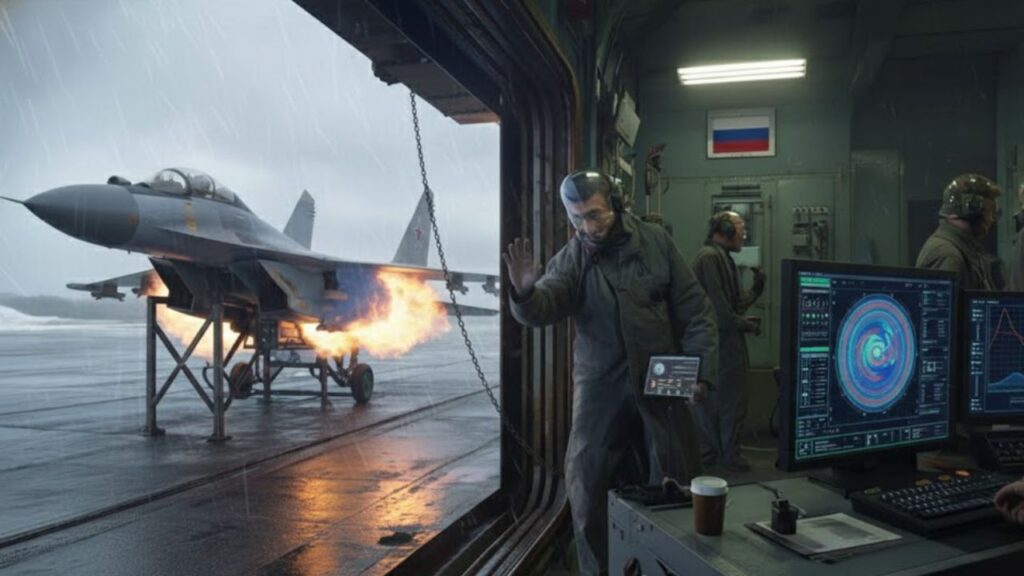
On a rainy morning in Istres in southern France a group of engineers stand silently behind thick glass. On the other side a Rafale fighter jet engine screams at full throttle while chained to its test bench with flames licking the metal exhaust. The ground vibrates and a coffee cup starts dancing on a nearby table. Nobody looks away from the monitors. One engineer leans closer and whispers almost to himself that they are playing with the limits of physics here. Few people outside this bunker-like building know what is really happening. Even fewer know that no other country in Europe can do it quite like this.
Inside France’s Engine Facilities Where Precision Equals National Sovereignty
If you drive past certain unmarked sites in Paris, Istres or near Bourges you will probably just see fences and trees with a few badges flashing at barriers. It looks like any other government compound. Behind those ordinary walls sits one of France’s least flashy superpowers which is the ability to design and test and qualify fighter jet engines down to the micron from the turbine blade to the final flight. This quiet power has a name that rarely makes headlines which is the DGA or the Direction générale de l’armement. While the world sees the Rafale storming across the sky the people here see something else entirely. They see temperature maps & vibration curves & clearances so small they’re measured in human hair fractions. Take the M88 engine which is the heart of the Rafale. On paper it’s a compact turbofan of about 5 tons of thrust built with Safran. In practice it’s a dense knot of metallurgy & aerodynamics and software & national pride. When France sells Rafales to Greece or India or the United Arab Emirates what really travels under the flag is this engine and everything it represents. The DGA follows it at every step from early design choices with industrial partners to the last brutal qualification tests where engines are pushed beyond their operational limits until parts literally melt or crack. The numbers are dizzying with turbine blades that spin at over 10000 revolutions per minute and temperatures higher than the inside of a volcano and tolerances smaller than a grain of dust. One minor error or one micro-crack not spotted and a pilot’s life is at stake.

How the DGA Converts Engineering, Data, and Risk Into World-Class Accuracy
Inside a DGA test cell the method borders on obsession. Every engine is instrumented like a hospital patient in intensive care. Dozens or sometimes hundreds of sensors track temperature & vibration and pressure and rotation speed. The slightest anomaly is logged and dissected and argued over. The process starts way before the first ignition. Models are run for months on supercomputers. Airflows are simulated. Digital twins fly virtually before a single bolt is tightened in real life. Then comes the noisy part which involves starting the engine & running it at partial power and then full power and then beyond what any pilot will ever demand. That’s how the DGA pushes France’s fighter engines to the limit by treating each test as both a technical step and a lesson in humility. Metal always has the last word. Most people imagine qualification tests as a few routine runs and a stamp of approval. The reality is a lot uglier. Sometimes engines are deliberately abused. Sand is injected into the intake. Bird-strike simulations send frozen chickens or gelatinous projectiles into spinning fans. Sudden power cuts are triggered mid-run to see how the whole system reacts. There’s a famous scene quietly told among technicians of an engine that exploded during an extreme test. Fragments of turbine hit the reinforced walls & alarms went wild and the room filled with a burnt-metal smell. Nobody was really surprised. These tests are designed so that failure is occasionally not a bug but a step. Let’s be honest because nobody really imagines that behind one smooth fighter take-off there are years of controlled chaos and broken hardware. On paper the DGA’s role is simple which is to act as the state’s technical arm for armament programs. In reality its power lies in its ability to say no when no one else dares. That’s where precision is born. When Safran or Thales present a new component for a fighter jet engine like a sensor or a fuel system or a software update the DGA engineers tear apart the proposal. They demand test results & ask for extra trials and cross-check data with their own labs. The relationship is close and often tense but deeply collaborative. Both sides share the same fear which is a hidden flaw that will only show up at 10000 meters. This is also what sets France apart in Europe. Other countries may build critical subsystems or host joint ventures but very few can claim a full sovereign chain from the design desk to the last test flight with one public authority coordinating it all with this level of technical depth & political weight.

Why This Hidden Precision Shapes France, Europe, and Future Combat Aircraft
Behind all this there is a method that looks surprisingly like craftsmanship but at an insane technological level. Every new engine program follows a cycle of predict and test and break & understand and improve and test again. The DGA’s test centers are like giant forges where the material is not just metal but also data. Want to know how an engine will behave when a Rafale catapults from an aircraft carrier deck in bad weather with salt attacking every component? The DGA recreates those conditions on the ground. Want to validate that a future European fighter like the FCAS project with Germany and Spain will remain stealthy & efficient while packing more electronics? The same logic applies with methodical and almost stubborn iteration. That’s how France can sit at the negotiation table not as a junior partner but as a country with rare and hard-won expertise. The common mistake in political speeches is to reduce all this to technology or industrial excellence. It sounds good but it hides the human part. In the corridors of the DGA you also meet people who live with the stress of invisible risks. An engineer may spend months analyzing a barely noticeable vibration peak at a specific rotation speed. A test operator might replay one engine incident in their head for nights. And yes sometimes decisions are made to delay a program because something doesn’t feel fully clear yet. We’ve all been there in that moment when a tiny doubt in your gut refuses to disappear. Here that doubt can decide whether a fighter goes on patrol or stays grounded. The DGA’s strength is that it gives space to this doubt instead of hiding it under slides and pretty graphs.

A Quiet Strategic Strength Revealing Europe’s Remaining Industrial Power
Once you have walked out of a DGA test center the next fighter jet you see on the news does not look quite the same. Behind the elegant gray silhouette you imagine the tortured engine on its bench with screaming metal and cold faces watching numbers on screens. You also realize something else. This kind of capacity does not survive on autopilot. It needs political will and budgets that do not vanish with each electoral cycle. It needs young engineers who still want to work on turbines rather than just apps. The day France stops feeding this ecosystem the knowledge will quietly evaporate and with it a whole piece of its strategic identity. For Europe the question goes beyond one country’s pride. Can a continent that often doubts itself still produce such narrow and extreme know-how? Can it still afford to say we will do it ourselves from A to Z even if it takes years and costs a lot? The DGA’s work around fighter jet engines offers a rare example where the answer is still yes. Not a loud triumphant yes but a discreet technical and demanding yes. The kind that does not trend on social networks but silently shapes what a country can or cannot decide alone. Next time you hear a Rafale roaring overhead you might remember that the real story is not only in the sky. It is also in those hidden rooms where precision has become a form of sovereignty.