
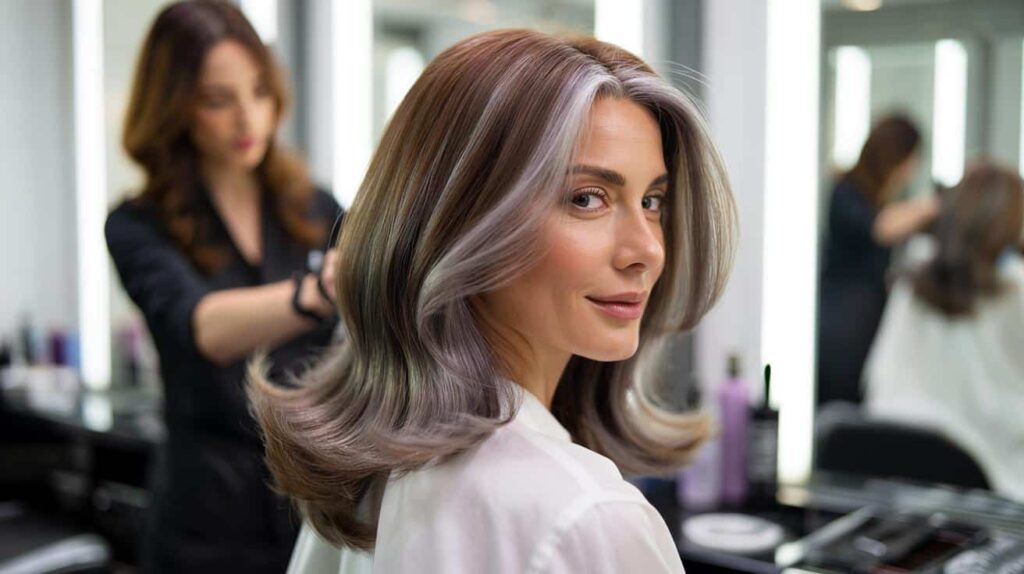
At 8:17 a.m. on a Thursday, under the flat neon lights of a city salon, a woman in her late forties hesitates in front of the mirror. Her balayage, once golden and easy, suddenly feels… off. The gray regrowth at her temples cuts through the soft highlights like a harsh line on a photo that’s been badly edited.
Her colorist leans in, lowers her voice, and says: “We’re not going to do balayage today. We’re going to melt.”

The word hangs in the air, strange and a bit magical. The woman frowns, then smiles, then sighs with relief as the first creamy color touches her roots. She doesn’t know it yet, but she’s about to discover the trend that quietly dethrones balayage for anyone flirting with gray.
 Meteorologists warn this country may face a historic winter as La Niña and the polar vortex align
A coloring technique that doesn’t hide age, just makes it almost disappear.

What “melting” really does to gray hair (and why balayage suddenly looks old-school)
Color melting is the quiet revolution happening between the shampoo basin and the blow-dryer. At first glance, it looks like just another fancy word for highlights. But when you watch a good colorist work, you see something else: the grays don’t vanish, they blur.
Instead of clear lines and strong contrasts like a classic balayage, you get a soft transition from your natural root to the lengths. Think of it as a gradient filter for real life. Grays are still there, but your eye stops obsessing over the root line. You just see dimension, movement, softness. And that slight feeling of, “Wait, did she color her hair, or is she just… lucky?”
Ask around in any busy salon and you’ll hear the same story. Clients in their late thirties and up are arriving with photos of balayage and leaving with something very different. One Paris colorist told me that half her “balayage” appointments end as melting sessions once she sees the gray at the hairline.
She talks about a client named Laura, 43, who came in desperate. Her balayage looked good for three weeks, then suddenly a thick gray band appeared at the roots. “I used to feel fresh when I left the salon,” Laura confessed. “Now I feel like I’m racing my own hair growth.” After switching to melting with two close shades at the root, she quietly stretched her appointments from every five weeks to every eight. No one at work asked if she’d “let her color slip” again.
The logic is simple and almost brutally pragmatic. Balayage relies on contrast: darker roots, lighter lengths. It’s beautiful on hair without too much gray, but contrast is exactly what makes gray roots scream when they grow in.
Color melting uses two or three shades extremely close to your natural base. The colorist overlaps them slightly, blurring the lines so your roots don’t look like a different chapter of your life. Grays get softly tinted instead of fully blocked out. Light still hits the hair, but the eye doesn’t catch a hard frontier between “colored” and “real”. That’s why melting feels more forgiving, more lived-in, and strangely calmer when you look in the mirror on day 27.
How color melting works at the bowl: from formula to gesture
From the technical chair, melting looks almost like painting with watercolors instead of markers. The colorist starts by identifying three things: your natural base, the density of your gray, and where your hair catches the light. Then comes the palette.

Usually there’s a root shade close to your natural color, a slightly lighter tone for the mid-lengths, and a brighter or warmer nuance on the ends. The color is applied in vertical or diagonal sections, then gently blurred with a brush or gloved fingers where the colors meet. No harsh foils with sharp lines. No aggressive bands. *The goal is for the eye to never find where one color stops and another begins.*
The trap many people fall into is asking for “something very different” from their natural color while also wanting their grays to be invisible. That’s like wanting a white shirt that never stains. Possible in photos, exhausting in real life.
With melting, the smartest strategy is subtle. Stay within one or two tones of your base at the root. If you’re naturally medium brown with 30–40% gray, going jet black or platinum will turn every new white hair into a spotlight. Colorists who work a lot with graying hair often say the same thing: the more realistic the starting point, the softer the grow-out. And yes, that can feel less “wow” on day one, but a lot more “oh, nice” on day 40 when you catch yourself in the bathroom at work.
The pros who swear by melting for gray hair repeat the same mantra.
“Color melting isn’t about lying about your age,” explains Sofia, a London-based colorist. “It’s about refusing to let one centimeter of gray control your whole face. We blend it into the story instead of fighting it.”
They often guide clients with simple checks:
- Choose a base shade as close as possible to your natural tone, not your teenage memory of it.
- Ask for soft, warm reflects rather than flat, opaque color that can look like a helmet.
- Keep the brightest pieces away from the root line so the grow-out is gentle, not striped.
- Plan maintenance around your lifestyle, not salon expectations. **Color should adapt to you, not the reverse.**
- Talk honestly about how often you can come back. Let’s be honest: nobody really does this every single day.
Living with melting: less panic, more “good hair day” surprises
What people notice most after switching to melting isn’t day one. It’s day twenty. Or day thirty. That random Tuesday morning when you throw your hair into a loose bun for a Zoom call and realize the root area still looks… soft. Not perfect, but not screaming.
We’ve all been there, that moment when you tilt your head under harsh office lights and suddenly see only the demarcation line between “beauty appointment” and “reality”. Melting doesn’t erase that moment forever, but it delays it, softens it, and sometimes cancels it completely. You catch more “oh, my hair looks nice today” moments without even knowing why.
| Key point | Detail | Value for the reader |
|---|---|---|
| Melting blurs gray regrowth | Uses close shades and overlapping application so roots grow in softly | Fewer “emergency” appointments, less anxiety about visible lines |
| Lower contrast than balayage | Soft gradient from root to lengths instead of dark/light blocks | Grays look integrated, not like a new problem every three weeks |
| Personalized and realistic | Takes into account natural base, gray percentage, lifestyle | Color that feels like you, works with your schedule, and ages gracefully |
FAQ:
- Does color melting completely cover gray hair?Not always. Melting often blends and softens grays rather than erasing them. Your colorist can still use coverage on key areas (like the hairline) while letting some grays become subtle highlights in the rest of the hair.
- Is melting better than balayage for first grays?For many people, yes. Balayage can exaggerate the contrast at the roots once gray appears. Melting keeps things closer to your natural shade, so early grays don’t stand out as much when they grow in.
- How often do I need to redo color melting?Most people go every 8–12 weeks, depending on how fast their hair grows and how much gray they have. Some stretch it further by adding a simple gloss between big appointments to refresh shine and tone.
- Can I do color melting at home?You can soften roots with a box color or root spray, but true melting requires precise blending and multiple shades. For a natural, seamless result, a professional colorist is the safer route, especially with gray.
- Does melting damage hair more than classic coloring?Not necessarily. Because the technique often avoids ultra-lightening at the root and plays with close shades, it can actually be gentler. Ask for nourishing treatments and low-ammonia or ammonia-free formulas if your hair is already fragile.
