
It always happens on the first bright morning after weeks of grey.
The sun finally pushes through the clouds, you pull up the blinds… and instantly regret it.
Fingerprints, vague streaks, that mysterious grey film that seems to appear overnight: suddenly your windows are less “view of the world” and more “dirty screen saver”.
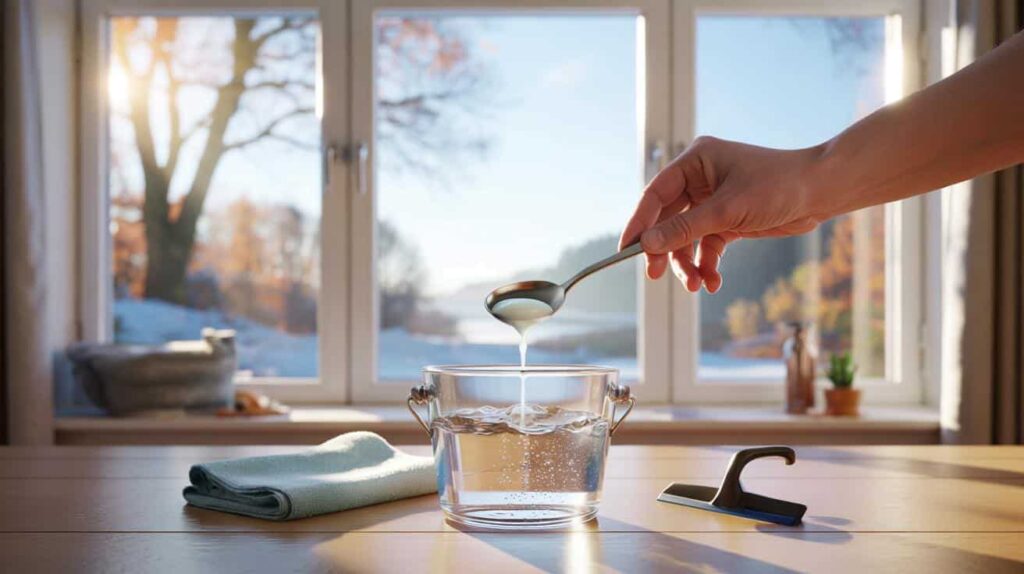
You sigh, grab the bucket, and begin that familiar dance with the squeegee, promising yourself this time they’ll stay clean.
Spoiler: by next week, they look tired again.

Yet some people clean their windows once in late autumn… and swear they stay clear until spring.
All because of a single spoonful of a product you probably already have at home.
Curious? You should be.

The spoonful that changes everything
On a cold November afternoon, I watched my neighbor Sofia lean out of her window with a bucket and a worn-out microfiber cloth.
Nothing unusual there, except she was oddly relaxed for someone about to wash four large bay windows.

She dipped the cloth, wrung it out with slow, practiced gestures, then wiped the glass in wide, lazy arcs.
No frantic rubbing, no squeaking wiper drama, no second bucket.
And yet, when the winter light slid across the glass an hour later, her windows looked almost invisible.
She laughed when I asked her what brand of miracle spray she used.
“It’s not a spray,” she said. “It’s a spoonful.”
Her “secret” was sitting in her kitchen cupboard: plain liquid dish soap.
One single spoonful in a bucket of warm cleaning water, not more.
She had learned it from her grandfather, who cleaned the windows of his small grocery store once before Christmas and then not again until March.
The trick, she explained, is that dish soap doesn’t just dissolve grease.
It leaves a microscopically thin, almost invisible film that helps dust slide off instead of sticking.
Not enough to see or feel, just enough to delay that dull grey layer you know too well.
No lab coat needed to understand it.
Glass is unforgiving, but it also loves balance.
From a basic chemistry angle, dish soap is a surfactant: it breaks the tension between water and oily dirt.
Used in tiny amounts, it loosens grime without leaving the kind of heavy residue some glass sprays do when overused.
Add too much, though, and you get streaks, fingerprints that seem to multiply, and that slightly greasy look in certain lights.
The spoonful rule keeps the mix gentle, wet, and easy to rinse while still leaving that ultra-thin barrier that slows down new dirt.
*The difference isn’t dramatic on day one — it’s on day fifty that you notice you’re still seeing the sky clearly.*
That’s when the method starts to feel less like a cleaning session and more like a smart investment in your own laziness.
Let’s be honest: nobody really does this every single day.
How to use the spoonful trick so your windows last until spring
Here’s how Sofia does it, step by step, twice a year at most.
She fills a bucket with warm, not hot, water — about 5 to 6 liters.
Into that, she adds just one tablespoon of liquid dish soap.
No foamy mountain, no extra “boost”, no random extra squeeze.
She stirs gently with her hand until the water turns slightly cloudy, then dips a clean microfiber cloth or sponge in.

She always starts by quickly wiping the window frame to remove dust and loose dirt.
Then she washes the glass from top to bottom in wide vertical movements, without pressing too hard.
A rubber squeegee or a dry microfiber passes once more from top to bottom and that’s it.
Most people mess up not because their product is “bad”, but because they rush the simple parts.
Cold water, for example, doesn’t dissolve grease well, so you scrub twice as long and still leave traces.
Another classic mistake: pouring in too much soap, thinking more foam equals more power.
What you get instead is a sticky film that catches dust like a magnet.
Same with paper towels on very large windows: they shred, they drink the product, and they leave those little ghost fibers behind that shine in the sun.
There’s also that slightly guilty habit of using the same grey cloth “one last time”.
That old cloth carries old residue, and your glass looks tired before the season has even started.
We’ve all been there, that moment when you step back and your freshly cleaned window already looks… average.
Sofia swears by three golden rules and repeats them to anyone who asks.
She even framed them like a mantra on a sticky note near her cleaning products cupboard.
“The window doesn’t care how hard you scrub, only how clean your water is.”
- Use warm waterIt dissolves grease faster and helps the spoonful of soap spread evenly, so you work less and get fewer streaks.
- Measure the soapOne tablespoon per bucket, not a freehand squeeze. That’s what gives you the invisible film without sticky build-up.
- Finish with a dry clothA clean, dry microfiber at the end polishes away any last drops, so rain slides off more easily in the weeks that follow.
If you live near a busy road or in a city center, she simply repeats the ritual in late autumn and again at the start of spring.
Not every month.
Just when the light changes and your eyes notice everything again.
Why this tiny gesture feels bigger than a cleaning hack
There’s something oddly satisfying about knowing that one five-minute choice in November can change how your home looks until the buds appear on the trees.
A spoonful of dish soap is not exactly glamourous, but it’s the quiet kind of trick that gives you back your Sunday mornings.
You stop dreading the winter sunlight that reveals every spot.
You let the blinds up earlier because the view doesn’t embarrass you.
You may even notice how much more spacious a room feels when the glass is truly clear, not “good enough if you don’t look too closely”.
In a world where everything screams for constant maintenance and never-ending tasks, this little formula stands out.
A bucket, warm water, a measured spoonful, and ten calm minutes.
Some households pass this down like a recipe; others discover it by accident and never go back.
Maybe you’ll be the one who tells a friend, “Try just one spoonful this time — then look at your windows in March.”
| Key point | Detail | Value for the reader |
|---|---|---|
| Single spoonful of dish soap | About one tablespoon in a bucket of warm water | Extends the time between full window cleanings |
| Simple method | Wash top to bottom, finish with a dry microfiber | Reduces streaks and keeps glass clearer longer |
| Avoid excess product | Too much soap leaves sticky residue that attracts dirt | Windows stay clean closer to spring instead of weeks |
FAQ:
- Question 1Can I use any kind of dish soap for this trick?Yes, most regular, unscented or lightly scented liquid dish soaps work. Super-concentrated or “lotion” versions can leave more residue, so use an even smaller spoonful if your soap is very thick.
- Question 2Will this method work on very dirty or neglected windows?Yes, but you may need a first “deep clean” with slightly stronger dilution or a second pass. After that, the spoonful mix is enough to maintain clarity over the colder months.
- Question 3Is this safe for wooden or painted window frames?Used with a well-wrung cloth and not left soaking, the diluted soap is generally gentle on frames. Always dry the frames afterwards if they are old or fragile.
- Question 4Can I use this spoonful method on mirrors and glass doors too?Absolutely. The same proportion works for mirrors, balcony doors, and shower screens — just dry them well to avoid any water spots.
- Question 5How often do I need to repeat the process in winter?In a quiet area, many people manage with just one big clean before winter and one in early spring. In polluted or coastal areas, plan on every 6–8 weeks for similar results.
