
At 11:57 a.m. in Shenzhen, the street-level delivery rush is already chaos. Scooters weave between cars, insulated bags stacked like Tetris blocks. But inside a 70-story glass tower, the real race is vertical. An elevator opens on the 63rd floor and a young guy in a blue jacket steps out, slightly out of breath, phone buzzing in his hand. He’s not just any courier. His whole job is to live between floors 40 and 80, riding elevators like a miner of the clouds, handing boxed noodles to people who practically never touch the ground.
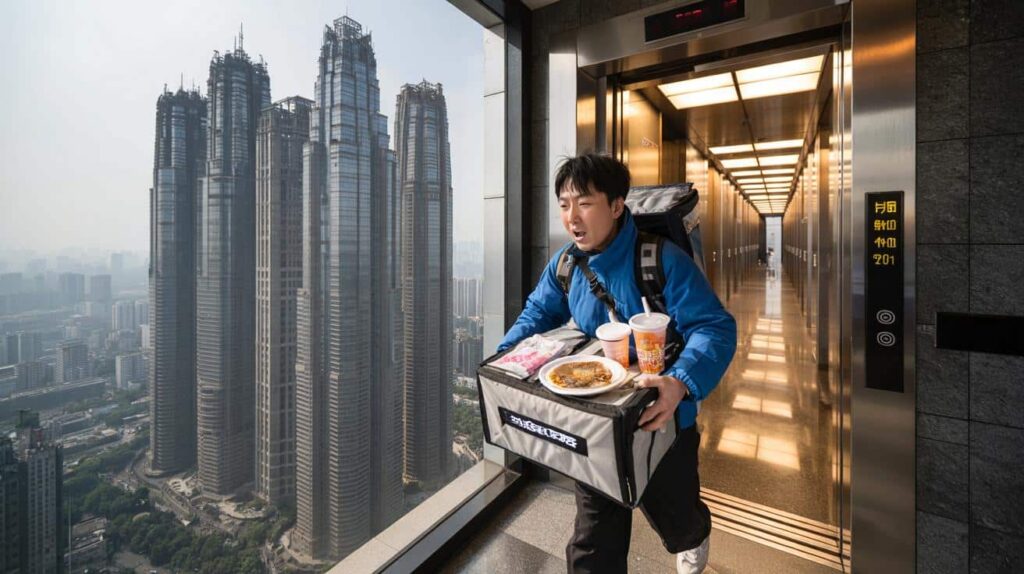
The building is a world. Supermarket in the basement, clinic on level 5, shared offices, co-living, gyms, kindergartens. Thousands of people stacked in the sky. And somewhere between the lobby and the penthouse, a strange, very modern job has appeared.

Someone has to carry lunch all the way up.

When skyscrapers become small vertical cities
Stand at the foot of some Chinese towers and your neck starts to hurt. In Chongqing, Guangzhou, Shanghai, they don’t just build tall anymore. They build thick, dense, and packed with life. These are vertical neighborhoods with their own rhythms and smells. Hotpot steam on level 3, printer ink on level 29, perfume and coffee at the top.

From the street, you just see glass and steel. Inside, delivery apps ping nonstop, people order milk tea from their desks and late-night congee from their beds. The demand doesn’t stop at the lobby. It climbs, floor by floor.
The classic delivery driver on an electric scooter can only go so far. He can drop the food at the entrance, maybe at the security desk. But when you have 80 floors, six elevator banks, face-scan gates, and corridors that all look the same, that last 300 meters can take longer than the whole ride across town. That’s where a new character appears: the “building runner”, specialized in one tower or one complex.
Take Chengdu’s huge residential compound Tianfu New District. Local media filmed young runners who spend their entire shift inside the same three towers. Their app assigns them orders not by street, but by floor range. 41–50, 51–60. They know every elevator trick, every shortcut through the fire stairs, and which security guards are in a bad mood that week.
There’s a simple economic logic behind this strange specialization. Elevators are bottlenecks. One delayed lift, a lunch rush, and your hot noodles turn into a lukewarm complaint. Platforms like Meituan and Ele.me are obsessed with those last minutes that decide ratings. So they created ultra-local jobs, splitting the old “one person does everything” model into two: the rider of the streets and the climber of the towers.
These vertical couriers cost less distance money, but add massive time savings. A building runner can complete dozens of short up-and-down trips in the time one mixed-role courier would spend getting lost in the labyrinth of levels.
How vertical delivery actually works inside a Chinese mega-tower
On the screen, it seems simple: tap, order, wait. On the inside, the system is a tiny choreography. Downstairs, a traditional courier rushes in, phone already open to the order number. At a small handover counter, he drops the plastic bag into a heated locker or passes it to a building runner. The timer doesn’t stop. The responsibility just transfers.
The runner scans the QR code, the app assigns a floor, and the race turns vertical. He scans his face or a temporary code to unlock the elevator area. On busy days, they group orders by “elevator trip”, trying to deliver three or four meals in one ascent, sometimes balancing drinks with one hand and tapping the floor button with an elbow.
There’s a phrase they use half-jokingly in some of these complexes: “We live on level 50, but our legs live on level 1.” One Guangzhou runner told a local reporter about his record: 200 orders in a single building during a rainy-day promotion. He walked the equivalent of a half-marathon without ever stepping outside, just pacing between elevator banks and doorbells.
He remembers one client on the 72nd floor who ordered bubble tea three times a day for a week, never once coming down to the lobby. The guy worked in tech, slept in the same building, lifted weights in the gym on level 6, and claimed he “had no reason to touch the street”. The runner laughed when he said it, but the laugh had an edge. “If the elevator breaks, half this building panics,” he added.
 This old-school moisturizer, not from big brands, is now ranked number one by dermatology experts
Behind the anecdote, you can feel how architecture rewires habits. When everything you need is stacked vertically around you, the ground starts to feel almost optional. Delivery apps just push this logic to its limit. They turn each door into an endpoint in a massive digital map and assign human legs to cover the gaps the system can’t automate yet.
*Skyscrapers used to symbolize aspiration; now they also create very literal delivery routes in the sky.*
The human tricks that keep meals hot… 70 floors up
Spend a morning following a vertical courier and you quickly see they run on instinct more than GPS. The first trick is timing. They learn which towers clog around noon, which office floors empty out at 6 p.m., which elevators always skip mid-levels when full. A good runner orders his stops almost like a bus driver planning a route, starting with the furthest floor and riding gravity on the way down.
They also develop a strange mental map of doors. Marble walls, identical carpets, same numbers. Yet they’ll tell you, “Oh, 5803? That’s the one with the plant in the corridor. Nice dog, always barks twice.”
And of course, mistakes happen. Wrong tower entrance, misread floor, elevator that decides to stop on every level when you’re already late. We’ve all been there, that moment when hunger meets delay and patience runs out. For the runner, that’s the worst part of the job: pressing a doorbell, already knowing the customer is annoyed about something that started 20 minutes earlier and 3 kilometers away.
So they adapt. They call ahead when they sense a wait. They add tiny courtesies: a “sorry, elevator jam today” or a quick smile. Let’s be honest: nobody really reads every push notification or tracks the rider dot on the map every single day. It’s the face at the door that carries the blame or the gratitude.
Some of them talk about their job with a simple, grounded pride that cuts through the glossy tech narrative.
“I’m not changing the world,” one runner in Shenzhen told a vlogger, “I’m just the guy who climbs so other people don’t have to. But when I see someone on a night shift, exhausted, and I hand them hot food, that feels like something real.”
To survive in these vertical mazes, they share informal “rules of the tower”:
- Always memorize at least one staircase route in case of elevator failure.
- Group orders by elevator bank, not just by floor.
- Carry napkins and spare straws – people forget, but they complain loudly.
- Never argue at the security gate; you’ll lose precious minutes every day.
- Protect your knees: compression sleeves and good shoes are not optional.
What these sky couriers say about how we live now
Once you notice them, you start to see vertical couriers as tiny indicators of a bigger shift. They’re not just moving food; they’re filling the gap between digital comfort and physical reality. Every “deliver to door” tickbox, every tower that seals its lobby behind gated access, quietly generates more of this hidden labor in the stairwells.
In a way, these skyscrapers are honest about our trade-offs. We accept longer elevator waits so we can stack more people in prime land. We accept invisible workers zigzagging through corridors so we can finish a meeting, a spreadsheet, or a video call without walking down 40 floors.
| Key point | Detail | Value for the reader |
|---|---|---|
| Vertical cities reshape work | New roles like building runners appear inside mega-towers | Helps you see how architecture quietly creates or erases jobs |
| Last meters matter | The hardest part of delivery is often from lobby to door | Explains why delays happen even when the restaurant is nearby |
| Hidden systems support daily comfort | Elevators, access controls, and human couriers interlock | Invites you to notice – and maybe value – the people behind each “order delivered” |
FAQ:
- Are vertical delivery couriers officially recognized jobs in China?Often they’re subcontracted through major platforms like Meituan or Ele.me, or hired by property management as “internal logistics” staff dedicated to a specific complex.
- Do they earn more than regular street-level couriers?Not always. They usually get paid per order with small bonuses at peak times. The work can be steadier in dense towers but also physically tougher on legs and knees.
- Why don’t buildings just use robots or delivery lockers on each floor?Some high-end towers test robots and smart lockers, yet access control, elevator complexity, and the need for flexibility still favor human couriers in many places.
- Is this kind of vertical city life common everywhere in China?It’s mostly concentrated in big urban centers like Shenzhen, Shanghai, Guangzhou, Chongqing, and parts of Chengdu, where land is scarce and towers are designed as mixed-use ecosystems.
- Could this model spread to other countries?Yes, especially in cities with booming high-rise districts. As more people live and work in tall, mixed-use buildings, the need for specialized “last-vertical-meter” delivery jobs is likely to grow.
