
The woman in the salon chair doesn’t look up when the hairdresser says, a bit too cheerfully, “So… lots of silver coming through here.”
She stares at her reflection instead, at the fine white roots cutting a clean line through what was once a perfect balayage. The foils, the three-hour appointments, the bills that quietly creep past the grocery budget — all for a color that barely survives six weeks.
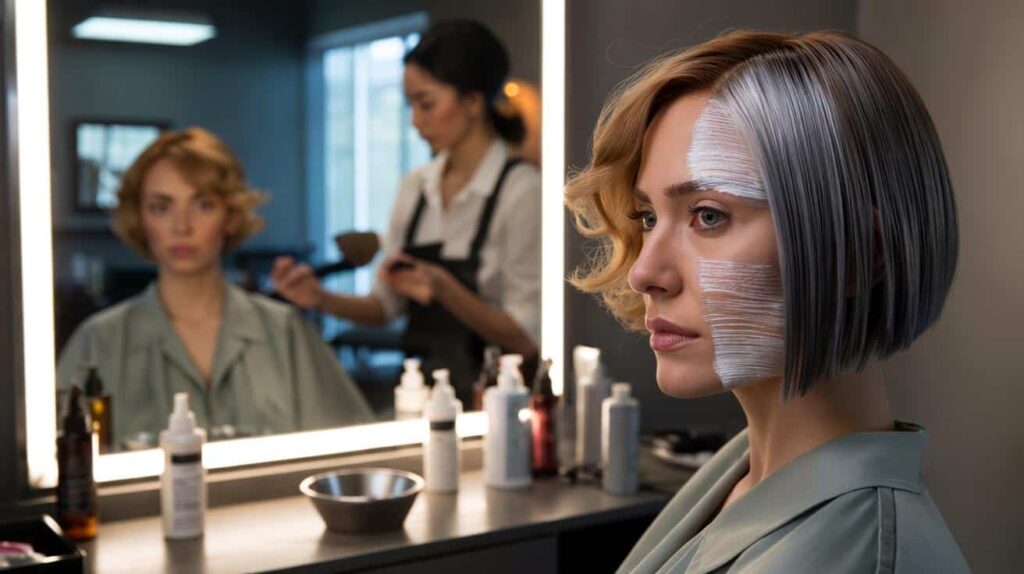
Her phone buzzes on her lap. A friend’s message: “You HAVE to see this. Permanent grey, no upkeep.”
She taps the link, and suddenly the screen fills with photos of women who’ve ditched the highlights and gone all-in on metallic, uniform grey — some calling it a miracle, others calling it madness.

Somewhere between those two words, a quiet revolution is starting.
 This old-school moisturizer, not from big brands, is now ranked number one by dermatology experts
From trendy balayage to bold permanent grey: what’s really going on?
Walk through any big-city salon on a Saturday and you’ll still see rows of women under foil, chasing that soft, filtered-on-Instagram balayage.
But discreetly, in the back rooms and private DMs, something else is happening: people are booking “full grey conversion” appointments. Not a few silver streaks. Not a graceful grow-out. A deliberate, permanent turn to grey — often a uniform slate, steel, or icy tone from roots to ends.

Stylists say the same sentence is heard again and again: “I’m tired.”
Tired of chasing youth. Tired of four-week root touch-ups. Tired of pretending those white hairs at the temples aren’t real.
Grey used to be a defeat. Now some women want it to be a statement.
On TikTok, the hashtag #goinggrey has racked up hundreds of millions of views.
In that scroll, you’ll find everything: corporate lawyers revealing freshly dyed gunmetal bobs, 30-somethings showing “before and after” from box dye chaos to tailored silver, grandmothers with ultra-chic chrome pixies.
One viral clip shows a French teacher in her forties who had been doing balayage for a decade. Her video opens on the classic scene: faded caramel lengths, sharp white root line, calendar reminder for another €180 session.
Cut to the next frame: she walks out of a salon with a cool, uniform grey, almost like polished steel. The caption reads: “Goodbye balayage, hello freedom. No more hiding.”
Her comments section is a war zone.
Fans shout “ICONIC” and “This is the future!” while others warn, “You’re crazy to put that much chemical on your scalp” and “You’ll regret this in five years.”
What’s driving this shift is both simple and messy. On one side, there’s the fatigue of upkeep and the cost of painted youth. On the other, there’s a real, grounded fear: long, repeated exposure to strong dyes and bleaches, especially for a color some brands market as “permanent grey”.
Grey conversion isn’t just a rinse. It often means heavy lightening of the whole head, sometimes multiple rounds, then toning with pigment designed to hold. The process can last six hours or more, and the formulas can include ammonia, peroxides, and a hit of metals or direct dyes.
Fans say, “One big jump, and I’m done with monthly color,” which feels like magic.
Critics look at the ingredient list and call it a health gamble you don’t fully see until years later.
How permanent grey really works (and how to avoid the biggest traps)
The promise sounds seductive: one radical appointment, one uniform grey tone, and then… peace. No more chasing roots, no more balayage “refresh”.
In practice, the path is much more technical. Most people don’t turn a clean, shimmering grey by themselves. Natural grey grows in patchy, with white around the temples, darker patches in the back, and leftover pigment hanging on for dear life through the lengths.
So stylists start by stripping. They lighten the hair to pale yellow or even near-white, depending on the starting color.
Then comes the toner or direct dye that deposits that cool, metallic grey. Some salon brands call it “permanent”, but many pros quietly admit it behaves more like a long-lasting stain that still fades, especially on porous hair.
The “miracle” feeling comes from seeing the real you, but edited — a curated, uniform version of nature.
One colorist in London tells a story that repeats almost word for word in different cities.
A client, mid-fifties, arrives with perfect honey balayage and a calendar reminder every five weeks. On paper, her hair is “goals”. In reality, she’s quietly panicking at each new cluster of white at the parting line.
They spend seven hours in the chair. Step one: remove years of warm pigment. Step two: rebuild structure with bond protectors. Step three: apply a cool smoke-grey formula that finally matches her fast-growing natural roots.
When she sees herself, she cries — not from sadness, but from a strange mix of relief and shock. “I look like me,” she whispers, “but also like my mother.”
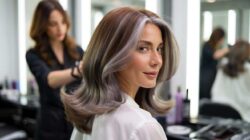 Goodbye balayage: “melting,” the new coloring technique that makes gray hair almost unnoticeable
The video clip of that transformation got millions of views. Brands jumped on it to sell “permanent grey kits”.
That’s where things get murkier.
From a biological point of view, hair that’s going grey is already changing. The follicles produce less melanin, the fiber can be drier, more fragile, and sometimes more resistant to color. Grey conversion has to wrestle with that.
Stronger formulas, longer processing times, repeated bleaching sessions — all of that adds up. Scalp irritation, breakage, allergic reactions, even delayed sensitivities to ingredients like PPD (paraphenylenediamine) are not rare stories in dermatologist waiting rooms.
Critics aren’t being dramatic when they talk about a health gamble. No, one color session won’t ruin your future. But a pattern of intense chemical exposure over years, on a scalp with micro-irritations and a body that’s already dealing with pollution, stress, and hormones? That’s a different equation.
Let’s be honest: nobody really reads the full leaflet in a home dye kit every single time.
Doing grey on your own terms: smart steps, red flags, and real talk
If the idea of saying goodbye to balayage and hello to grey is tugging at you, the most practical step isn’t buying a box. It’s slowing down.
Start with a consultation, not a color. A real one. A stylist or colorist who understands grey transitions will ask for your hair history, your allergies, your budget, even your patience level. They may suggest a slower path: blending lowlights, softening the contrast between roots and lengths, then gradually cooling your overall tone.
One precise method many pros use: a “grey blending” technique. They add ultra-fine highlights and lowlights in ashy shades close to your natural base, then tone everything cooler.
You don’t jump to full metal silver overnight, but the root line stops screaming.
This phased approach uses fewer aggressive steps and gives your scalp time to speak up if something doesn’t agree with it.
The biggest trap is the all-or-nothing leap with no plan B. You see a magical before/after online, order a harsh lightener, and spend Saturday in your bathroom chasing a result that took a pro eight hours, three products, and twenty years of training.
We’ve all been there, that moment when you think, “How hard can it be?”
Grey is unforgiving when it goes wrong: it can grab patchy, fade to greenish, or simply leave your hair feeling like wet cotton. The emotional hangover of a bad color is real, especially if it’s tangled up with ageing and identity.
A softer approach is to treat grey as an experiment instead of a life sentence. Semi-permanent toners, low-volume developers, strand tests done days before the big change — these aren’t just fussy steps. They’re what separates a controlled risk from a blind dive. *Going slow is not the enemy of courage.*
“Grey is not a trend color, it’s a life color,” says one Paris-based colorist who now refuses to do full grey conversions in a single session. “When you alter it, you’re not just shifting shade. You’re rewriting the story your hair tells about you. That deserves more than a quick viral transformation.”
- Ask for a patch test at least 48 hours before any major color, especially if you’ve never reacted to dye before. Sensitivities can develop over time.
- Start with a grey-blending strategy rather than full coverage. This keeps options open if you change your mind.
- Schedule “rest” months between heavy chemical services so your scalp and hair can recover and you can monitor any delayed reactions.
- Invest in gentle, sulfate-free care and UV protection for your new grey. The more fragile the fiber, the less harsh cleansing it can handle.
- Have an honest talk about maintenance: even so-called “permanent grey” needs toning or glossing. True zero-upkeep is a myth.
The quiet question under the trend: what are we really chasing?
The permanent grey wave is not just a color story. It’s a mirror held up to our fear of ageing and our exhaustion with pretending. Fans call it a miracle because, for once, the outside matches the inside: yes, I have grey, and yes, I chose it. Critics see the same process and ask why we need this much chemistry to accept something that would happen naturally if we simply waited.
Between those two positions lies a messy reality. Some women feel powerful with chrome hair and swear their self-esteem finally caught up with their reflection. Others try it, hate it, and crawl back to balayage with a fresh sense of what comfort looks like for them. Neither side is wrong.
The plain-truth sentence no brand puts on the box is this: there’s no morally superior hair color. There’s only what lets you move through your life with less noise in your head.
Maybe that’s uniform, high-impact grey. Maybe it’s soft, lived-in balayage you’re not ready to leave behind.
The real revolution isn’t the shade. It’s giving yourself permission to change your mind, to ask harder questions about what touches your scalp, and to talk openly about the cost — emotional and chemical — of chasing a look. The next time you catch your reflection and see those silver threads, the biggest decision might not be “dye or don’t dye” but “how much of this story do I want to rewrite, and at what price?”
| Key point | Detail | Value for the reader |
|---|---|---|
| Grey conversion is a process | Often involves full-head lightening, toning, and several hours in the chair | Sets realistic expectations about time, cost, and hair impact |
| Chemical exposure has trade-offs | Strong dyes and bleaches can irritate scalp, weaken hair, and cause sensitivities over time | Helps weigh the “miracle” effect against potential long-term health risks |
| Slow transitions are safer | Grey blending, patch tests, and rest periods between services | Offers a safer, more flexible path to embracing grey without drastic damage |
FAQ:
- Question 1Is “permanent grey” really permanent?
- Answer 1Most so-called permanent grey colors fade over time, especially on porous or heavily lightened hair. The base lightening is permanent, but the grey tone usually needs refreshing with glosses or toners every few weeks to months.
- Question 2Is going fully grey in one session dangerous for my hair?
- Answer 2It can be very aggressive. Multiple rounds of bleaching in a single day increase the risk of breakage, dryness, and scalp irritation. Hair with previous color, keratin, or damage is especially vulnerable, which is why many pros recommend multi-step transitions.
- Question 3Can I get a grey conversion safely at home?
- Answer 3Home kits rarely offer the control a pro has over lightening and toning. Uneven lift, unexpected tones, and chemical burns are real risks. If you want to experiment at home, start with temporary grey toners on already light hair, not full-on bleaching.
- Question 4What if I go grey and hate it?
- Answer 4You’re not stuck, but reversing a grey conversion can be complex. Warmth often returns unevenly, and more chemical work is needed to re-pigment the hair. A stylist can create a softer in-between color (like smoky beige) while your natural hair grows.
- Question 5Is staying with balayage “safer” than going permanent grey?
- Answer 5Both involve chemicals; the difference is frequency and intensity. Regular balayage means repeated but often localized lightening. A one-time grey conversion might be more intense but less frequent. The safest route is a customized plan that keeps both your scalp and lifestyle in mind.
