
The drill bit squeals like an angry violin as it bites into Antarctic ice that hasn’t seen sunlight since our ancestors were small, nervous mammals hiding from dinosaurs. The wind tears at the tents, a constant white roar, while a small group of researchers squint at screens inside a heated container that smells of coffee, metal, and old socks. Outside, the ice sheet looks empty, endless, almost boring. Beneath their boots lies something that hasn’t breathed our air for 34 million years.
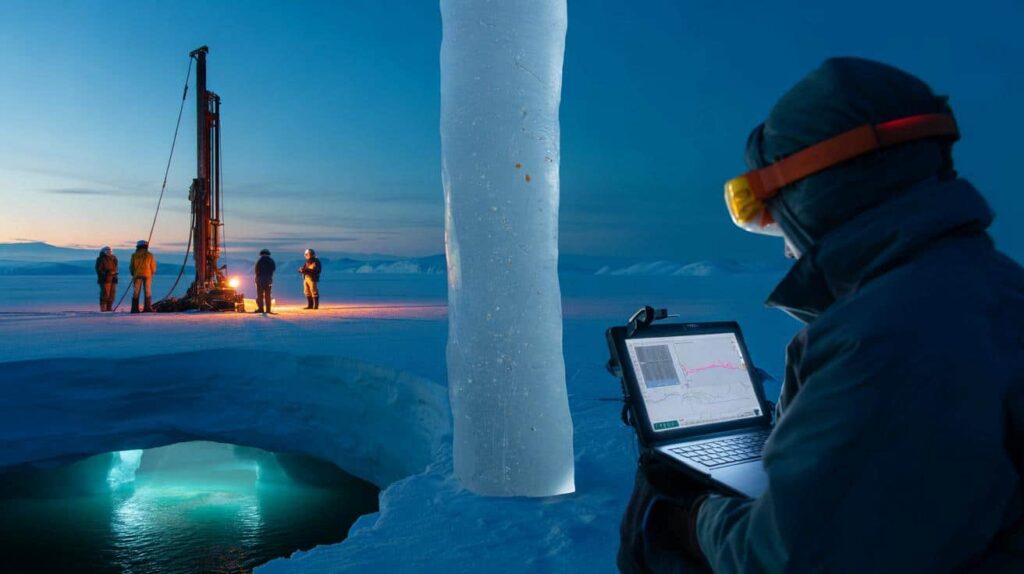
Nobody really knows what will come up with the melting ice.
 Turning the heating down when you go out: experts reveal the trap that wrecks comfort and savings
The day we realized Antarctica wasn’t just frozen emptiness
For most of us, Antarctica lives in our heads as an endless postcard of white. Penguins, blue cracks in the ice, maybe a research base from a movie. Then a radar screen lights up, and that blank space suddenly looks crowded. Under several kilometers of ice, scientists have mapped entire networks of dark lakes and winding rivers, some as big as European countries, sealed away since before humans existed.

When the first data from these deep surveys came back, people in the lab just stared. The ice sheet wasn’t a lid on a dead world. It was a roof.
 Meteorologists warn early February may bring an Arctic disruption outside historical norms
The big turning point came with Lake Vostok, a body of water the size of Lake Ontario buried under more than 3,700 meters of ice. Russian teams spent decades drilling toward it, battling broken equipment, brutal winters, and international worry about contamination. When they finally reached the lake in the early 2010s, the world held its breath.
The first samples were messy, partially contaminated by drilling fluid, and sparked arguments from New York to Moscow. Some labs reported strange microbial DNA, others called it noise. That messy, imperfect first contact with a hidden world raised a sharper question: were we exploring responsibly, or trampling through a prehistoric nature reserve with ice drills and diesel?
Since then, American and European teams have gone after other buried lakes with cleaner, hot-water drilling systems, sterilized hoses, and protocols that look more like space missions than field geology. They’ve found living microbes, clumps of cells adapted to crushing pressure, total darkness, and water hovering just below freezing.
These organisms have been evolving on their own path since long before humans, cities, agriculture, even apes. **That’s exactly why some researchers are both thrilled and terrified.** To reach these ecosystems, we have to melt tiny doors into their prison of ice. The question hanging over every expedition is simple and uncomfortable: what else escapes through that door with the water sample?
The thin line between scientific curiosity and playing microbial roulette
In the cleanest Antarctic labs, the routine before touching a core of ancient ice looks borderline obsessive. Boots scrubbed. Gloves doubled. Surfaces blasted with UV and bleach. Instruments baked, boiled, or autoclaved until there’s no reasonable way anything alive could cling on. Then, under hoods that hiss like quiet snakes, scientists crack open the ice and wait for the first drops of meltwater to appear.
The goal is always the same: get a glimpse of that hidden ecosystem without introducing a single modern microbe, and without giving ancient ones a free ticket into our world.
The harder truth: we’re not perfect at this. A drill bit can pick up bacteria from the surface, a tiny leak can let dust in, a mislabeled tube can throw a whole analysis into doubt. We’ve all been there, that moment when a careful plan bumps into real life and something slips.
Some experts argue that as drilling technology gets better, the risk becomes tiny, statistical, something we can manage with enough testing and protocols. Others look at the same numbers and shake their heads. One spilled bottle, one overlooked crack in a hose, and 34‑million‑year‑old microbes could be mixing with meltwater, boots, or transport planes headed north. *That’s the image that keeps a few people awake at 3 a.m.*
The fear isn’t based on sci‑fi alone. Modern pathogens have escaped sealed labs before, even in high-security facilities. It’s rare, but it happens. And those are microbes we already know, that our immune systems at least recognize. With Antarctic subglacial life, we’re talking about organisms that have never seen human cells, never tasted modern oxygen levels, never met our viruses or we theirs.
Some microbiologists believe **most of these creatures would simply die on contact with our world**, unable to cope with our temperatures, chemistry, or UV. Others counter that all life is strangely adaptable, and that the very fact these microbes survived in such extremes means we shouldn’t underestimate them. Scientific progress is hungry, restless, always wanting the next sample, the next genome. Safety, by nature, is slow and suspicious. Between those two instincts, policy is struggling to keep up.
How to explore the deep past without creating tomorrow’s problem
The teams trying to drill responsibly into these lakes borrow a lot from space agencies. They talk about “planetary protection” even though they’re still on Earth. Before any expedition, they map risk like cartographers: where does meltwater flow, what paths could microbes take, how can they trap every liter they disturb.
Some projects now use closed‑loop hot‑water drilling, where water used to melt the tunnel is filtered, UV‑treated, heated again, and never touches the environment twice. Every drop of lake water they bring up is kept in sealed systems, processed in negative‑pressure labs, tracked with a level of paranoia that would make airport security look relaxed.
Yet even with all this, there’s an unspoken guilt that sometimes hangs in the air. Scientists are human; they feel the pull of discovery as strongly as the rest of us feel the pull of a glowing notification on our phone. There’s pressure from funding agencies, from universities, from the quiet competition of who publishes first.
Let’s be honest: nobody really follows every safety protocol every single moment of every season without ever cutting a tiny corner. That’s not a moral failure, it’s just how people function in blowing snow at ‑30°C after three nights of little sleep. The ethical weight of “what if we wake something we can’t put back” sits on top of all that messiness. And not everyone in the field agrees on how much risk is acceptable.
Some researchers argue that pausing deep drilling until we strengthen global biosecurity rules is the smarter move. “We’re standing on the shore of a biological time machine,” one polar microbiologist told me. “The adult move might be to slow down, not jump in head‑first because we’re curious.” Others respond that delaying too long could mean losing critical clues about climate history and evolution as warming ice sheets start to crumble on their own.
- Stricter contamination standards for all Antarctic drilling projects
- Shared global databases tracking every subglacial sample and its handling
- Independent safety panels with power to halt risky missions
- Clear rules on what can and cannot be grown from ancient microbes
- Public transparency reports so this doesn’t happen in the dark
The story under the ice is also a mirror of us
Standing on that frozen plateau, it’s easy to feel that nothing we do could possibly matter to something buried under kilometers of ice. Then the drill stops, someone opens a valve, and a thin stream of water older than every city on Earth slides into a waiting bottle. On the screen, sensors start to flicker with temperature, chemistry, maybe even signs of metabolism.
The Antarctic subglacial world isn’t just a treasure chest of data or a potential source of new antibiotics or enzymes. It’s a test of how we behave when faced with pure, dazzling curiosity and a non‑zero risk that we will regret our impatience decades from now.
As ice melts at the edges of the continent, some of those hidden waters may one day surface naturally, with or without us. That doesn’t automatically excuse racing to poke holes in the roof. The real question is whether we can learn to treat deep time as something other than a resource to extract.
If you were handed a locked diary written 34 million years ago, would you rip it open or spend a moment deciding what kind of reader you want to be? Antarctic microbes can’t vote, can’t lobby, can’t write warnings in our language. The decision about waking them—or leaving them to their quiet, ancient darkness—sits squarely with us, in this short, noisy moment of human history.
| Key point | Detail | Value for the reader |
|---|---|---|
| Hidden ecosystems under Antarctic ice | Networks of lakes and rivers sealed for up to 34 million years host unique microbial life | Offers a vivid sense of how much of Earth’s story is still untold beneath “empty” places |
| Scientific promise vs. biosecurity risk | Drilling can reveal climate history and new biology, while carrying a small but real chance of releasing unknown microbes | Helps readers weigh the trade‑off between progress and precaution in a concrete, relatable way |
| Need for stronger ethical rules | Calls for stricter protocols, transparency, and independent oversight of subglacial research | Invites readers to see polar science as a shared responsibility, not a remote technical issue |
FAQ:
- Question 1Could ancient Antarctic microbes really cause a new pandemic?Most experts think the odds are low, because these organisms evolved in extreme, isolated conditions and may not survive in our world. The concern isn’t just a Hollywood‑style outbreak, but unpredictable interactions with modern ecosystems, including our own microbiomes.
- Question 2Why do scientists want to access these buried lakes at all?They hold records of past climate, evolution, and geology locked in their water and sediments. Studying them could sharpen our forecasts of sea‑level rise, reveal new biochemical tricks, and even guide the search for life on icy moons like Europa.
- Question 3How do researchers try to prevent contamination?They use sterilized equipment, closed‑loop hot‑water drilling, filtered and UV‑treated fluids, and strict clean‑lab protocols. Many projects are reviewed under guidelines inspired by planetary protection rules used for Mars missions.
- Question 4Are there international rules about this kind of research?The Antarctic Treaty System sets broad environmental protection principles, and scientific committees issue recommendations, but binding, detailed biosecurity rules for subglacial drilling are still patchy and evolving.
- Question 5Could climate change expose these ecosystems even without drilling?Yes, as ice sheets thin and retreat, some subglacial waters may eventually reach the ocean or surface melt zones. That’s one more reason some scientists argue we should study them now, while others say that rising risk is exactly why we should slow down and plan more carefully.
