
On a quiet summer night, I was standing on a balcony in a small coastal town, watching the sea breathe in and out. The tide had just turned, leaving a shining band of wet sand that reflected the Moon like a tilted mirror. A couple walked along the shore, stepping over stranded seaweed and tiny pools where crabs hid from the receding water. The Moon hung low, bright and familiar, like it had always been and always would be.
Then a scientist friend beside me said, almost casually: “You know it’s leaving us, right?”
I laughed, thinking it was a joke.
But he was serious. The Moon is slowly drifting away. With every millimeter of distance, our days stretch a little longer, our tides lose a bit of their punch. You don’t feel it tonight. You won’t feel it tomorrow.
Yet the clock is quietly being rewritten above our heads.
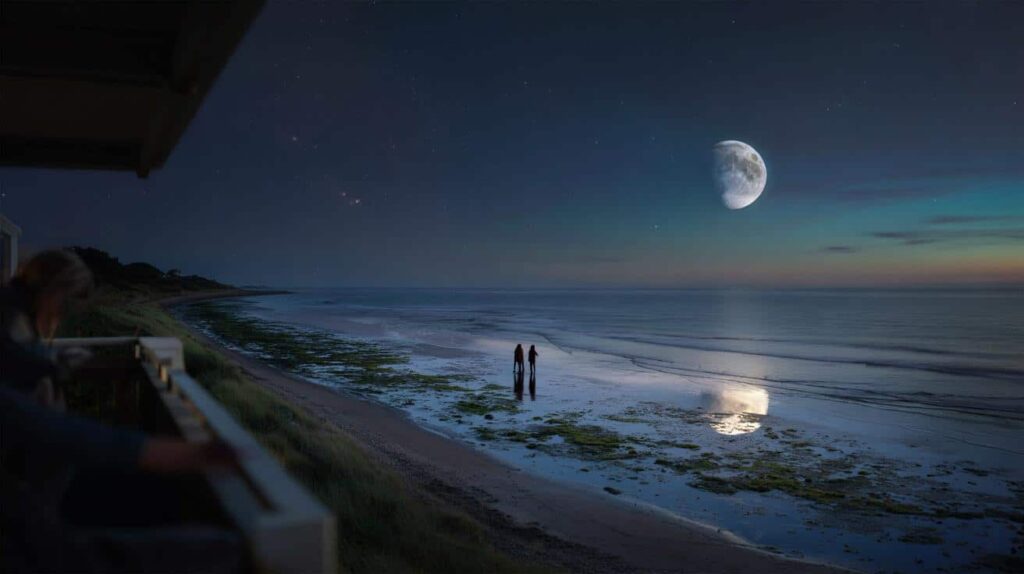
The Moon is sneaking away, one tiny step at a time
We tend to imagine the sky as frozen, like a painted ceiling over our heads. The Moon, especially, feels fixed: same size, same path, same calm presence in the night. Reality is less static and much stranger. The Moon is slipping away from Earth at about 3.8 centimeters per year. That’s roughly the speed your fingernails grow, only stretched across 384,000 kilometers of emptiness.
We don’t see it moving. No alarm goes off. Nothing in your daily routine changes this week or this year.
But that tiny drift is stacking up, day after day, century after century.

If you want proof this isn’t just a poetic idea, look at what Apollo astronauts left behind. On the Moon, some missions placed small reflectors, like crystal cat’s eyes. On Earth, scientists fire laser beams at these reflectors and measure the time it takes the light to return. That delay tells them the distance to the Moon with mind-bending precision.
Comparing measurements over decades, they saw the numbers creep upward. No big jumps, no drama. Just a steady, stubborn increase.
Geologists also read the story in rocks. Ancient coral fossils and sediment patterns show that hundreds of millions of years ago, days on Earth were shorter, and the tides stronger. The Moon was closer, and the planet’s daily rhythm beat faster.

The core of the story is this: Earth and the Moon are locked in a slow, gravitational negotiation. As our planet spins, its oceans bulge toward the Moon, creating tides that are slightly misaligned with the straight Earth–Moon line. That misalignment acts like a brake on Earth’s rotation, pulling on the Moon and giving it a tiny push outward.
Energy doesn’t vanish; it moves. The Earth loses rotational energy, so our days lengthen by a fraction of a second over long spans of time. The Moon gains orbital energy and climbs into a higher orbit.
The result is subtle but relentless: longer days, gentler tides, greater distance.

How longer days and softer tides touch life on Earth
So what does a creeping, microscopic change like this mean for us down here, trying to get kids to school on time or catch a train? On a human scale, almost nothing changes, and that’s the strange beauty of it. Days are lengthening by about 1.7 milliseconds every century. You will never wake up and suddenly have a 25‑hour day.
Yet stretched across Earth’s long history, this effect rewires the basic tempo of life. Billions of years ago, a day lasted closer to 6 hours. Sunrises and sunsets came in quick succession, like a planet living on fast-forward.
Every extra minute we’ve gained has quietly shaped the rhythms of sleep, migration, and the opening of flowers.
Think of coastal life, the communities that literally live between high tide and low tide. In places like the Bay of Fundy in Canada or Mont-Saint-Michel in France, tides still rise and fall with dramatic height differences. Fishermen read these tides the way traders read stock charts, planning their days around the ocean’s mood.
Now imagine rolling the clock back 900 million years. Researchers using ancient rock layers estimate there were around 420 days in a year then, meaning each day was just over 20 hours long. Tides from a closer Moon would have been even more powerful, larger, and more frequent. The entire schedule of coastal ecosystems would have been different.
Today’s gentler tides are part of a long, slow calming of the planet’s pulse.
The softening of tides isn’t just a curiosity for oceanographers. Stronger tides mean more mixing between deep and surface waters, stirring up nutrients and oxygen. Weaker tides, over vast time scales, could change how oceans circulate and how heat is moved around the globe. That quietly affects weather, climate, and the habitats where marine life can thrive.
There’s a feedback loop at play. As the Moon moves away and tides weaken, the braking effect on Earth’s rotation also changes. The system constantly adjusts, like a spinning top wobbling, then finding a new balance.
*This is planetary mechanics as slow drama: no explosions, no apocalyptic scenes, just a constant reshuffling of energy that will echo far beyond our species’ lifetime.*
Living with a drifting Moon: how to relate to something so slow
When faced with these cosmic timescales, a practical question sneaks in: what can we actually do with this knowledge? One answer is surprisingly down-to-earth. We can start by paying more deliberate attention to our own cycles of time. The Moon’s phases still organise fishing calendars, religious holidays, planting seasons, and even how some of us sleep.
A simple gesture is to track the Moon for a month: its shape, its rising time, the way tides shift if you live near water. Not as a mystical routine, but as a quiet experiment in noticing.
The more you connect with these rhythms, the easier it is to grasp that our “24 hours” is not a fixed, sacred number, but a moving target in a long story.

There’s also a mental trap we often fall into. Faced with huge, slow changes, we either panic or shrug. Climate change, for example, has taught us that “too slow to notice” can quickly become “too fast to manage”. With the Moon drifting away, the stakes are different, but the psychological pattern is similar.
We’ve all been there, that moment when you realize years have passed and you barely felt them going. Cosmic changes work the same way, just on a scale that dwarfs memory itself.
Let’s be honest: nobody really runs their day around the precise length of Earth’s rotation. Yet remembering that our planet is not frozen in time can shift how we see our own urgency, our deadlines, our constant race against the clock.
At some point, the story becomes philosophical. What does it mean to live a short human life on a world whose days are stretching and whose satellite is walking away?
“Standing under a full Moon,” says planetary scientist Frédéric Marin, “you are watching a goodbye so slow that no single generation can feel it, but so certain that it will reshape the distant future of Earth.”
- Remember the scale: The Moon’s drift and day lengthening happen over millions of years, not election cycles or news cycles.
- Reconnect with tides: If you live near the sea, watch a full tidal cycle once. It’s the Moon’s pull made visible.
- Teach the story: Share this with kids as a real-life science tale, not a sci‑fi plot.
- Use it as perspective: When daily problems feel overwhelming, this slow cosmic change can be a strange kind of grounding.
- Stay curious, not fatalistic: Our role isn’t to “fix” the Moon; it’s to understand and adapt to the world it’s quietly shaping.
A planet whose clock is always changing
On some far future evening, if intelligent beings are still here, they might stand on a beach and see a slightly smaller Moon hanging just a bit higher in the sky. Their days will be longer, their tides a little less dramatic. For them, this will feel normal, the way our 24-hour days feel normal to us.
What we call “normal” is just a snapshot in a very long, unfolding sequence. The Earth once spun faster, the Moon once loomed larger, the oceans once surged higher under its pull. Nothing about the current setup was guaranteed.
When you step outside tonight and glance up, remember that you’re catching the Moon in the middle of a slow-motion journey. You’ll never see it move, yet the evidence is hardwired into ancient corals, into laser measurements, into the very length of the day that structures your alarm clock and your evening plans.
We live in a world where the basics—day, night, tide—feel permanent, yet they’re quietly changing beneath our feet. That realization can be unsettling, but also oddly freeing.
Our stories, our schedules, our anxieties about time exist on top of a planet that refuses to stay exactly the same. The Moon is leaving, the days are stretching, the tides are softening, and we’re all just trying to find our rhythm inside this slow and silent drift.
| Key point | Detail | Value for the reader |
|---|---|---|
| The Moon is moving away | Drifts about 3.8 cm farther from Earth every year | Turns a distant concept into a measurable, concrete change |
| Days are getting longer | Earth’s rotation slows, adding ~1.7 ms per century | Shows that even “24 hours” is a flexible, evolving number |
| Tides are slowly softening | Weaker tidal forces as distance increases over millions of years | Helps readers connect cosmic mechanics with real-world oceans and climate |
FAQ:
- Question 1Is the Moon drifting away dangerous for life on Earth?
- Question 2Will humans ever notice a real difference in the length of the day?
- Question 3Could the Moon ever completely escape Earth’s gravity?
- Question 4How do scientists actually measure that the Moon is moving away?
- Question 5Does the Moon’s drift affect earthquakes or volcanoes?
