
The ship’s metal hull vibrates with a low, unfamiliar groan. On deck, a handful of researchers huddle in thick orange parkas, eyelashes clumped with frost, eyes fixed on a screen that shouldn’t be showing what it’s showing. The Southern Ocean, the wild ring of water around Antarctica that usually spins in one unwavering direction, appears to be doing something no one on this vessel has ever seen.
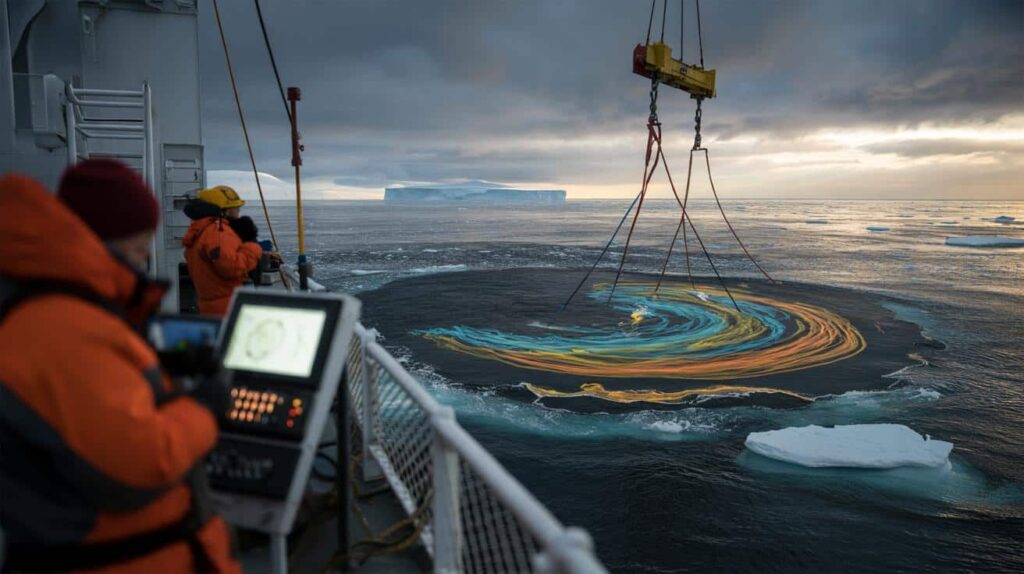
The numbers tick, the arrows flip, and a slow, stunned silence settles over the group.

The current, the great conveyor belt of cold and salt and life, has just reversed.

And for a few long seconds, no one speaks.

The moment the ocean did something it “never” does
On satellite maps, the Southern Ocean often looks like a simple blue halo. In reality, it’s a roaring machine, a band of water whipped by furious winds, usually flowing west to east in a near-continuous loop. That movement powers what scientists call the “global conveyor belt,” the deep ocean circulation that stabilizes temperatures, feeds marine life, and quietly shapes our weather.
So when, this year, instruments anchored thousands of meters down began recording a brief but clear reversal in part of that current, alarms rang far beyond the icy horizon.
This wasn’t just a quirk of water. It was the planet’s thermostat twitching.
The first clues came not from a headline, but from a messy spreadsheet in a cramped lab. A PhD student, squinting at columns of numbers collected from moored sensors in the Southern Ocean, noticed that flow speeds dropped, stalled, then flipped direction for the first time in the record. At first, the team thought “instrument error.” A cable snagged on ice? A miscalibrated sensor?
Then another station, hundreds of kilometers away, reported the same signal.
When satellites and floating Argo drifters confirmed the anomaly in the region of deep water formation, the story shifted from “bug in the data” to “something structural is happening.”
To understand why this single flip is so unsettling, you need to picture the Southern Ocean as the hinge of the climate system. Cold, salty water sinks around Antarctica, driving deep currents that crawl around the globe, carrying heat and carbon with them. This sinking motion has already slowed by roughly 30% in recent decades, according to several studies.
Now, with warmer, fresher meltwater from Antarctica pouring in at record rates, parts of that circulation appear not just to be weakening but wobbling.
*When a system designed to be steady starts hesitating, you’re edging toward what scientists call a tipping point.*
What a “flipped” current really means for the rest of us
From a kitchen table thousands of kilometers away, the Southern Ocean feels impossibly abstract. Your coffee cools, the dog sleeps under the chair, and outside the weather just looks… normal enough. Yet the same deep currents now misbehaving near Antarctica are linked to the storms hitting your coast, the heat lingering over your city, the harvests in the fields you never see.
Think of the ocean circulation like the invisible plumbing of the climate. When a pipe reverses, pressure shifts everywhere. That can mean more intense heatwaves in one region, heavier rain in another, and strange winters where snow shows up where it rarely does, and disappears where it once seemed guaranteed.
We’ve all been there, that moment when a small, odd glitch in daily life suddenly hints at something bigger. The kitchen tap sputters once, then again, until one morning no water comes out. That’s the vibe unsettling climate scientists right now.

Recent model runs suggest that if Antarctic melt accelerates at current rates, the deep overturning circulation in the Southern Ocean could weaken by up to 40% this century. Some simulations show local reversals, like the one just recorded, becoming more frequent as the system loses stability.
This isn’t a Hollywood-style “day after tomorrow” scenario, but a slow distortion of seasons, coastlines, and food chains.
The logic behind this shift is, unfortunately, straightforward. Warmer air melts more Antarctic ice. That meltwater is fresher and less dense than the salty ocean around it, so it floats instead of sinking. The sinking is what usually powers the deep current. So as the surface freshens, the engine at the bottom of the planet starts to sputter.
As that engine stalls, less heat and carbon are carried into the abyss. More stays near the surface, amplifying warming and disrupting weather patterns.
Let’s be honest: nobody really tracks the state of a deep ocean current on their phone every single day. Yet this hidden system quietly underpins the relatively stable climate our societies were built around.
How to live with a climate system that’s starting to wobble
There’s no single gesture that “fixes” a reversing current at the bottom of the world, but there are very concrete levers that matter more now than ever. Cutting fossil fuel use isn’t an abstract moral task, it’s a direct way to ease the pressure on Antarctic ice and the ocean engine around it. That starts annoyingly close to home: how we heat our houses, move through our cities, and vote in local elections.
One practical move: shift your attention to the big-ticket items. Home insulation, switching to cleaner heating, reducing car dependency, and pushing for renewable energy in your region have far more impact than obsessing over plastic straws.
Many people feel quietly ashamed that they’re not “doing enough” for the climate. That shame is heavy and not very useful. The truth is, this crisis was not created by your occasional flight or your forgotten reusable bag, but by a global system locked into fossil fuels for decades.
Where individuals have real power is in pushing that system to flip direction, just as the current did. That can mean joining a tenants’ group demanding efficient building retrofits, backing mayors who prioritize clean public transport, or supporting coastal communities asking for protection and adaptation funding.
Small acts still matter, especially when they gather. But they don’t have to be perfect to count.
As oceanographer Dr. Lena Morales put it during a late-night video call from her research vessel: “The Southern Ocean is sending us a warning, not a prophecy. The physics is clear: less ice means weaker circulation. What isn’t fixed yet is how much we choose to push it.”
- Follow the signals: Pay attention to credible updates from scientific institutions on Antarctic ice melt, deep ocean circulation, and extreme weather in your region.
- Back the big shifts: Support policies that phase out fossil fuels, expand renewables, and protect ocean and polar ecosystems.
- Protect your own patch: If you live near coasts or flood-prone areas, look into local adaptation plans, insurance risks, and community response networks.
- Talk, don’t preach: Share what you learn with friends or colleagues in simple, everyday language, not in jargon or doom-speak.
- Allow room for feelings: Anxiety about tipping points is rational; channeling it into action and solidarity is healthier than pretending the unease isn’t there.
A climate system at a crossroads, and us with it
The image of a current reversing in the black, freezing depths of the Southern Ocean lingers like a strange dream. Somewhere between those icy waters and the sidewalk outside your door, an invisible thread is tugging. The planet is not just gradually warming; parts of its machinery are starting to behave in unfamiliar ways, testing how much strain the system can take before it reconfigures into something new.
What that “new” looks like isn’t written yet. The models show branches, not a single track: one where Antarctic ice retreats fast and ocean circulation falters deeply, another where greenhouse gases peak sooner, ice loss slows, and the ocean engine limps but keeps running. Your life, my life, our cities and food systems sit right on that fork.
This strange moment — a deep current flipping, a ship’s crew staring at reversed arrows on a screen — is not a distant science story. It’s an invitation to decide which way we want our own currents to turn.
| Key point | Detail | Value for the reader |
|---|---|---|
| Southern Ocean current reversal | First recorded local flip in a key deep circulation region, linked to Antarctic meltwater | Helps readers grasp why a remote ocean signal matters for everyday weather and stability |
| Risk of climate tipping points | Weakened overturning circulation can lock in stronger warming, sea-level rise, and extreme events | Clarifies what is at stake beyond abstract “climate change” headlines |
| Action levers close to home | Focus on big-impact choices and political pressure rather than perfection in small habits | Gives readers realistic, non-paralyzing ways to respond to unsettling news |
FAQ:
- Question 1What does it mean that the Southern Ocean current “reversed”?
- Question 2Does this mean a sudden climate catastrophe is imminent?
- Question 3How is Antarctic ice melt connected to ocean circulation changes?
- Question 4Could this affect weather where I live, far from Antarctica?
- Question 5What can ordinary people realistically do in response to this kind of news?
