
The first thing people did was fall silent.
On a blistering April afternoon in the Mexican desert, phones went up, conversations cut off, and a strange coolness slipped across the sand like someone turning down a dimmer switch on the world. Dogs stopped barking. A rooster, completely confused, crowed in the middle of the day. A woman next to me held her breath as the last slice of sun vanished behind the moon. For three minutes, it felt like the universe was holding a secret right in front of us.
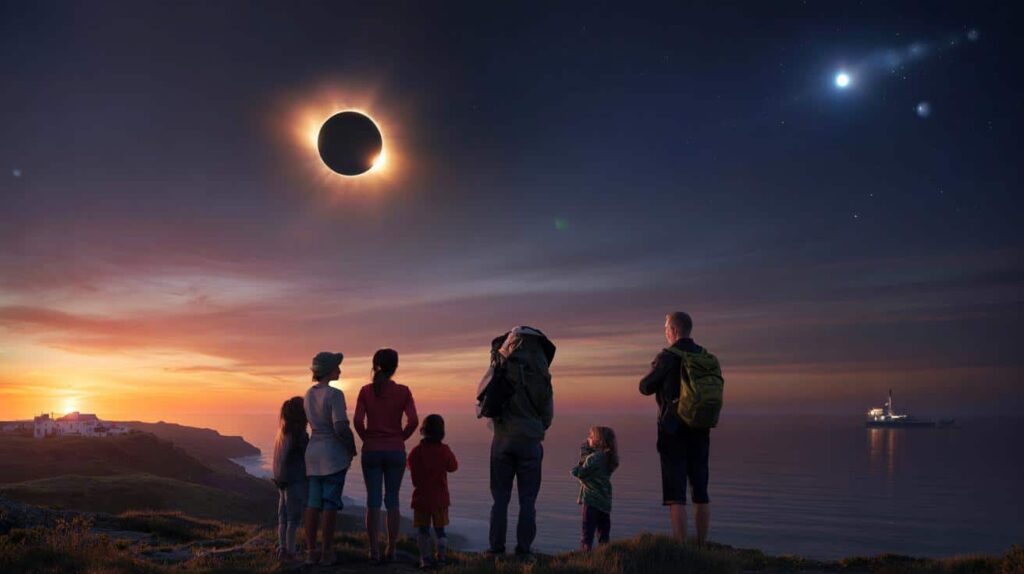
Now imagine that same scene… stretched to more than six minutes.

Eclipse of the century: what is coming, and why this one is different
Astronomers are already whispering about it with a mix of awe and nervous excitement. On 16 July 2186, a total solar eclipse will sweep across parts of South America and Africa, and at one point in the Atlantic it will deliver around **6 minutes and 40 seconds** of total darkness. That makes it the longest total solar eclipse between the years 1000 and 3000.

Six minutes doesn’t sound like much on paper. Under the shadow of the Moon, it’s an eternity.

To get a sense of what this means, think back to the “Great American Eclipse” of 2017, or the total eclipse of April 8, 2024. People drove all night, slept in their cars, and stood shoulder to shoulder in small towns just to catch **barely two or three minutes** of totality. Some cried. Some laughed. Others just stood there, mouth open, like kids seeing fireworks for the first time.
Now stretch that raw, electric moment to almost seven full minutes. The sky dark, the air cooler, the stars visible in the middle of the day, for as long as a pop song on the radio.
The reason this future eclipse is so long is almost poetic. The Moon will be at just the right distance from Earth, close enough to cast a wide, fat shadow. Earth itself will be near its farthest point from the Sun, so the Sun looks slightly smaller in the sky. The geometry clicks like a cosmic lock.
This perfect alignment slows the apparent movement of the Moon’s shadow across Earth, so the darkness lingers. *You could say the universe is giving us a slow-motion replay of one of its rarest tricks.*
When and where: how to “watch” an eclipse that’s centuries away
Here comes the plain truth sentence: **Most of us reading this today will never see the 2186 eclipse with our own eyes.** That sounds harsh, but it’s also strangely freeing. Instead of a consumer-style countdown, it becomes a story we carry forward. A promise we pass on.
The central line of this eclipse will cross northern Colombia and Venezuela, sweep into the Atlantic, then graze parts of western Africa. Near the small town of Boa Vista in Brazil’s Roraima state, totality will last more than six minutes — exceptionally long by any standard.
If you’re thinking, “Well, that doesn’t help me much,” you’re not alone. We’ve all been there, that moment when you read about a stunning cosmic event and realize you’ll either be too old to travel, or simply not around. Some people respond by shrugging and scrolling on. Others start planning legacies.
There are astronomy clubs already talking about time capsules, digital archives, and letters to future eclipse-chasers. Parents name stars for their kids today; some are now leaving eclipse maps and hand-written notes in family files, hoping that a great-great-grandchild might one day stand under that 2186 shadow and think, “Someone in my family knew this was coming.”
 One simple bathroom product is enough: why rats refuse to overwinter in gardens where it’s used
From a scientific point of view, this “eclipse of the century” is also a test of our collective memory. Will our cities, power grids, and climate look anything like they do today? Will totality pass over quiet savannahs or hyper-developed coasts? Astronomers already publish exact timings down to the second, but the human story around those seconds is unwritten.
Let’s be honest: nobody really builds daily life around something scheduled for 2186. Yet history shows that eclipses leave long fingerprints. Stories survive in myths, ship logs, old diaries. This time, the footprint will be digital, global, and carefully timestamped.
How to prepare for the next great eclipses you CAN see
The future is dreamy, but the sky above you is concrete. If the 2186 event feels like science fiction, the next decades are very real. The simplest, most precise method to catch your own “mini eclipse of a lifetime” is this: look up the path of totality for upcoming eclipses, then draw a real route on a real map.
Not a vague “I’ll go somewhere near there.”
An actual city, a backup city, and a third backup for bad weather. That’s what seasoned eclipse-chasers do.
There’s a common emotional trap that ruins eclipses for people: they stay in the “almost” zone. They’re 100 or 200 kilometers from the path of totality, thinking, “Close enough, right?” Sadly, no. Partial eclipses dim the light, create weird shadows, but that jaw-dropping, 360-degree sunset and sudden night? That only happens in the thin ribbon of totality.
If you’ve already missed one by staying put, don’t beat yourself up. The human brain loves comfort and hates long drives at dawn. Next time, imagine you’re going to a once-in-a-lifetime concert. You wouldn’t stand outside the stadium and say, “Well, I can kind of hear it from here.”
Astronomer and veteran eclipse-chaser Jay Pasachoff once told a group of students: “You haven’t really seen a total solar eclipse until you’ve stood in the path of totality. Everything else is just a rehearsal.”
- 1–2 years before
Pick your target eclipse and region. Join an astronomy club or online group that’s planning a trip. - 6–12 months before
Reserve basic accommodation along the path of totality, even if it’s a small town you’ve never heard of. - 1–2 weeks before
Watch weather forecasts, prepare a “plan B” town a few hours away, label your eclipse glasses. - Day of the eclipse
Arrive early, test your camera or phone, then… put it down for at least one full minute of totality and just look.
Why this distant eclipse still matters to us right now
An event in 2186 sounds remote, like something filed under “not my problem, not my lifetime.” Yet there’s something grounding about a date that far ahead locked to a precise, shared experience on Earth. Children not yet born will stand under the same Sun and Moon, following a script written long before we argued about social media or streaming platforms.
Thinking about a six-minute eclipse we’ll never see gently re-sizes our worries. It nudges us toward long-term thinking instead of just the next notification. Someone will be there: a teenager on an African beach, an old woman on a Venezuelan hill, a researcher aboard a ship in the Atlantic. They’ll feel the temperature drop, hear the birds shift, and watch day turn to deep, metallic twilight.
And maybe, because we talked about it, they’ll know we were thinking of them.
| Key point | Detail | Value for the reader |
|---|---|---|
| “Eclipse of the century” date | Total solar eclipse on 16 July 2186, with ~6 min 40 s of totality at maximum | Gives a concrete future landmark to share, teach, or pass on |
| Geographic path | Crosses parts of Colombia, Venezuela, Brazil, the Atlantic, and western Africa | Helps readers visualize where this rare event will unfold |
| What you can do now | Plan for nearer eclipses, travel into the path of totality, join eclipse communities | Turns distant astronomy into a practical, lived experience |
FAQ:
- Will the 2186 eclipse really be the longest of the millennium?
According to current astronomical calculations, yes. Around 6 minutes 40 seconds of totality makes it the longest total solar eclipse between the years 1000 and 3000.- Who will be able to see this eclipse?
People within the narrow path of totality in northern South America, parts of Brazil, over the Atlantic Ocean, and sections of western Africa. Outside that path, only a partial eclipse will be visible.- Can I watch it online if I’m not alive then?
You personally can’t, of course, but streaming is almost guaranteed for those living in 2186. If anything, future coverage will be more immersive than today, with high-resolution and likely VR-style broadcasts.- Are there big eclipses I can see sooner?
Yes. Several total and annular eclipses will cross different parts of the world in the coming decades. Checking NASA or your national astronomy society’s eclipse calendar is the best starting point.- Do I really need special glasses for an eclipse?
For every phase except totality itself, yes. Looking directly at the Sun without certified eclipse glasses can damage your eyes, even when the Sun looks “mostly” covered. During totality only, when the Sun is completely blocked, you can safely look with the naked eye until the first bright sliver returns.
