
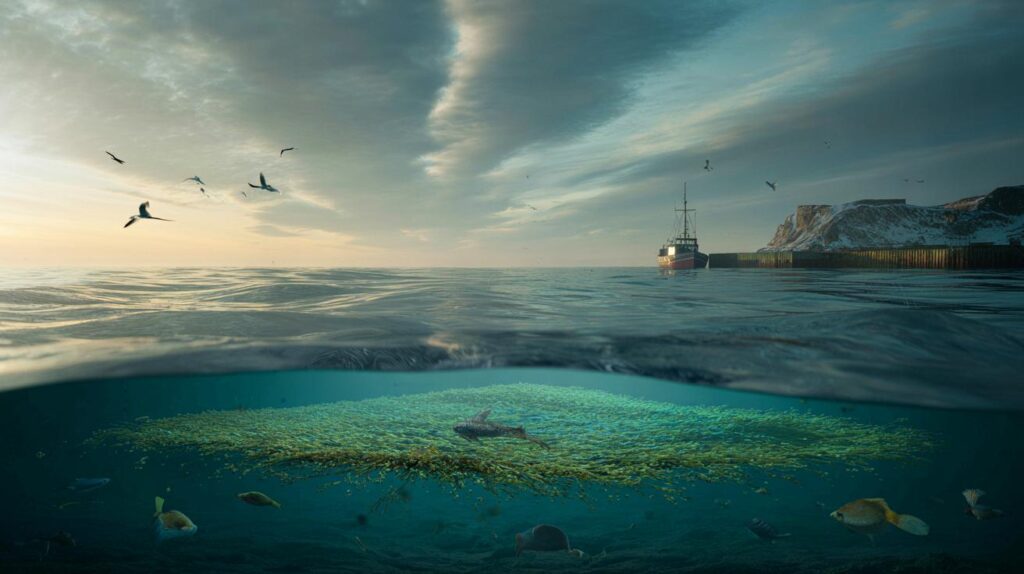
The sea looks calm from the harbor wall, a grey-green sheet under a pale winter sky. Gulls hang in the wind, waiting for scraps from the fishing boats, as if nothing in the world could really change out here. Yet beneath the surface, scientists say the ocean’s smallest inhabitants may be heading for a rough start to the year.
In early February, meteorologists tracking the Arctic have spotted subtle but troubling shifts: strange warmth in the upper atmosphere, late ice growth, storm tracks tilting off their usual paths.

On the quayside, none of this is visible. The water moves. The boats rock. The air stings your cheeks.

But the timing of these Arctic mood swings could shake the tiny plankton blooms that feed almost everything in the sea.

When the Arctic’s mood swings, the ocean notices
Ask a meteorologist what keeps them up at night this winter and they probably won’t say snowstorms. They’ll talk about the Arctic’s sudden quirks: patches of warm air punching into the pole, cold plunges diving south, and a polar vortex that looks a little looser around the edges than it used to.
On satellite maps, the changes show up as wavy lines and strange colors swirling around the top of the globe. For most of us, it’s just weather porn on social media. For scientists, it’s a warning light.
Because what starts over the Arctic in early February doesn’t stay there. It ripples down through the atmosphere, reshaping wind patterns, sea ice formation and, quietly, the light and nutrients that plankton need to wake up.
Off the coast of Norway last year, marine biologists watched the spring plankton bloom misfire. The usual emerald explosion that normally peaks in late March arrived a couple of weeks early, then fizzled.
One research vessel logged lower chlorophyll levels across a wide stretch of water, while local fishers reported “thin” seas: fewer shoals of herring close to shore, seabirds circling a little longer before diving. No apocalypse, nothing you’d see in a Hollywood script. Just a long, subtle hunger.
Official records later traced the timing mismatch back to a winter of disturbed Arctic circulation and unusually warm spells at high latitudes. A quiet chain reaction that started over sea ice and ended in a less generous ocean.
The logic isn’t that mysterious once you zoom in. Plankton are like living alarm clocks, tuned to a mix of light, temperature and nutrients. When winter winds churn the sea, they pull nutrient-rich deep water up toward the surface. As days lengthen, sunlight hits that chemical soup and plankton burst into life.
Early February is a crucial setup phase. If Arctic-driven weather flips the script — weaker storms, warmer top layers, odd cloud cover — the nutrient mixing can falter or rush ahead. The light might come “on” before the pantry is stocked.
So you end up with blooms that are too early, too late, or simply too small. And when the ocean’s calendar slips, everything that depends on plankton has to improvise. Spoiler: most wild animals are terrible at improvising on short notice.
Why a few weeks’ drift can starve an entire food web
Ask any ocean ecologist for their single biggest practical fear and they’ll mention timing. Not storms. Not temperature spikes. Timing.
The trick, they say, is that fish, seabirds and marine mammals don’t just need food. They need food at the exact moment when their young are most vulnerable and most hungry. That window can be just a few weeks.
So when meteorologists warn that this early February’s Arctic patterns may nudge plankton blooms out of sync, they’re really hinting at something more intimate: chicks hatching into empty skies, fish larvae drifting in barren water, whales arriving on centuries-old routes to find their buffet delayed.
Picture a puffin colony on a low, grassy island in the North Atlantic. The adults arrive in late spring, beaks painted bright, wings beating hard after months at sea. Their calendar is embedded in their bones, shaped by thousands of generations.
They lay eggs so the chicks will hatch at the peak of small fish abundance, which itself depends on plankton having bloomed at just the right time weeks earlier. When that chain works, the cliffs are noisy and alive, and the air smells like fish and salt and guano.

When the chain slips, the story is quieter. Chicks beg, adults fly farther and longer, and more nests fail without drama. The colony looks almost normal from a distance. It’s just a little emptier the next year.
Scientists call this problem a “phenological mismatch” — a fancy label for a simple horror: predators and prey running on different clocks. The Arctic tweaks that clock from the top down. Sudden stratospheric warming, shifting jet streams and delayed sea ice affect when and where storms track across the ocean.
Those storms are the ocean’s stirring spoon. Less stirring means fewer nutrients at the surface. Strange storm timing can shift cloud cover, changing how much light reaches the water just when plankton are ready to grow.
We like to think of climate as a slow background soundtrack, but here the beat matters. Change the rhythm by even two or three weeks and the entire marine food web has to dance to a tune it never rehearsed.
What we can actually do when the ocean’s clock feels broken
When you hear “Arctic disruption” and “plankton cycles”, it’s easy to feel tiny and useless. Still, there are concrete levers that don’t require superhero powers.
The first is data. Meteorologists and oceanographers are pushing hard to stitch together real-time weather observations, sea-ice maps, and plankton monitoring into faster alerts. Instead of waiting months for research papers, they want dashboards that say, in plain terms: the bloom in this region is likely to come early, late, or weak.
That kind of early signal lets fisheries managers adjust quotas or shift seasons by a week or two. It helps coastal communities prepare for odd years, when traditional knowledge says “go” but the ocean quietly says “wait.”
For everyday people, the obvious asks sound repetitive: cut emissions, back renewables, push for serious climate policy. We’ve all been there, that moment when you hear the same advice and your brain quietly tunes out.
Yet this is where the messy human scale matters. Coastal towns can choose how they fish, not just how much they fish. They can protect nursery habitats, so that even in lean plankton years, young fish have some shelter and food.
Let’s be honest: nobody really does this every single day. No one wakes up, checks Arctic weather anomalies, and plans their grocery list around plankton. But people do show up to local hearings, vote for mayors, sign onto marine protected areas. That’s where broad, fuzzy climate anxiety turns into narrow, practical action.
“Plankton don’t read climate reports,” one marine ecologist told me on a blustery pier. “They respond to light, temperature and nutrients. We’re the ones who have to read the signs and adjust our behavior before the ecosystem hits a wall.”
- Watch the timing stories
News about odd seasons, early blooms or late ice isn’t background noise. It’s the narrative thread tying Arctic weather to your seafood, your coastal holidays, your local seabirds. - Support smarter fishing and marine protections
From seasonal closures to no-take zones, these dry policy tools are basically shock absorbers for years when plankton cycles wobble. - Stay curious, not numb
*The ocean story can feel huge and distant, but every bit of attention you give it keeps pressure on decision-makers to treat marine timing shifts as urgent, not abstract.*
A small, invisible drama with very real consequences
Some stories about the planet shout. Vanishing glaciers. Raging fires. Flooded streets. The Arctic plankton story is different. It whispers.
You won’t see the February jet stream shift on your morning walk, or notice when storms fail to properly churn the winter sea. You might, one summer, see fewer seabirds. Or hear that local cod aren’t biting like they used to. Or notice that whales, once reliable visitors, have become unpredictable guests.
This is the texture of climate disruption in the ocean: not just warming, but the subtle scrambling of time itself. Plankton, those drifting specks of life, sit right at that crossroads. They bloom when the cues feel right, not when the news says they should.
The question lingering over this early February is simple and unsettling: how many more years can marine wildlife keep adjusting to a calendar that’s being quietly rewritten from the Arctic down? And how long before we start treating those invisible shifts with the same urgency we reserve for disasters we can see from the highway?
| Key point | Detail | Value for the reader |
|---|---|---|
| Arctic weather is shifting in early February | Meteorologists are tracking unusual warmth, jet stream wobbles and late ice that reshape storm paths | Helps you connect winter headlines about the Arctic to real impacts on marine life and food chains |
| Plankton timing drives whole ecosystems | Small changes in light, nutrients and mixing can delay or weaken blooms, starving fish, seabirds and whales | Shows why “invisible” changes matter for seafood, coastal economies and biodiversity |
| Local actions can ease the shock | Smarter fisheries, marine protected areas and better monitoring cushion wildlife against bad plankton years | Gives you practical entry points to respond, not just worry, about Arctic-driven ocean shifts |
FAQ:
- Question 1How can weather in the Arctic actually affect plankton thousands of kilometers away?
- Answer 1Arctic temperature patterns reshape the jet stream and storm tracks. Those changes alter how strongly winter storms mix the ocean and how clouds affect sunlight, which in turn shifts when and where plankton get the right blend of light and nutrients to bloom.
- Question 2Does a slightly earlier or later plankton bloom really matter that much?
- Answer 2Yes, because many fish, seabirds and marine mammals time breeding and migrations so their young hit the water right when food peaks. A mismatch of just a couple of weeks can mean larvae or chicks face a food gap at their most vulnerable stage.
- Question 3Is this just a one-off problem for this February, or part of a trend?
- Answer 3Scientists are seeing more frequent disruptions in Arctic circulation and sea-ice patterns in recent decades, which suggests a growing trend of timing instability, not just random bad luck in a single year.
- Question 4What does this have to do with the fish or seafood I buy?
- Answer 4Commercial species like cod, herring or mackerel depend on reliable plankton booms. When those booms falter, stocks can weaken over time, affecting availability, prices and how strictly fisheries need to be managed.
- Question 5Is there anything non-scientists can realistically do about this?
- Answer 5Beyond supporting broad climate action, you can back sustainable seafood labels, marine protected areas, and local policies that give ecosystems more breathing room when plankton cycles go off-script. You can also simply stay engaged with ocean news, which keeps pressure on leaders to respond.
