
The sky started dimming in the middle of math class. Phones lit up before the overhead lights did, a wave of whispered “Look, look!” rolling across the room as the world outside went strangely quiet. In the schoolyard, a science teacher handed out crinkled eclipse glasses with the solemn pride of someone distributing rare treasure. Two streets away, a small church locked its gate and taped a handwritten sign to the door: “Parents, keep your children indoors. Today is not a day to play under the sun.”
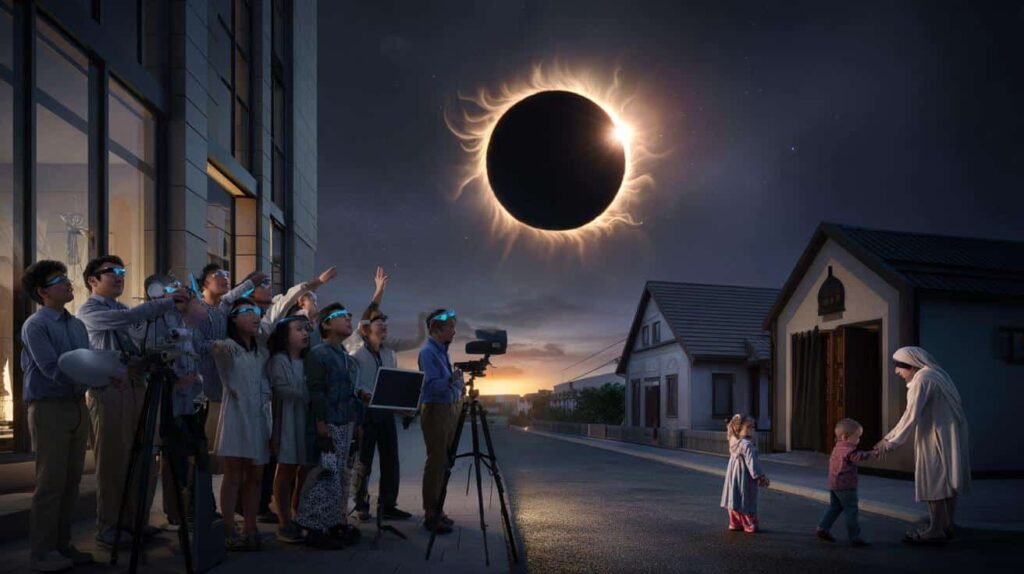
On one side of town, astronomers hugged and high‑fived as the Moon slid perfectly in front of the Sun, starting the longest solar eclipse of the century. On the other, pastors and imams closed curtains and led hushed prayers.

Same sky. Two completely different stories.

The longest eclipse of the century, seen through two very different lenses
For scientists, this eclipse is a once‑in‑a‑lifetime gift. In observatories from Chile to China, researchers have been waiting years for these few minutes of darkness, timing their instruments down to the second. The longer the Sun is covered, the more data they can collect about the corona, those ghostly white plumes that only show up during totality.

In their world, this isn’t a “dark omen”. It’s free lab time written into the sky, and the clock is ticking.
In a hillside village in northern Pakistan, the call to prayer came early today. Parents pulled kids off dusty soccer fields as the first bite appeared on the Sun. “No, don’t look,” a grandmother scolded, pulling a curtain tight. On the TV, a preacher called the eclipse a “warning” and urged families to ask for forgiveness.
Across the ocean, in a sprawling Nigerian megachurch, worshippers packed the pews for a special midday service. Outside in the same city, university students crowded campus lawns with cardboard viewers and home‑made pinhole projectors, laughing each time the crescent Sun sharpened. One group posted a selfie with the caption: “Scientists 1 – Superstition 0.”
This clash isn’t new. Every time the sky behaves strangely, ancient fears crawl out of old stories. Long before we knew about orbital mechanics, eclipses were blamed on dragons, wolves, angry gods, the end of kings. Those stories don’t just vanish because a physics teacher draws a neat diagram on a whiteboard.
Religious leaders who worry about omens and punishment are often repeating what they were taught as children, wrapped in the duty to protect “their” people. For them, telling parents to keep kids inside is an act of care, not control. Scientists, on the other hand, work from a different kind of faith: that the universe follows rules, and that human beings can understand them if we’re brave enough to watch.
How to navigate an eclipse when science and faith collide at your front door
If you’re a parent stuck between an excited child and a nervous elder, the day of a major eclipse can feel like a tug‑of‑war. One practical step is to bring the sky safely inside. Lay a white sheet on the floor, poke a tiny hole in a piece of cardboard, and let the sunlight project a perfect crescent onto your living room like a mini cinema.
You’re not defying anyone’s beliefs by watching patterns of light on the wall. You’re just letting your kid see the choreography of Sun, Moon, and Earth in a way that doesn’t set off anyone’s alarm bells.
 What you see is not a ship : at 385 metres long, Havfarm is the world’s largest offshore salmon farm
Many families end up negotiating a fragile truce. A child can join a short prayer before totality, then step outside with proper eclipse glasses, watched by an anxious but curious grandparent. That mix of reverence and wonder is messy, and that’s alright. We’ve all been there, that moment when you whisper “just be safe” even though you’re not fully sure what you’re afraid of.
Let’s be honest: nobody really follows every strict rule their community sets during celestial events. Some people secretly peek through the window. Some religious leaders later admit they watched, too, “just for a second.” That human gap between rule and reality is exactly where conversations can start.
On the steps of a small city mosque, I met Imam Kareem, who had just finished leading a special eclipse prayer. Children tugged at their parents’ sleeves, begging to go outside with their science teacher waiting at the gate with a stack of black paper viewers.
“An eclipse is a sign, not a sentence,” Kareem told me. “In our tradition, we pray, we reflect on how small we are. But I tell my students: look at it safely, learn from it. God didn’t hide the universe from us.”
Then he turned to the children and listed what mattered most:
- Use proper protection for your eyes, not sunglasses or phone cameras.
- Stay with an adult who understands both the science and your family’s rules.
- Treat the moment as special, whether you call that sacred or scientific.
- Talk afterward: what did you feel, what did you fear, what did you notice?
When the sky darkens, what story do we choose to tell?
An eclipse does something strange to time. Day turns to night, animals go quiet, traffic slows, and for a few impossible minutes everyone is looking in the same direction. *That doesn’t happen very often in our distracted, fragmented lives.*
This century’s longest eclipse is a gift not only for researchers testing theories about solar winds, but also for communities testing how they handle disagreement. One parent might call it a laboratory in the sky. Another might call it a reminder from God. The child standing between them mostly feels a tremor of awe and a little fear, wanting to belong to both worlds.
If there’s a quiet opportunity hidden inside this “dark omen”, it may be this: to admit that the same shadow crossing the Sun can cast completely different meanings on our streets. And to talk about those meanings, not just the math, once the light slowly returns.
| Key point | Detail | Value for the reader |
|---|---|---|
| Historic eclipse | Longest solar eclipse of the century, giving scientists rare extended observation of the Sun’s corona | Helps you grasp why researchers are so excited about “just a few minutes” of darkness |
| Religious reactions | Some leaders frame the event as an omen, urging families and children to stay indoors and pray | Explains why your community may feel tense or divided about stepping outside |
| Living the moment | Simple ways to watch safely, respect beliefs, and turn the eclipse into a shared experience | Gives you concrete options to balance curiosity, safety, and family traditions |
FAQ:
- Question 1Is it really dangerous for children to be outside during a solar eclipse?
- Question 2Why do some religious leaders call the eclipse a sign of anger or warning?
- Question 3What do scientists actually study during such a long eclipse?
- Question 4Can I respect my faith and still watch the eclipse with my kids?
- Question 5What’s the safest and simplest way to watch an eclipse without special glasses?
