
King cobras, normally tied to remote forests, are turning up in the last place you’d expect: near busy railway lines and even inside stations, sparking a bold new theory about how these giant snakes may be quietly riding the rails across India.
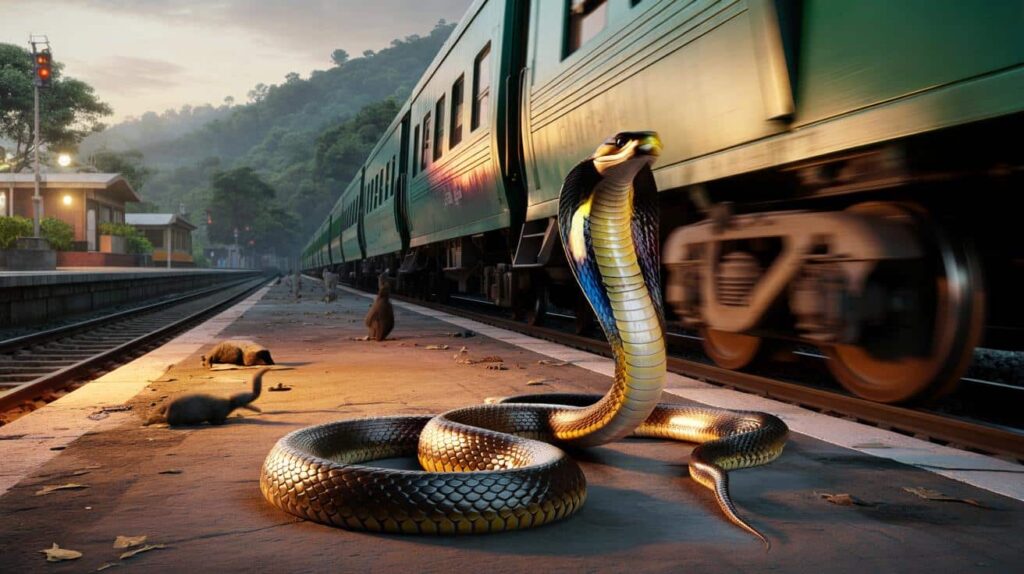
King cobras on the move in India
The focus of the new research is the Western Ghats king cobra, a relative of the better-known Ophiophagus hannah, the longest venomous snake on Earth. This population lives mainly in Goa and neighbouring regions along India’s biodiverse western mountain range.

A team of researchers set out with a straightforward goal: understand how this highly venomous predator is faring in a landscape where forests, farms and towns increasingly compete for space. To do that, they looked at 47 documented rescues of king cobras carried out in Goa between 2002 and 2024.
 What you see is not a ship : at 385 metres long, Havfarm is the world’s largest offshore salmon farm
Those rescues were not random. Many were logged by local snake rescuers who respond when terrified residents call about a cobra in their backyard, by the roadside or near a school. One of the scientists, Dikansh Parmar of the Leibniz Institute for the Analysis of Biodiversity Change, also volunteers in these rescue operations, giving him rare, ground-level insight.

The rescue records, meant to protect both people and snakes, accidentally captured a strange side story: cobras appearing along rail routes.
The team combined these field notes with environmental data, climate records and maps of human disturbance to understand where king cobras should naturally live and where they should not.
Where the snakes should be — and where they are
Using species distribution models, the researchers mapped the areas in Goa that provide ideal conditions for king cobras: humid, wooded, relatively undisturbed landscapes in the eastern part of the state, where hills and forests dominate.
Most of the 47 rescues fell neatly into these expected zones. That matched what herpetologists already know: king cobras favour dense vegetation, stable prey populations and shelter in termite mounds, tree roots or burrows.
Then came the odd cases. Five rescues occurred in places that did not fit the usual ecological profile. These snakes were not in the wooded east but in more developed, flatter areas, and each of these cases shared one detail that raised eyebrows among the scientists.
All five “out-of-place” cobras were found either on railway premises or within a few hundred metres of train tracks.
In one instance, the animal turned up inside a station. In others, it was found close enough to the line that the simplest explanation — a long overland journey through unsuitable habitat — felt increasingly unlikely.
A radical idea: cobras catching trains
Faced with these patterns, Parmar and colleagues put forward a provocative idea in the journal Biotropica: king cobras in India may be using trains as unintentional transport.
The theory is not that snakes queue for tickets or knowingly commute. Instead, the animals may slip into stationary freight trains, wagons, storage areas or piles of goods near platforms, attracted by prey such as rats and other snakes that thrive around rail infrastructure.
Rail yards offer dark hiding spots and plenty of rodents, creating a moving buffet that could quietly ferry snakes across the landscape.
Once a train departs, any hidden cobra is carried with it. When it feels threatened or finds an exit at another station or rail yard, it may emerge — suddenly “appearing” in an area where its species is not expected.
Local anecdotes support the idea. Residents and railway workers in parts of India have long reported seeing snakes close to trains, sometimes even on carriages or platforms at night. Until now, those stories were treated more as folklore than data.
 “I’ll buy it until I’m 90”: a dermatologist reveals the name of her favorite supermarket shampoo
Why this matters for genetics and conservation
If king cobras are hitching rides by rail, the implications go well beyond strange rescue reports.
- Gene flow: Individuals travelling large distances could mix previously separate populations, altering genetic diversity.
- Population dynamics: New arrivals could boost or destabilise local snake numbers.
- Human–wildlife conflict: Cobras suddenly appearing in new towns or villages increase the risk of panic, bites and retaliatory killing.
The authors suggest that this “passive transport” could shape how king cobra populations spread across fragmented habitats. In a region where roads, farms and cities already carve up forests, trains might unintentionally reconnect or rearrange snake populations in unpredictable ways.
How scientists could test the train theory
For now, the train-riding cobra remains a compelling hypothesis, not a proven behaviour. The study’s authors outline several ways to check it.
| Method | What it could show |
|---|---|
| Camera traps at stations and rail yards | Direct footage of snakes entering wagons, moving along platforms or emerging from trains |
| Radio or GPS tagging | Sudden long-distance jumps in a tagged cobra’s location that match train routes |
| Genetic analysis | Evidence that individuals near tracks belong to distant populations |
| Interviews with railway staff | Systematic collection of observations and incident reports |
Such work could clarify not only whether king cobras use trains, but how often, how far they travel and under what conditions.
Living with a giant venomous neighbour
King cobras sit at the top of the snake food chain. They mainly eat other snakes, including venomous species, and can reach lengths of over five metres. A bite can be deadly, though these animals usually avoid confrontation with people when possible.
India already deals with thousands of snakebites each year, mostly from other species such as kraits and Russell’s vipers. Encounters with king cobras are rarer, yet the sheer size and reputation of the snake trigger intense fear.
When a king cobra surfaces in a market town or beside a platform, fear spreads faster than facts, and the snake often pays with its life.
That is where trained rescue teams come in. In Goa and many other Indian states, volunteers and forest officials capture snakes and relocate them to safer habitat. These rescues generate valuable data while lowering the risk for both people and wildlife.
What “passive transport” actually means
Researchers use the term “passive transport” when an animal moves long distances without doing the work itself. The movement is driven by wind, water, vehicles or human trade. Examples include insects accidentally shipped with fruit, lizards transported in cargo, or seeds stuck to boots and tyres.
In this case, the idea is that king cobras are not choosing to change regions in a planned way. Instead, they follow prey and shelter into train environments, and the rail system does the long-distance moving for them.
If confirmed, the king cobra would join a growing list of species that travel by human infrastructure without anyone noticing, creating new conservation challenges.
What this could mean for rail safety and local communities
Rail operators and nearby communities might need to adapt if train-assisted snake movements are real. Simple measures can reduce unwanted encounters:
- Regular cleaning of food waste and rubbish that attract rats and, in turn, snakes.
- Sealing gaps and crevices in wagons where large reptiles could hide.
- Training staff to safely report and respond to snake sightings.
- Working with local rescue groups instead of killing snakes on sight.
For villagers, basic awareness helps. Knowing that king cobras prefer to avoid humans and often bite only when trapped or provoked can reduce panic. Learning to recognise the snake, keep a safe distance and call local rescuers instead of attacking it can save lives on both sides.
The idea of a king cobra quietly riding the night train through the Western Ghats sounds like the start of a thriller. For researchers, it is a practical puzzle with real consequences for genetics, conservation policy and public safety — and one that may soon be tested with cameras, tracking tags and a closer look at what is really lurking beneath those rumbling carriages.
