
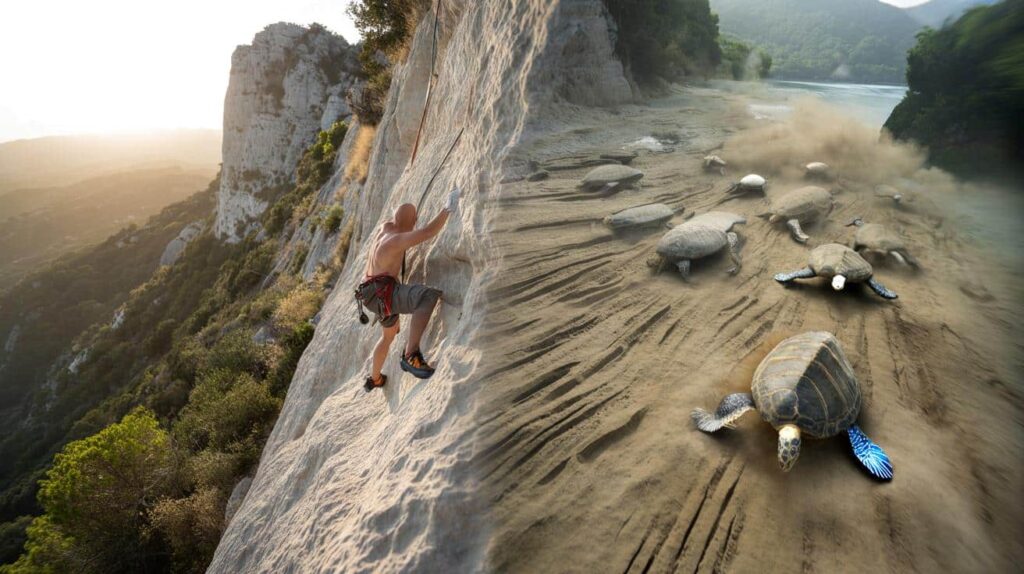
What began as a routine ascent on a cliff in central Italy has turned into one of the strangest palaeontology cases of the year: hundreds of parallel grooves carved into ancient seabed rock that researchers now interpret as traces of an underwater “stampede” of marine reptiles, probably sea turtles, fleeing a powerful earthquake around 79–80 million years ago.
Climbers who noticed something was off in the rock
The scene was Monte Cònero, a dramatic headland in Cònero Regional Park, near Ancona, on Italy’s Adriatic coast. The rock face is part of the Scaglia Rossa limestone, a pale, fine-grained formation famous among geologists for preserving a long history of deep-sea sediment.
 What you see is not a ship : at 385 metres long, Havfarm is the world’s largest offshore salmon farm
Several local climbers, already aware of recent scientific work on strange fossil tracks nearby, spotted grooves that looked uncannily similar. These weren’t random cracks or erosion. The lines were smooth, repeated, and arranged in patterns that suggested movement.
They contacted fellow climber and geologist Paolo Sandroni, who in turn reached out to Italian geologist Alessandro Montanari, director of the Coldigioco Geological Observatory.
 “I’ll buy it until I’m 90”: a dermatologist reveals the name of her favorite supermarket shampoo
The “rock problem” that stalled a climbing route turned out to be evidence of frantic movement on an ancient seabed.
Within weeks, Sandroni and a teammate returned to the cliff with sampling tools and a drone. They documented the exposed surface, mapped the distribution of the grooves and collected pieces of rock from just above the track-bearing layer.
A mountain that used to be deep ocean floor
Today, Monte Cònero rises steeply from the Adriatic. During the Late Cretaceous Period, around 79 million years ago, that same rock sat hundreds of metres below the surface of a warm ocean.
The Scaglia Rossa limestone formed slowly as mud and microscopic shells settled from the water column onto a deep, quiet seabed. Over millions of years, tectonic forces folded and pushed that seabed upward, transforming it into the cliffs and ridges now crossed by hiking trails and climbing routes.
Thin slices of the rock examined under a microscope show microfossils of tiny organisms that lived on or just above the seafloor. These organisms point to a relatively deep, offshore setting, not a shallow shoreline. That context is vital, because it helps rule out many possible track-makers and behaviours.
The track-bearing layer represents a calm, deep seabed that was suddenly disturbed by something violent – likely a strong earthquake.
What the tracks actually look like
The surface is patterned with hundreds of shallow, elongated grooves. They sit in clusters and run broadly in the same direction, as though many animals moved at once.
Key features described by the research team include:
- Paired grooves that appear to have been made by two forelimbs pressing down together.
- Curving, overlapping lines that suggest repeated strokes along the soft seabed.
- Variations in depth and length, hinting at animals of different sizes or moving at different speeds.
- A sudden end to some trackways where sediment changes, consistent with rapid burial.
The grooves were preserved in a layer that shows signs of a submarine landslide – an underwater avalanche of mud and debris that rushed downslope across the sea floor.
Earthquake, underwater avalanche and a burst of panic
According to the study, the sequence of events began with a strong earthquake shaking the Cretaceous sea floor. That shaking destabilised the sediments on a slope, triggering an underwater avalanche.
Marine reptiles living or resting near the bottom would suddenly have felt the ground shift beneath them. Sand and mud began to move. The water column filled with suspended particles. For animals sensitive to pressure and vibration, this would have been a clear signal to move – fast.
The team argues that the grooves were carved in those frantic minutes as animals pushed off the unstable bottom and tried to get away.
The researchers suggest that some individuals angled upward into open water, while others scrambled along the seabed to reach safer, deeper ground. The submarine avalanche then swept over part of the area, quickly burying the fresh tracks under a new blanket of sediment. That rapid burial froze the movement in place for tens of millions of years.
Why sea turtles are the leading suspects
Several groups of marine reptiles lived in the Late Cretaceous: sea turtles, long-necked plesiosaurs and the large, predatory mosasaurs. All were big enough to leave marks in soft sediment.
The authors lean toward ancient sea turtles for several reasons:
| Feature | Interpretation |
|---|---|
| Paired, simultaneous limb strokes | Suggests two front paddles pushing together, as in some turtle swimming behaviours. |
| High number of tracks | Fits with the idea of multiple turtles using the same area, perhaps for feeding or nesting-related activity. |
| Deep-sea setting | Consistent with turtles commuting between coastal and offshore zones. |
| Lack of large claw marks or tail drags | Makes big, heavy-bodied predators like some mosasaurs less likely. |
The researchers also draw on modern sea turtle behaviour. Many living species gather in large numbers along migration routes or around nesting seasons. If something brought Cretaceous turtles to the same stretch of seafloor at the same time, a sudden earthquake could have sent them fleeing together.

Not everyone is convinced about the turtle stampede
The interpretation has sparked debate. Michael Benton, a vertebrate palaeontologist at the University of Bristol who was not part of the study, agrees that the geological context is persuasive: there is strong evidence for a submarine avalanche tied to seismic activity.
He is less certain about the animal behind the traces. Benton notes that the grooves suggest “underwater punting”, where both front limbs push down together. Many vertebrates, including living turtles, typically move their limbs in sequence when swimming, rather than slamming both front paddles into the sediment at once.
One challenge is that modern marine turtles usually use a smooth, wing-like stroke in open water, which does not match the grooves perfectly.
Benton also points out that in a crisis, animals might simply swim clear of the bottom instead of pushing along it. The authors argue that sudden shaking and sediment movement could temporarily trap animals near the seabed or reduce visibility enough that staying close to the bottom made sense.
Montanari and colleagues accept that more work is needed. For now, they stress that the main story is geological: a seismically triggered underwater avalanche preserved a rare, large set of vertebrate traces. Pinning down the exact track-maker may require further fieldwork and comparisons with experimental data on how different animals move through soft sediment.
How such delicate traces survived for 79 million years
Modern sea floors are busy places. Worms, clams and other creatures constantly churn the upper layers of sediment. Ocean currents reshape ripples and erase footprints within hours or days.
That constant “gardening” of the seabed makes fossil trackways from deep water extremely rare. To preserve them, two things need to happen almost at once: an animal must disturb the sediment, and a rapid burial event must seal those traces away from further disturbance.
The earthquake-triggered avalanche acted like a protective blanket, covering the fresh grooves before other animals or currents could erase them.
Over millions of years, the buried layers compacted and cemented into rock. Later, tectonic forces uplifted and tilted that rock, turning the ancient seabed sideways. Erosion then stripped away overlying material, leaving parts of the track-bearing surface exposed on the cliff where the climbers found it.
Why underwater avalanches matter beyond this case
Submarine landslides, also called turbidity currents, are not just curiosities from the past. They still happen today along continental slopes and submarine canyons. They can damage underwater cables, alter seafloor habitats and move vast amounts of sediment in a single event.
In the fossil record, these events often leave distinct layers made of mixed, quickly deposited material. Those layers can preserve buried organisms and traces in exceptional detail. Famous fossil sites in other parts of the world, including some rich in dinosaur bones and marine reptiles, also formed in connection with sudden sediment flows.
For geologists, the Monte Cònero case shows how behavioural evidence – the way organisms moved at a specific moment – can be captured by these catastrophic flows, not just bones and shells.
Key terms that help make sense of the find
Several technical terms used by researchers can sound opaque. A few are worth breaking down:
- Late Cretaceous: The final slice of the age of dinosaurs, spanning roughly 100 to 66 million years ago.
- Ichnofossil: A fossilised trace of activity, such as a footprint, burrow or feeding mark, rather than a body part.
- Benthic organisms: Creatures that live on or in the seafloor, like worms, clams and some crustaceans.
- Subduction and uplift: Processes where one tectonic plate pushes under another, later helping lift former seabeds up into mountain ranges.
In Monte Cònero’s limestone, the grooves count as ichnofossils. They record behaviour – frantic movement across a shaking seabed – rather than the animals’ skeletons.
What future work at Monte Cònero could reveal
Researchers hope that additional mapping, 3D modelling and microfossil analysis will sharpen the picture. A more detailed survey could show whether the tracks cluster into clear pathways, or whether they form overlapping fans that point away from a seismic centre.
There is also room for experimental work. Biologists and biomechanists could film modern turtles, seals or other marine animals moving along soft tank floors during simulated shaking, then compare those traces with the Italian grooves. Even if no living animal is a perfect analogue for Cretaceous species, such tests might narrow down the range of plausible behaviours.
For now, the Monte Cònero site stands as an unusual intersection of climbing, geology and palaeontology: a sheer wall where people today inch upward by fingertips and toes, while the stone beneath their hands still holds the hurried marks of ancient reptiles that once scrambled for their lives on a collapsing sea floor.
