The first thing people noticed wasn’t the thermometer.
It was the silence.
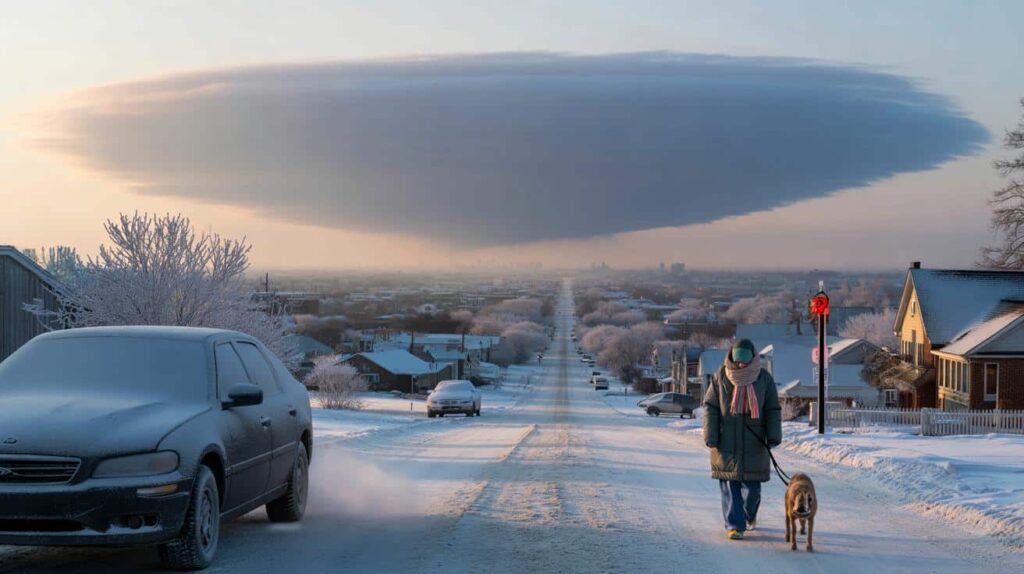
Early one recent morning, the usual drip of melting gutters fell quiet, breath fogged a little thicker, and the air suddenly felt heavier, as if someone had quietly closed a door on the season. On the outskirts of Chicago, a dog walker pulled her scarf higher and muttered, “This feels different,” without really knowing why.
At that exact moment, hundreds of miles away, a cluster of tiny blue and purple shapes on a meteorologist’s screen started to connect, stacking like heavy bricks of cold. A “cold dome” was taking shape over North America, a dense lid of Arctic air pressing downward.
The maps looked calm.
The models did not.
A silent giant above our heads
On big forecast days, TV weather studios don’t feel dramatic.
They feel tired.
Screens glow in dim rooms, coffee is lukewarm, and someone is always rereading the same model run for the fifth time. This week, what caught forecasters’ eyes was a slow, stubborn bulge of cold building over western Canada and the northern Plains, thickening day by day.
They call it a **cold dome**: a mass of very dense, very cold air that behaves less like a breeze and more like a heavy stone bowl dropped over a region. Once it settles, warmer air has a hard time shoving it away.
It just squats there.
And that’s when frost starts to bite earlier, sharper, and longer than usual.
If you zoom in on the latest model runs, a story starts to appear in numbers.
Meteorologists are tracking temperatures at around 850 hPa — roughly 1,500 meters above the ground — dropping 10 to 15°C below seasonal averages across large swaths of the continent in early February.
For people in Minneapolis, that could mean pre-dawn lows plunging into the -15°F to -20°F range again, just as they were starting to talk about “maybe an early spring.” In parts of the Midwest and interior Northeast, the forecast lines lean toward a string of nights well below freezing, without the usual daytime thaw to soften the blow.
One forecaster in Montreal described it bluntly in a local briefing: “This is the kind of pattern where pipes start to complain and car batteries suddenly remember their age.”
Cold domes don’t just cool.
They harden everything.
Why does this “dome” matter so much when winter is already cold?
Because it changes the rules of the game.
Under normal winter patterns, cold fronts slide through, then milder air sneaks back for a day or two. The rhythm is harsh but forgiving. When a cold dome forms, especially one anchored by strong high pressure, that ebb and flow slows. The cold thickens, hugging the ground, especially at night.
Moisture from passing systems can then ride up and over this chilled layer, turning ordinary showers into freezing rain, or light snow into powder that squeaks under your boots. *That’s when early-February frost stops feeling like a “cold snap” and starts to feel like a reset button pushed on the whole landscape.*
For energy grids, farmers, commuters, even school principals, that shift is everything.
How to live under a cold dome without losing your mind
There’s a small, practical art to surviving a stubborn stretch of deep cold.
It starts days before you actually feel it on your skin.
When meteorologists see a cold dome building, the quiet advice starts circulating: bleed outdoor faucets, check old weatherstripping, test the furnace before the real plunge. On a personal level, it can be even simpler. Move gloves and hats to the front door, not buried under beach caps from last year. Bring the car scraper inside for once.
One useful trick from northern nurses: create a “cold shelf” near your entryway — basket for neck warmers, hooks for scarves, a small box for chemical hand warmers. When the dome settles in and mornings are rough, reducing the number of decisions you have to make in the dark actually matters.
We’ve all been there, that moment when you’re already late, the car is frozen, and you’re scraping ice with a loyalty card because the real scraper is “somewhere in the trunk.” That’s exactly the kind of tiny chaos that a long, intense frost stretches out over weeks.
Experts say people consistently underestimate how tiring cold can be on the brain, not just the body. You sleep a bit worse, move a bit slower, and small irritations stack up like the snowbanks on the curb. The routine advice — hydrate more, layer properly, avoid long outdoor exposure — sounds basic. Let’s be honest: nobody really does this every single day.
Yet under a persistent cold dome, skipping the basics stops being just sloppy and starts edging into risky, especially for kids, older adults, and anyone with heart or breathing issues.
“People see one brutal night and think, ‘Okay, that’s the worst of it,’” says Laura Jensen, a broadcast meteorologist based in Fargo. “What worries us more is five, six, seven nights in a row below freezing, with no real daytime break. That’s when homes, roads, and bodies start to show hairline cracks.”
- Protect your home: Let faucets drip on the coldest nights, open cabinet doors under sinks on exterior walls, and clear snow away from basement windows and vents.
- Protect your body: Dress in three layers, not one giant coat; cover fingers, toes, and ears first; limit heavy outdoor work to shorter bursts.
- Protect your routines: Plug in car block heaters where possible, charge power banks, and set alarms a bit earlier to account for slow starts and icy commutes.
- Protect your neighbors: Check on older residents or anyone living alone, offer a ride when roads are slick, and share local warming-center info before someone needs it.
Under a dome, small gestures scale quickly.
What this cold dome quietly says about our winters
Step back from the maps for a moment, and the early-February cold dome tells a bigger, more complicated story about our changing winters. On one hand, long-term data still shows a warming trend, with fewer extreme cold days than in the 1970s or 1980s. On the other hand, the cold that does arrive can feel more chaotic, stitched between oddly mild spells and rain where snow “should” fall.
Some researchers are watching this dome in the context of a wobbly polar vortex and shifting jet stream patterns, where tongues of Arctic air dip farther south while other regions bake. The science is still being argued over in conferences and long Zoom calls. On the ground, people just feel the whiplash: backyard ice rinks melting one week, then creaking solid the next.
These are the winters our kids will grow up with — not the steady, predictable seasons our grandparents remember, but something more like a series of weather mood swings. Whether you’re enjoying the crisp air or bracing for heating bills, this developing cold dome is a reminder: the atmosphere still has teeth, even in a warming world.
How we adapt — from city infrastructure to the way we talk to each other on the coldest mornings — will say a lot about who we are in the years ahead.
| Key point | Detail | Value for the reader |
|---|---|---|
| Cold dome formation | Dense Arctic air building and settling over parts of North America in early February | Helps readers understand why frost may be harsher and longer-lasting than a typical cold snap |
| Daily-life impact | Stronger night frosts, higher risk of frozen pipes, tougher commutes and strain on energy systems | Translates technical forecasts into concrete situations people can anticipate and prepare for |
| Practical responses | Layering, home protection steps, checking on vulnerable neighbors, adjusting routines | Gives readers simple, actionable moves to stay safer, warmer and less stressed under persistent cold |
FAQ:
- How long can a cold dome last?Most cold domes last several days to around two weeks, depending on how strong the high-pressure system is and whether the jet stream shifts enough to push milder air back in.
- Is a cold dome the same thing as the polar vortex?No, the polar vortex is a large circulation of cold air high over the Arctic; a cold dome is the dense, surface-level pool of cold air that can form underneath when that circulation sends Arctic air farther south.
- Which areas are most at risk from early-February frost under this dome?Typically, interior regions away from the ocean — parts of the northern Plains, Midwest and interior Northeast — feel the sharpest, longest frost, but local forecasts are crucial.
- Can a cold dome bring more snow?On its own, a cold dome is just cold air, but when moist systems ride over it, they can generate heavy snow, powdery squalls, or even freezing rain depending on the temperature layers.
- What’s the best quick step to prepare my home?Insulate or cover exposed pipes, especially in unheated spaces, and identify the coldest spots in your home — basements, drafty windows, garage entries — so you can focus your efforts where they matter most.