Many passers-by see that bright ribbon and instinctively reach out for a pat, a photo, a quick cuddle. Yet that small strip of fabric is not a fashion choice. It is a quiet warning, a request for distance, and ignoring it can turn a calm walk into an avoidable incident.
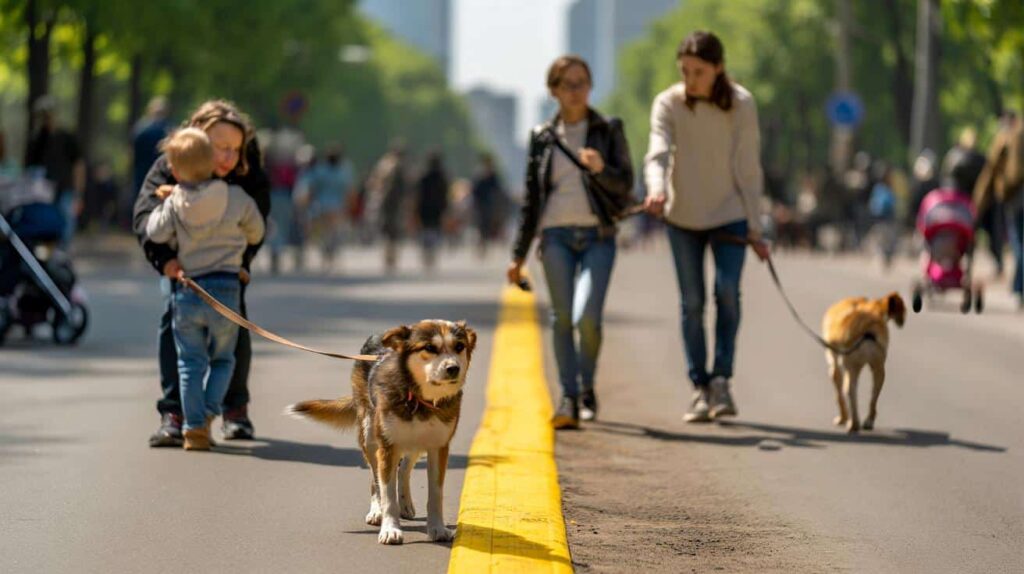
More than an accessory: a visual code for “give us space”
The yellow ribbon system started as a simple way for dog owners to communicate a basic need without confrontation: this dog should not be approached. No arguments on the pavement, no raised voices – just colour.
The yellow ribbon means: please keep your distance, do not touch the dog, and do not let your own dog run up.
Think of it like a temporary “no entry” sign wrapped around a lead. The idea is prevention: reduce stressful encounters before they happen, rather than managing the fallout after a growl, lunge or bite.
The ribbon can be tied to a lead, clipped to a harness, or attached to the collar. Some owners use yellow bandanas, lead covers or tags carrying words such as “nervous”, “training” or “do not pet”. Different designs, same message.
Why a silent signal works in busy streets
Urban walks are noisy and crowded. Dogs, prams, scooters, headphones, traffic – nobody has time to stop and explain their dog’s full medical and emotional history to every stranger. A visual code cuts through that chaos.
For owners of sensitive dogs, those few extra seconds of space can be the difference between a calm walk and a meltdown. For everyone else, it helps avoid awkward moments when an enthusiastic hand is met with a warning growl.
Health, fear or work: why some dogs need that buffer zone
A yellow ribbon does not mean “dangerous dog on the loose”. It usually means the opposite: a dog who is being carefully managed, who needs protection from rough or unpredictable encounters.
A dog wearing yellow is asking for peace, not trouble. The ribbon protects the dog as much as it protects you.
Common reasons a dog might wear a yellow ribbon
- Physical pain or fragile health: Dogs recovering from surgery, dealing with arthritis or other chronic pain can react sharply if bumped, hugged or jumped on. They look fine from a distance, but every step may hurt.
- Fearful or reactive behaviour: Some dogs are anxious or traumatised. A stranger’s hand over their head, or another dog rushing up, can trigger a panic response: barking, lunging or snapping to keep the threat away.
- Work in progress: When a dog is in the middle of training or behaviour rehab, surprise interactions are a nightmare. One unexpected cuddle can undo weeks of careful confidence-building or lead work.
- Hormones and mating: Unspayed females in heat can attract persistent male dogs from several streets away. A yellow signal can be a polite way of saying: now is really not the time.
In every case, the common thread is the need for calm, predictable space. The ribbon is not there to make the owner feel special; it is there because something about that dog, on that day, requires extra care.
How you should react when you see the yellow ribbon
The correct response is simple, and for dog-lovers, a little counterintuitive: do absolutely nothing.
See yellow on a lead? Keep walking, stay neutral, and act as if the dog is invisible.
That means no eye contact, no talking to the dog, no whistling, no “it’s okay, I’m good with dogs” approach. For many anxious or reactive dogs, even a friendly human staring or bending over them is an intense social pressure.
If you are walking your own dog, shorten the lead and calmly curve away. Avoid those nose-to-nose “meet and greet” moments that humans love and many dogs quietly hate. Most leash fights start with one dog invading the other’s personal space.
This quiet indifference is not rudeness. In this context, it is respect. You are giving the dog and their person a rare gift: a peaceful, uneventful walk.
Why ignoring the ribbon can end badly
Many people assume that if a dog is in public, it must be fine with being touched. That belief puts both humans and dogs in difficult situations.
| Typical reaction | Dog’s possible experience | What can go wrong |
|---|---|---|
| “He looks friendly, I’ll just say hello.” | Dog feels trapped by a stranger’s hand over its head. | Growling, snapping, bite to warn the person away. |
| Letting your dog run up “to make friends”. | Nervous dog feels attacked or overwhelmed. | Leash fight, injuries, vet bills, conflict between owners. |
| Ignoring the owner saying “please don’t touch”. | Owner loses control of a training situation. | Setback in behaviour work, increased fear next time outside. |
When incidents happen, the dog in yellow is often blamed as “aggressive”, even if it tried to warn with body language first. The ribbon is an extra layer of warning aimed at people who do not read subtle cues like lip-licking, yawning or turning away.
How owners can use the yellow signal thoughtfully
For guardians of sensitive dogs, the ribbon is a tool, not a magic shield. It works best when combined with clear handling and honest communication.
- Be consistent: Use the yellow marker on every walk so the dog learns that people usually keep away when it is on.
- Choose visibility: A bright ribbon, bandana or “nervous dog” lead cover is easier to spot at a distance than a tiny tag.
- Support the signal with body language: Keep the lead short but relaxed, and position yourself between your dog and approaching strangers when needed.
- Have a polite script ready: Phrases like “she’s in training, please give us space” or “he’s not comfortable with strangers” help reinforce the message.
Used this way, the yellow ribbon does not isolate the dog forever. It can buy enough calm time for training, healing or gradual socialisation to succeed.
Common misunderstandings around the yellow ribbon
Despite growing awareness, many people still misinterpret what the yellow signal means. Clearing up a few myths helps everyone share pavements more peacefully.
- “Yellow means the dog is dangerous.” Not necessarily. Many are simply in pain, shy, or overloaded by busy environments.
- “If the dog is out on the street, it must be fine to touch.” Dogs do not lose their right to boundaries because they are in public.
- “Children need to meet lots of dogs to learn to love animals.” Teaching children to ask before touching, and to accept no for an answer, is a far more valuable lesson.
Scenarios that show why this signal matters
Picture an older Labrador with stiff hips, walking slowly after surgery. From the other side of the road, he looks like the perfect family dog. A child runs up to hug him around the back legs. Sudden pain, a startled snap, frightened tears – and a dog now labelled “unpredictable”. A yellow ribbon could have prompted the parent to hold back.
Or imagine a rescue dog who spent months in a shelter after being attacked by other dogs. His new owner is working with a behaviourist, taking short, controlled walks with treats and calm praise. A loose dog rushes straight into his face “to say hi”. The fearful dog explodes. Weeks of careful work unravel in seconds.
In both cases, the yellow signal is not about blaming other people. It is a realistic way of managing risks in shared spaces, where not everyone can read a dog’s tiny warning signs.
Practical tips for walkers, parents and dog owners
Whether you own a dog or not, a few habits can make walks safer and less stressful for everyone.
- If you see any yellow on dog gear, assume it means “do not approach”.
- Teach children to always ask the owner, “Can I say hello?” and to accept “no” cheerfully.
- Keep your own dog close around narrow pavements, shop entrances and busy junctions.
- Avoid letting extendable leads run out around unknown dogs; reel in and pass with space.
- When in doubt, ignore the dog and walk on. Friendly owners without issues will invite interaction.
Related signals and terms worth knowing
The yellow ribbon has become the most widely recognised distance cue, but similar ideas are spreading. Some dogs wear harnesses marked “assistance dog” or “do not distract”. These animals may be guiding blind handlers, alerting to seizures, or supporting people with autism or PTSD. Interacting with them without permission can interrupt life-saving work.
You might also hear trainers talk about “reactive dogs”. This does not mean “bad-tempered” or “vicious”. It usually describes dogs who react strongly to triggers – like other dogs, bikes or strangers – because they feel unsafe or overwhelmed. The yellow signal gives them a chance to move away before their stress spills over.
Used thoughtfully, that small strip of yellow turns into a shared language between dog owners and everyone they meet on the pavement. One quick glance, one choice to keep your hands to yourself, and the walk stays quiet, safe and, for that dog on the end of the lead, just a little less frightening.