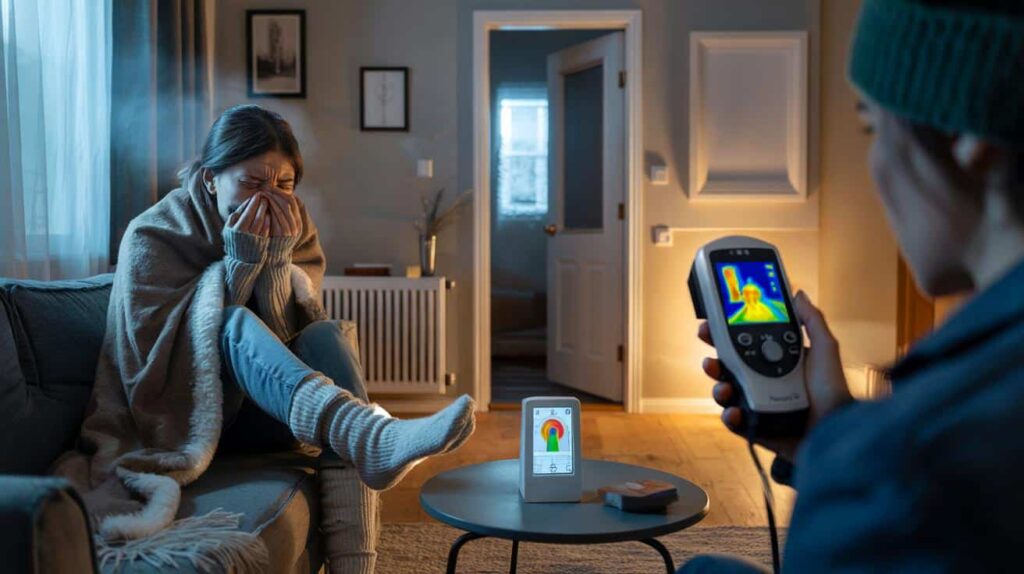
The third time I padded barefoot to the thermostat, it was midnight and the screen already glowed 24°C. The radiators were humming, the gas meter was spinning, yet my fingers felt like ice. The living room looked cozy on Instagram, with its lit candles and chunky knit throw. Reality: I was huddled under two blankets, wondering if I was getting sick or slowly going broke heating the street.
Somewhere between the draft under the front door and the window that never quite shuts, the warmth was escaping. I’d tap the thermostat up one more degree and wait, like some strange modern ritual.
The house stayed stubbornly cold.
Experts say this scene is way more common than we think.
Why your home feels cold even when the heating is blasting
The first surprising thing experts say: if you keep turning the heat up and still feel cold, your thermostat is probably not the villain. The real culprits are usually silent and invisible – tiny air leaks, poorly insulated walls, a badly placed radiator, a clogged filter. Your body doesn’t care what the thermostat says. It cares about what it feels on the skin and how fast warm air vanishes into thin air.
You end up paying to heat your neighborhood, while your feet stay numb on the tiles. It feels a bit like throwing coins out of the window with every comforting click of the boiler.
Energy consultant Laura Mendes sees this same scene in home after home. She tells me about a family in a 1990s semi-detached house who kept their thermostat at 23°C all winter. Their bill? Almost 40% higher than similar homes on the same street. Yet the kids still complained it was “freezing” in the living room by 8 p.m.
When Laura walked around with her thermal camera, the images were brutal. Big blue streaks around the windows. A cold patch right behind the sofa where insulation was missing. The front door frame was practically a wind tunnel. “You’re not cold because your heating is weak,” she told them. “You’re cold because your house is leaking heat faster than you can buy it.”
What’s happening is simple physics dressed up as frustration. Warm air naturally moves toward colder areas. If your walls, roof, or windows are poorly insulated, they suck out the heat like a sponge. Drafts under doors or through keyholes create tiny currents that cool your skin, even if the thermostat reads 22°C.
Your body also reacts to surfaces around you. Sitting next to a cold window makes you feel chilly, even in a “warm” room. Experts call this mean radiant temperature. You just call it “Why am I freezing when the heating is on?” Two names for the same annoyance.
What experts really do first when a home always feels cold
When professionals visit a “cold” home, they rarely start by fiddling with the thermostat. The first move is almost always a slow walk around the house, hand outstretched, feeling for drafts along skirting boards, window frames, sockets, and doors. A tissue or a candle flame can reveal sneaky air movements that your eyes can’t see.
They’ll often suggest one simple ritual: before you boost the heat, do a five‑minute “heat check”. Close interior doors, pull curtains at night, open them to the sun in the morning, and block obvious drafts with strips or simple draft stoppers. Then let the heating do its job at a steady temperature, rather than yo‑yoing up and down.
People also underestimate how much furniture can sabotage a whole heating system. Sofa pushed right against the radiator? Long curtains covering a heater? Big shelf unit hiding a convector? You’re basically putting a pillow over the mouth of your heating. The air can’t circulate, so the room never really feels evenly warm.
Plumber and heating engineer Tom Riley tells me he often just moves a sofa 20 centimeters and hears, “Oh wow, it’s already warmer.” No new boiler, no massive investment. Just letting the warm air actually reach you instead of being trapped behind fabric and wood.
Let’s be honest: nobody really bleeds their radiators or cleans their heat pump filters every single month. Yet those unglamorous chores are exactly what experts insist on. Air trapped in a radiator means it never gets fully hot at the top, so you crank the thermostat higher to compensate. A clogged filter on a heat pump makes it work harder, consume more electricity, and still blow out lukewarm air.
“People call me out convinced their boiler is dying,” says Tom. “Half the time, I bleed the radiators, balance them properly, and suddenly the same system feels like a different house.”
- Seal obvious drafts: door bottoms, window frames, letterbox, keyholes.
- Free your radiators: no furniture in front, no heavy curtains over them.
- Bleed and balance radiators at the start of the season.
- Use thick curtains at night and let sunlight in by day.
- Keep a stable, moderate temperature instead of constant thermostat spikes.
Rethinking “warmth” at home, beyond the thermostat number
Once you notice it, you can’t unsee it: warmth at home is a mix of physics, habits, and a bit of psychology. We chase a number on the wall, yet what truly matters is how our body experiences the space. Draft on your neck, cold floor under your feet, glass that chills the side of your face on the sofa. These micro‑details decide whether you grab another sweater or tap the thermostat again.
Experts quietly agree on a strange truth: many homes don’t need more power, they need more intelligence in the way that power is used and kept inside.
That also means the solution is often more accessible than buying a brand‑new boiler. Insulating a loft hatch, adding a rug on a cold floor, fixing that one window that never quite closes, programming the heating to rise before you wake instead of hammering it at 7 a.m. with chattering teeth. None of these things looks impressive on social media. *They just work in the background, every single day of winter.*
We’ve all been there, that moment when you stand in the hallway, hesitating between turning up the heat or putting on thicker socks, wondering why staying warm is suddenly a small life puzzle.
So maybe the next time your fingers go numb and your first reflex is to stab the thermostat button, you pause. You listen for the faint whistle of a draft, feel along the wall, look at that armchair blocking the only radiator in the room. You ask: am I really cold because of the temperature… or because the warmth is leaking away from me?
Some people start with an energy audit, others with a roll of draft tape and a cheap thermal camera attachment for their phone. Either way, once you shift focus from “more heat” to **less loss**, your home slowly changes personality. Quieter, softer, more predictable. Maybe that’s the real luxury – not a bigger boiler, but a house that finally learns to hold on to the warmth you already pay for.
| Key point | Detail | Value for the reader |
|---|---|---|
| Stop overheating | Stable, moderate settings reduce energy use and keep rooms more comfortable | Lower bills and fewer temperature swings |
| Hunt the drafts | Seal gaps around doors, windows, floors, and outlets | Instant improvement in comfort with minimal cost |
| Let heat circulate | Unblock radiators, bleed them, and balance the system | Existing heating works better without expensive upgrades |
FAQ:
- Why do I feel cold at 22°C while others feel fine?Your body reacts not just to air temperature but to drafts, humidity, and cold surfaces. If walls or windows are chilly, or if air moves across your skin, you’ll feel colder than the thermostat reading suggests.
- Is it cheaper to leave the heating on low all day or to turn it on and off?Experts tend to favor steady, well‑timed heating with a programmer. Letting the house cool completely and reheating from scratch can use more energy, especially in badly insulated homes.
- My radiators are hot but the room is still cold. Why?Warm radiators plus a cold room usually mean heat is being blocked or lost. Check for furniture in front of heaters, long curtains, drafts, or missing insulation around windows and walls.
- Do smart thermostats really help with feeling cold?They can, by learning your routine and pre‑heating rooms before you use them. The real magic comes when they’re combined with better insulation and good habits at home.
- What’s the first low‑cost step to take if my home always feels cold?Start with a “draft hunt” and seal obvious gaps, then bleed radiators and free them of obstacles. Those three moves often bring a noticeable comfort boost for very little money.