The robin lands almost at your feet, a little orange-breasted daredevil against the grey winter sky. You hold your breath, watching it hop across the frosted patio, head tilted, waiting. In your hand: a crust of pastry from yesterday’s mince pies, a bit of bacon fat from Sunday’s roast, the kind of scraps many of us throw out onto the lawn with a quiet sense of virtue. You feel you’re doing the right thing. A tiny act of kindness in a hard season.
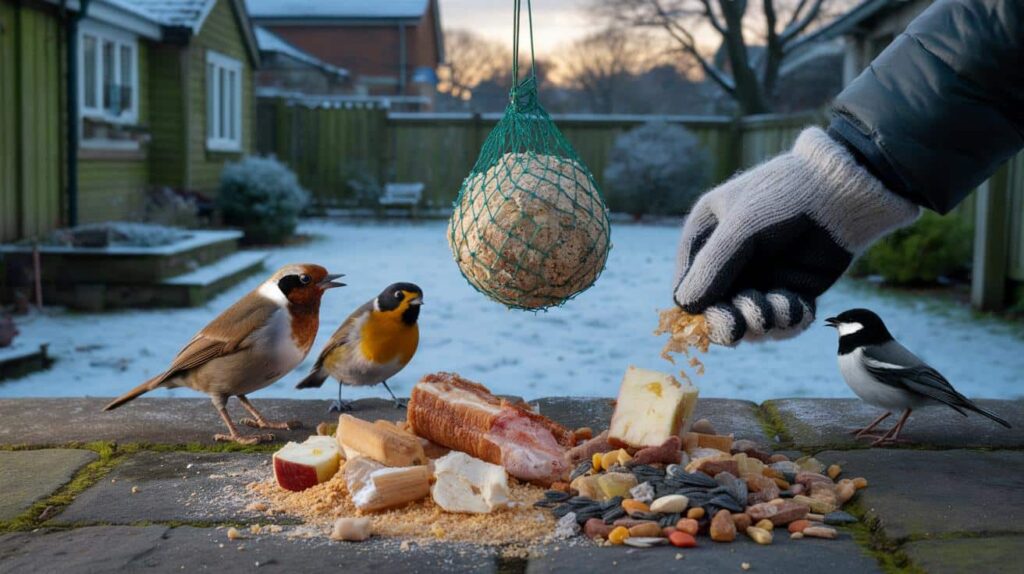
The bird grabs a chunk that looks far too big for its body and flutters away.
You smile, close the door, and put the kettle on.
You don’t see the way that same treat might clog its gut. Or what happens to its liver in the weeks that follow.
You just see an empty plate.
When winter kindness hides a cruel side
Every winter, across small gardens and city balconies, people turn into amateur bird wardens. We hang fat balls, throw out leftover cake, pile up soft bread, and feel quietly pleased when robins, blackbirds, and tits gather like confetti around the feast. It feels like a gentle rebellion against the cold.
Yet behind the charming scene, something uncomfortable lurks. Many of the treats we scatter are closer to junk food than survival fuel. The birds don’t know this, of course. They eat what’s easiest, quickest, richest. And some pay with slow, unseeable damage that starts long before any wing falls silent.
Take the humble fat ball, that winter classic. Sold in net bags, hung from branches, they’re marketed as “high-energy” saviours. In theory, that’s true. Birds do need dense calories when the ground freezes. But cheaper versions are often made from low-quality fats that go rancid quickly, especially if they sit in damp, mild spells. A robin can’t smell oxidation. It just sees food.
Now picture the stale white bread tossed out “so it doesn’t go to waste”. A blackbird fills up on those soft slices, feeling sated. Full, but not nourished. No real protein. No micronutrients. Just a heavy lump in a tiny stomach, leaving less room for the insects, fruit, and seeds it desperately needs.
This is where the hidden harm begins to stack up. High-fat, low-nutrient diets can trigger obesity in garden birds, just as in pets. Layers of fat around their organs, disrupted metabolism, weakened immune defences when cold snaps hit hardest. They still look adorable on the feeder, fluffed up, bright-eyed. We don’t see enlarged livers or digestive blockages from dried mealworms and oversized chunks of suet.
Scientists have been warning for years that winter feeding shapes survival, breeding success, and disease patterns. We just rarely connect the dots between our kitchen leftovers and a blackbird quietly struggling to fly that bit further, that bit faster, when a predator appears. The risk isn’t dramatic, like a dead bird at the back door. It’s a slow erosion of resilience.
What robins and blackbirds really need from your table
The twist is that helping garden birds safely is not about doing less. It’s about feeding them more like birds and less like tiny feathered humans. Robins and blackbirds are not seed machines. They’re mainly ground feeders, evolved for a mixed, shifting diet of insects, worms, berries, and fallen fruit.
When you scatter food, think “small, soft, and natural”. Unsalted, finely chopped peanuts. Grated mild cheese in tiny threads. Cut-up apples or pears on the grass. High-quality fat balls, ideally net-free, broken into morsels no bigger than a pea. Mixed birdseed with oats and sunflower hearts, not just cheap wheat filler. These are the quiet upgrades that change everything for a bird that weighs less than a letter in your hand.
We’ve all been there, that moment when you’re scraping plates and suddenly think, “The birds will love this.” A bit of sausage, a buttery crust, the corner of a muffin. It feels thrifty, generous, almost nostalgic. Yet festive leftovers are a minefield for robins and blackbirds. Salty gravy, cured meats, seasoned stuffing, heavily processed fats – all these hit their organs like a slow-moving storm.
Plain-truth sentence: nobody really reads the fine print on bird food bags every single day. So the same mistakes play out year after year. Too much bread, cheap fat blocks, sugary scraps. When you switch to species-appropriate food, you’re not just being “good”. You’re matching your kindness to their biology.
“People rarely see the direct consequence of poor winter feeding,” says one urban ecologist I spoke to in a frost-bitten London park. “Birds just seem to disappear. But behind those vanished songs, you often find underweight bodies, fatty deposits, and signs of chronic stress. It’s death by a thousand tiny treats.”
To turn that around, some practical guidelines help. Think of them as a quiet toolkit for kinder winters:
- Offer high-energy foods from reputable brands, not bargain-bin fat full of fillers.
- Prioritise variety: seeds, fruit, a little grated cheese, soaked oats, and soft suet.
- Cut everything into small pieces, especially for robins and blackbirds feeding on the ground.
- Keep feeders clean and rotate feeding spots to limit disease spread.
- Avoid salty, seasoned, mouldy, or sugary human food, no matter how much they “seem to love it”.
A different way to share your winter garden
Once you start seeing your bird table as a kind of open-air kitchen, the whole scene changes. That robin at the edge of your patio isn’t a character in a Christmas advert. It’s a tiny animal walking a razor’s edge between enough energy and too much of the wrong kind. The blackbird that yanks a worm from your soggy lawn isn’t craving cake crumbs; it’s trying to balance protein, fat, and fibre on a schedule measured in heartbeats.
*Feeding them well becomes less about a moment of joy at the window and more about a quiet, sustained responsibility.* You don’t need to be perfect. You just need to be a little more curious about what goes into that beak and what it does once it gets there.
| Key point | Detail | Value for the reader |
|---|---|---|
| Choose quality over quantity | Use species-appropriate, reputable bird foods instead of random scraps | Reduces hidden suffering and improves bird survival in your garden |
| Match food to natural diets | Focus on seeds, fruit, soft suet, insects, and small portions | Supports healthy metabolism, immunity, and breeding success |
| Feed with hygiene and moderation | Clean feeders, avoid mouldy food, rotate spots, don’t overfeed junk | Cuts disease risk and prevents mass mortality events |
FAQ:
- Can I still give bread to robins and blackbirds?A tiny amount of plain, stale (not mouldy) bread won’t kill them, but it fills them up without nutrition. Better to replace it with oats, fruit, or quality birdseed.
- Are fat balls dangerous for birds?Cheap or old fat balls can go rancid, and net bags can trap legs and feet. Use net-free, good-quality fat balls, break them up, and replace them regularly.
- Is it bad to feed birds all year round?No, feeding year-round can help, especially in urban areas. Just adapt what you offer: more high-energy in winter, more balanced and varied food in spring and summer.
- What is the safest winter food for robins and blackbirds?Soft fruits (like apple pieces), soaked raisins, mealworms in moderation, quality suet pellets, sunflower hearts, and finely chopped peanuts are excellent options.
- How can I tell if I’m overfeeding or causing harm?If food lies uneaten and goes mouldy, or if you rely heavily on bread and leftovers, it’s a red flag. Aim for small, regular portions of varied, bird-specific food and keep everything clean.