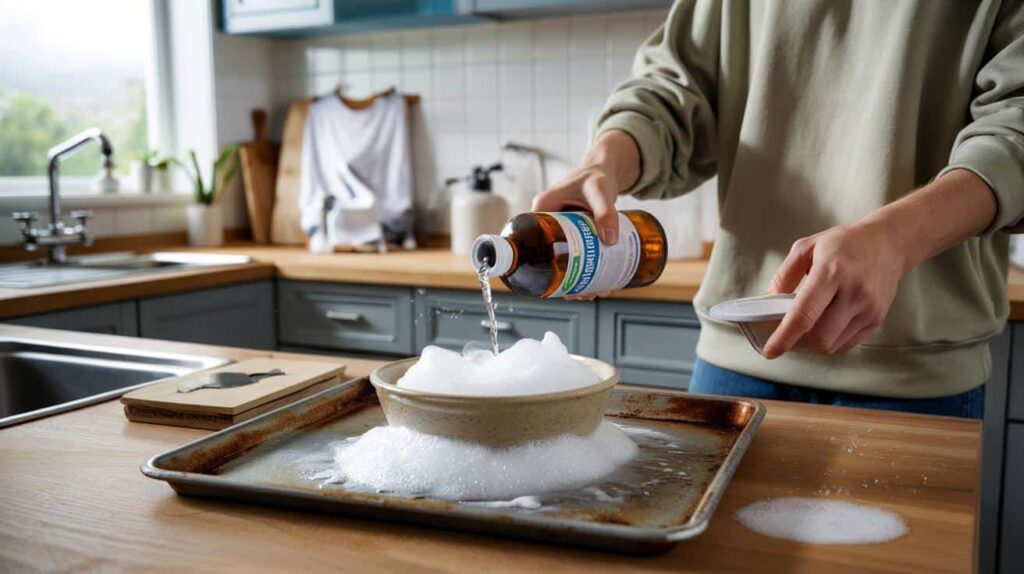
On a rainy Tuesday in a cramped city kitchen, a woman in an oversized sweatshirt stands over her sink, squinting at two unremarkable bottles. One is an old cardboard box of baking soda, soft at the corners from years of opening and closing. The other is a brown bottle of hydrogen peroxide she bought once for a skinned knee and then forgot in the back of the medicine cabinet. She tips a spoon of white powder into a small bowl, adds a splash of clear liquid, and watches as the mix fizzes like a tiny, quiet volcano. She isn’t doing a school science experiment. She’s cleaning her stained baking trays. And slowly, quietly, this exact scene is playing out in thousands of homes.
Something big is happening in those little bubbles.
The odd couple that keeps showing up in expert tips
If you scroll through home hacks on your phone these days, baking soda and hydrogen peroxide pop up like a recurring character in a long-running series. One day it’s a dentist talking about brightening teeth. Another day, a dermatologist mentions it for stubborn underarm stains. Then a cleaning expert swears this duo can rescue the grimiest grout. Many of these pros don’t know each other, yet they keep recommending the same two cheap, almost boring products. It starts to feel less like a trend and more like a quiet revolution hiding under your kitchen sink.
One cleaning coach I spoke with described her “conversion moment” in almost religious tones. She had a rental apartment to turn around in 24 hours, with a baked-on oven that looked like it had never met a sponge. No fancy product worked, not even the ones that promise miracles on TV. Out of frustration, she mixed baking soda into a paste, splashed in hydrogen peroxide, and spread it over the blackened metal racks. After half an hour, she wiped once and watched years of gunk slide off. That day, she says she threw out three different branded cleaners. “I just didn’t need them anymore,” she shrugged.
Experts love this pairing for a simple reason: the chemistry makes sense. Baking soda is mildly abrasive and alkaline, so it loosens dirt, deodorizes, and softens surface stains without scratching most materials. Hydrogen peroxide, on the other hand, is a gentle oxidizer that breaks down color molecules and kills many bacteria and fungi. When they meet, you get a bubbly, slightly foamy paste that clings to surfaces instead of sliding off. You’re not dealing with magic. You’re watching a small, controlled reaction doing the heavy lifting for you.
How to actually use this duo without wrecking your stuff
The basic method experts repeat is disarmingly simple. Sprinkle baking soda generously on the area you want to treat: a cutting board, a grout line, the inside of a stained mug, a yellowed sink. Then drizzle hydrogen peroxide over it until it looks like wet sand and starts to fizz. Let it sit for 5–15 minutes, depending on the stain, resisting the urge to scrub right away. When the bubbles calm down, gently rub with a cloth, sponge, or soft brush, then rinse with plenty of water. For vertical surfaces like grout or the back of an oven, many pros like to stir the two into a thicker paste in a bowl first, then smear it on with an old toothbrush.
The honest truth? Most people hear this kind of tip and then either overdo it or never try it at all. Some pour on far too much peroxide, creating a runny mess that drips before it can work. Others use it once on the wrong surface, get a disappointing result, and give up. We’ve all been there, that moment when a “miracle hack” doesn’t look like the TikTok video. Experts quietly point out that the trick is patience and moderation. Thin layers, short contact times, and spot tests in a hidden corner matter more than dramatic before-and-after photos.
One chemist I interviewed summed it up in a plain, almost blunt sentence:
“This combo is powerful, but it’s not a magic wand. It’s a tool, and tools need a brain attached.”
She warns against using high-strength hydrogen peroxide from hair bleaching kits or industrial supplies on household surfaces. Stick to the 3% pharmacy version for most uses. She also insists on a quick test on fabrics, grout, or sealed stone, because lightening stains can slide into lightening colors. Let’s be honest: nobody really reads product labels every single day, but with this duo it’s worth pausing a second. To keep it practical, here’s what professionals say they actually use it for:
- Home cleaning: oven racks, baking trays, grout, cutting boards, sinks
- Textiles and laundry: sweat stains, mattress spots, dingy white socks
- Bathroom help: soap scum on tiles, mild mold on silicone joints
- Care uses (with caution): occasional whitening toothpaste base, nail brightening, cleaning hairbrushes
- Miscellaneous: deodorizing trash cans, freshening fridge shelves, reviving stained coffee mugs
A small mix that quietly changes how we look at “clean”
There’s something strangely satisfying about realizing two simple, cheap products can replace half a cupboard of colorful bottles. It feels a bit like pulling back a curtain: so much of what we buy is perfume, dye, and marketing wrapped around a handful of basic ingredients. *Once you see baking soda and hydrogen peroxide at work, that knowledge is hard to unsee.* Some people start with ovens and end up rethinking their whole cleaning routine. Others just adopt one new habit, like rescuing white T‑shirts from yellow sweat marks before tossing them in the bin.
The growing body of research around this duo points in the same direction: controlled, targeted use can be both effective and gentler than you’d expect. Lab tests show hydrogen peroxide breaking down into water and oxygen, leaving no harsh residue behind. Baking soda rinses away easily, without the slick film that many all-purpose cleaners leave. For families with kids, pets, or sensitive skin, that’s not a minor detail. It’s a quiet kind of reassurance, the kind that doesn’t shout on a label but feels better in your lungs and on your hands.
At the same time, experts keep repeating a simple caution: “natural” doesn’t mean harmless. That brown bottle can still irritate skin and discolor fabrics if you splash it carelessly. Baking soda can scratch delicate coatings if you scrub like you’re sanding a plank. The power of this pair isn’t in using more, or using it everywhere. It’s in using it consciously, in small, precise ways that slowly add up. And that’s maybe the real surprise behind this fizzing duo: not just the shine it brings back to your oven door, but the feeling that you’re a little more in control of what “clean” means in your home.
| Key point | Detail | Value for the reader |
|---|---|---|
| Versatile cleaning duo | Baking soda adds mild abrasion and deodorizing power, hydrogen peroxide offers stain-lifting and disinfecting | Helps tackle tough jobs (grout, ovens, stains) with two low-cost products you probably already own |
| Simple, repeatable method | Sprinkle baking soda, drizzle 3% hydrogen peroxide, let it fizz, then gently scrub and rinse | Gives a clear, easy routine you can adapt to different rooms and surfaces |
| Safer, more conscious cleaning | Breaks down into water, oxygen, and rinsable residue when used correctly, with spot tests and moderation | Reduces reliance on harsh chemicals while keeping control over health, budget, and indoor air quality |
FAQ:
- Can I use baking soda and hydrogen peroxide on my teeth every day?Most dentists say no. Occasional use in a very mild paste can help surface stains, but daily use may wear down enamel and irritate gums. Keep it rare and gentle, and ask your dentist first.
- Will this mix bleach colored fabrics?It can. Hydrogen peroxide has a lightening effect on dyes, especially when combined with baking soda’s alkalinity. Always test a hidden corner of fabric and use it mainly on whites or very light textiles.
- Is it safe to mix baking soda, hydrogen peroxide, and vinegar together?Experts strongly advise against stacking random reactions. Peroxide and vinegar combined in a closed or concentrated space can form peracetic acid, which is irritating and potentially harmful. Use one method at a time, with a rinse in between.
- Can I store the mixed paste for later use?No. The reaction starts as soon as the two meet and then loses strength over time. Mix only what you need on the spot, apply it, and discard the rest after cleaning.
- What strength of hydrogen peroxide should I buy?For home cleaning and light care uses, professionals recommend standard 3% hydrogen peroxide from the pharmacy or supermarket. Stronger concentrations are meant for specialized uses and can damage skin, surfaces, and fabrics.