That small, slightly awkward gesture can spark debate at the table. Is it good manners, meddling, or a subtle bid for control? Psychologists say it may reveal far more about personality than most diners realise.
Why stacking plates is more than just “being nice”
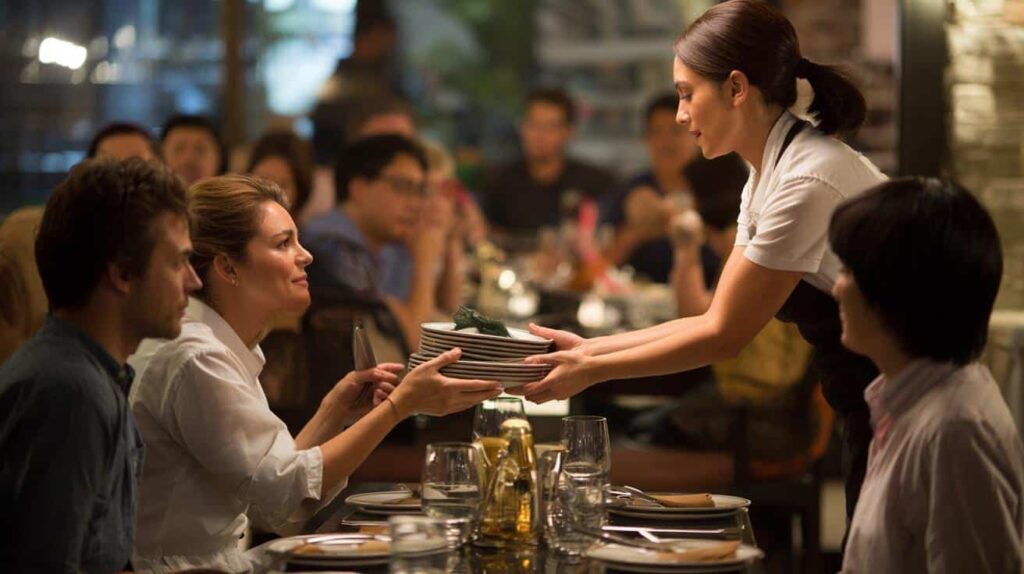
In many restaurants, there are two kinds of customers. Some quietly stand up, say thank you and leave everything as it is. Others cannot resist tidying the battlefield of plates, cutlery and empty glasses before the waiter arrives.
At first glance, it looks like simple politeness. You make the server’s job a bit easier, save them a few seconds, maybe speed up the table turnover. Yet researchers who study social behaviour see a deeper pattern.
Helping the server clear the table is often a visible sign of kindness and a strong capacity for empathy.
Martin L. Hoffman, an American psychologist known for his work on empathy, has argued that these small behaviours are rarely just “logistical help”. When someone instinctively gathers plates for a stranger’s benefit, they are not only thinking about the task; they are actively thinking about the other person’s day, mood and workload.
In psychological terms, this gesture sits within what specialists call prosocial behaviour.
Prosocial behaviour: the science behind the gesture
Prosocial behaviour covers voluntary actions aimed at helping others, without expecting a reward. The goal is to bring comfort, joy or a bit of relief to another person.
Psychologists define prosocial behaviour as voluntary actions directed towards others, driven by care, support and a wish to improve their well-being.
Most people are capable of such behaviour, but not in the same way and not with the same people. Many individuals keep their efforts for family and close friends. Offering that same generous reflex to complete strangers, such as a busy server, is much less common.
What this says about your personality
Helping clear the table can reflect several traits, often mixed together:
- High empathy: you can imagine what the server is going through and want to lighten their load.
- Social awareness: you read the room, see that they are in a rush, and step in.
- Internalised politeness: the gesture feels normal, even expected, because of how you were raised.
- Occasional need for control: in some cases, tidying the scene soothes a personal need for order.
Empathy is key here. Those who act without being asked often see the server as a full person, not just part of the restaurant setting. Their brain makes a quick emotional calculation: “If I do this, their evening might be slightly easier.” That short inner dialogue can be automatic, built up over years of repeated behaviour.
Childhood lessons that resurface at the restaurant
Psychologists studying the development of empathy have noticed a strong link with childhood environment. Hoffman, in his work on moral development, argues that caring behaviour is partly learned by imitation. Children copy the adults they watch every day, not just what they’re told.
Growing up around adults who help others freely makes prosocial gestures, like aiding a server, feel natural in adulthood.
If someone repeatedly saw parents hold doors, carry bags for neighbours or chat kindly to staff, those scenes can become their template for “normal” social life. By the time they reach adulthood, picking up plates in a restaurant may feel as automatic as saying please and thank you.
Research by psychologist Michael Tomasello also suggests that children show early signs of spontaneous helping. A toddler might hand over an object an adult has dropped, with no promise of reward. Families and schools can either strengthen or slowly suppress that instinct, depending on how they respond.
Helping strangers versus helping loved ones
Prosocial actions do not all carry the same weight. Holding your partner’s bag or making tea for a friend fits within relationships where affection, habit and mutual support are expected.
Helping strangers, though, follows a slightly different logic. There is less emotional payoff, less chance of a favour being returned, and sometimes even a social risk if the gesture is misread.
| Type of prosocial act | Typical context | Psychological meaning |
|---|---|---|
| Clearing plates for a server | Restaurant, brief contact | Empathy towards strangers, social awareness |
| Helping with a pushchair on stairs | Public space, physical effort | Responsiveness to visible need, altruism |
| Carrying someone’s shopping | Street, shop, neighbours | Readiness to offer time and energy |
| Giving blood | Health services, anonymous | Abstract concern for others’ survival |
| Volunteering a few hours | Charities, community groups | Stable commitment to others’ well-being |
In all of these, the person acts with no guaranteed direct benefit. Yet regular engagement in such acts tends to be linked with higher life satisfaction, a stronger sense of meaning and better social bonds.
When helping can feel intrusive
Not everyone welcomes assistance at the table. Some waiters see customers reaching for plates as a kind gesture; others feel it interrupts their routine or breaks safety rules in crowded dining rooms.
The same behaviour can be interpreted in two ways:
- As a genuine attempt to cooperate and reduce workload.
- As interference from someone who cannot bear to sit still.
The difference often lies in timing and attitude. A quiet “Can I pass these to you?” gives the server the chance to accept or decline, and keeps the power dynamic balanced. For anxious or perfectionist diners, the gesture might be less about empathy and more about easing their own discomfort with mess or waiting.
Prosocial habits beyond the restaurant
Clearing a table is only one expression of a wider pattern. Psychologists often group such behaviour with everyday micro-acts that hold social life together.
Common examples include:
- Letting someone go ahead in a queue when they look stressed.
- Offering a seat on public transport without being prompted.
- Checking on a neighbour during extreme weather.
- Spending a few hours at a shelter or food bank.
Each action is small, yet the accumulation changes how communities feel. People surrounded by such gestures report higher trust in strangers and are more likely to help in turn, creating a cycle of kindness.
Practical ways to read – and use – this insight
For readers curious about their own behaviour, a simple self-check can be helpful. Next time you’re in a restaurant or café, watch your instinctive reaction once the meal is over. Do you feel a pull to help, or a need to wait for instructions?
Try running a brief inner scenario: if the server looks overloaded, would a discreet offer help them, or slow them down? Matching your impulse with their visible needs keeps the gesture aligned with genuine empathy rather than personal habit.
For parents, small rituals at home can shape future behaviour. Asking children to help set or clear the table, thanking them explicitly, and pointing out how their actions help others all reinforce the idea that care is active, not abstract.
Key terms and what they really mean
Two concepts often appear in this research, and they are worth separating clearly.
- Empathy: the capacity to feel or imagine what someone else might be experiencing. It creates the emotional push to act.
- Prosocial behaviour: the concrete action taken to help, comfort or support another person.
A person might feel empathy yet stay silent if they fear embarrassment. Another might act helpfully out of habit, with little emotional involvement. When both line up—feeling and action—the result is that quick, almost automatic move to pass your plates to a tired server and lighten their evening, even just a little.