Built to squeeze geological ages and vast landscapes into a compact laboratory chamber, China’s latest hyper-gravity centrifuge is quietly rewriting how engineers and scientists study the planet.
China’s new machine that bends time and space for science
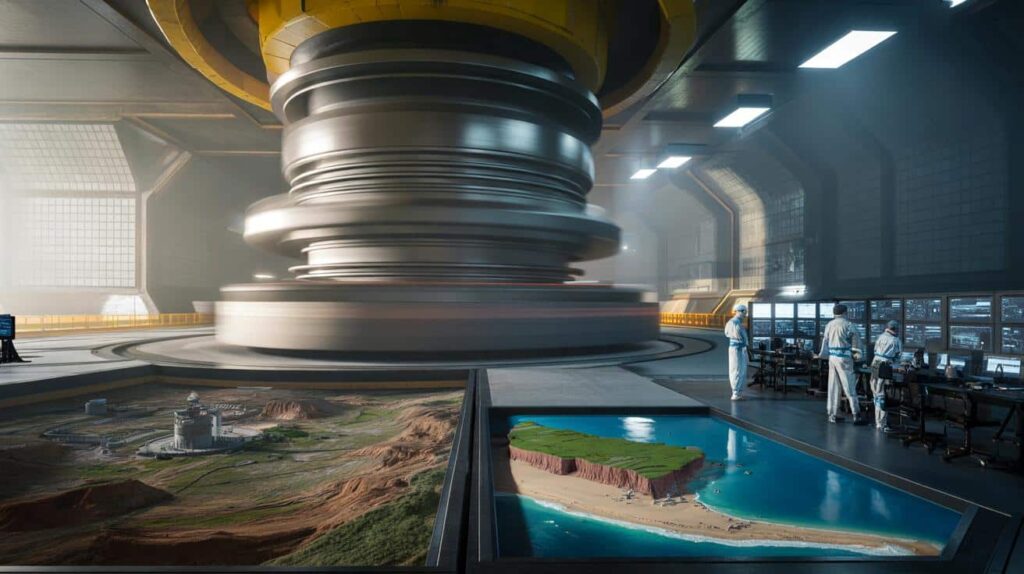
China has unveiled the CHIEF1900, a colossal research centrifuge designed to generate extreme levels of gravity, or “hypergravity”, on demand. Developed by Shanghai Electric Nuclear Power, the device took just five years to move from concept to near-completion.
Its headline figure is startling. The CHIEF1900 is rated at 1,900 g‑tonnes, a measure that combines gravitational force and the mass it can spin. That puts it far beyond the previous global record, held by a US Army Corps of Engineers centrifuge in Vicksburg, Mississippi, which tops out at 1,200 g‑tonnes.
The CHIEF1900 is currently the most powerful scientific centrifuge on Earth, capable of loading entire miniature landscapes into a spinning arm.
The machine follows fast on the heels of another Chinese record-setter, the CHIEF1300, installed near Zhejiang University in Hangzhou and commissioned only a few months earlier. Together, they signal a rapid escalation in China’s ambitions to dominate high-end experimental infrastructure.
How a hypergravity centrifuge “compresses” time and distance
On the surface, a centrifuge is a simple concept: a rotating arm spins around a central hub, and anything attached to it feels a force pushing it outward. On Earth, we feel 1 g from gravity. In a centrifuge, that force can be multiplied thousands of times.
What makes machines like CHIEF1900 special is not just their brute force, but what that force allows researchers to simulate.
By subjecting scale models to thousands of g, scientists can reproduce decades of erosion, ground movement or material fatigue in a matter of hours.
The trick lies in scaling laws. A miniature model of a dam, a slope, or a section of seabed is built at, say, 1/100 or 1/1000 of its real size. Under normal gravity, it would not behave like the real thing, because stresses and flows would be too small.
Increase the effective gravity by a factor matching the scale, and the physics lines up again. The tiny model now experiences forces equivalent to those acting on a full-sized structure, but all within a small laboratory rig.
From spinning steel to compressed millennia
Researchers using CHIEF1900 can:
- Study how pollutants migrate through soil and groundwater over thousands of years
- Test how embankments, dams and slopes respond to heavy rain, earthquakes or long-term loading
- Examine seabed stability for deep-sea drilling or offshore wind farms
- Probe geological processes such as subsidence, fault movement or sedimentation
- Assess how materials and biological tissues behave under sustained high gravity
The centrifuge hosts six separate test chambers, letting teams run very different experiments in parallel. That turns the facility into a multi-discipline hub, where civil engineers, nuclear specialists, geologists and environmental scientists share the same spinning arm.
Why hypergravity matters for far more than spaceflight
Hypergravity often brings to mind astronaut training or fighter pilots enduring brutal g‑forces in tight turns. CHIEF1900 taps the same underlying physics but for much larger masses.
Instead of a human strapped to a chair, engineers mount ton-scale models: concrete structures, soil columns, tanks filled with layered sediments, or even living samples such as plant cells or small animal tissues.
Where pilot centrifuges test the limits of the human body, infrastructure centrifuges test the limits of the ground and structures humans build on it.
Chinese researchers are particularly interested in three big themes:
| Research area | What CHIEF1900 can reveal |
|---|---|
| Deep earth environment | How heat, pressure and fluids interact in rock layers targeted for tunnels, storage or mining |
| Seismic geotechnics | How earthquakes trigger landslides, liquefaction and failures in foundations or dams |
| Deep-sea engineering | How seabed sediments deform under heavy structures, pipelines or drilling platforms |
There is also an environmental angle. Long-term groundwater contamination, slow leakage from waste repositories, or the potential failure of protective barriers over centuries are extremely hard to study at real scale and in real time. Hypergravity experiments give regulators and industry at least a fighting chance of testing worst-case scenarios.
Inside the giant machine: engineering on the edge
Building something like CHIEF1900 is itself a high-risk engineering challenge. A building large and robust enough to host the centrifuge had to be erected from scratch before any major components could be installed.
The rotating arm, bearings, and drive system must withstand enormous mechanical loads. At thousands of g, even a modest imbalance in mass can create dangerous vibrations or catastrophic failure. Every bolt, weld and cable is part of a tightly controlled system.
Then comes heat. At the speeds required for hypergravity, friction in bearings, air resistance and electrical losses all generate substantial warmth.
The team behind CHIEF1900 developed a vacuum-based temperature control system that combines liquid cooling with forced ventilation to prevent overheating.
Running the centrifuge in low-pressure conditions reduces air drag, cuts noise and helps stabilise motion. But it also complicates maintenance, monitoring and safety procedures, since instruments and sensors must keep functioning in a sealed, spinning environment.
From Hangzhou to global competition
The earlier CHIEF1300 is located near Zhejiang University’s campus in Hangzhou, a city that is rapidly becoming a tech and research hotspot. That machine already broke performance records when it entered service in late 2023.
The CHIEF1900 pushes things further, turning China from a fast follower into a clear pace-setter in hypergravity research infrastructure. Western labs still run powerful centrifuges, but many date back decades and have lower capacity.
For Beijing, this is not just about prestige. Large-scale experimental tools underpin national strategies in energy, transport, climate adaptation and defence. Whoever owns the best data and testing platforms can shape global standards.
What “g‑tonnes” actually means
The headline rating of 1,900 g‑tonnes sounds abstract. It combines two factors:
- g: the multiple of Earth’s gravity applied (for example, 100 g, 500 g or more)
- tonnes: the total mass that can be spun at that gravity level
Multiply the two and you get a sense of the total “load” the machine can handle. A 1,900 g‑tonne centrifuge could, for instance, spin a 10‑tonne model at 190 g, or a 19‑tonne model at 100 g, depending on the configuration and safety margins.
This flexibility matters because different experiments demand different balances between model size and gravity. Testing a complex dam might require a larger physical model at moderate g, while soil contamination studies might work with smaller samples at extremely high g.
Risks, limits and what could go wrong
No hypergravity facility operates without risk. A structural failure at full speed could send debris flying with the energy of an explosion. That is why centrifuges are typically housed in reinforced buildings, with remote control rooms and multiple interlocks.
There are scientific limits too. Models can only approximate reality. Soil grains in a scaled-down embankment, for instance, are not scaled down themselves; they are just real grains, rearranged. That can distort water flow or stress patterns unless researchers adjust materials and design carefully.
Biological experiments add ethical and technical constraints. Plant or animal cells exposed to huge g‑forces may suffer damage that does not neatly translate to spaceflight or medical scenarios. Data need careful interpretation before anyone draws conclusions about human health.
How this could shape future projects and policies
Despite the caveats, machines like CHIEF1900 can change how countries plan mega‑projects and manage risk. Before committing billions to a high‑speed rail line, a new reservoir, or an underground waste repository, engineers can run accelerated-lifetime tests of the surrounding ground.
Governments might also use hypergravity data to refine building codes in earthquake zones, or to set tighter standards for long-term storage of industrial and nuclear waste. Insurance companies could draw on centrifuge studies when pricing risk for coastal infrastructure or offshore platforms.
For students and early‑career researchers, access to such a facility offers a rare chance to turn abstract equations into physical experiments. Seeing a scaled volcano flank slowly collapse at 500 g, or a miniature city block survive a simulated quake, gives an intuition that purely digital models sometimes lack.
In the longer run, pairing hypergravity experiments with advanced computer simulations may yield the strongest insights. The centrifuge can provide high-quality benchmark data, while numerical models fill in the gaps and test conditions that are too dangerous or impractical to reproduce physically.