The queue at Lidl’s middle aisle moved in slow, shuffling waves, trolley wheels squeaking over the tiles. A woman in a bobble hat held up a compact white box, turning it in her hands like it might reveal a secret if she stared long enough. “Martin Lewis says these are brilliant,” she told the man beside her, half convinced, half suspicious. He shrugged, eyeing the growing line of people clutching the same thing – a neat, plug‑in winter gadget promising lower bills and warmer toes.
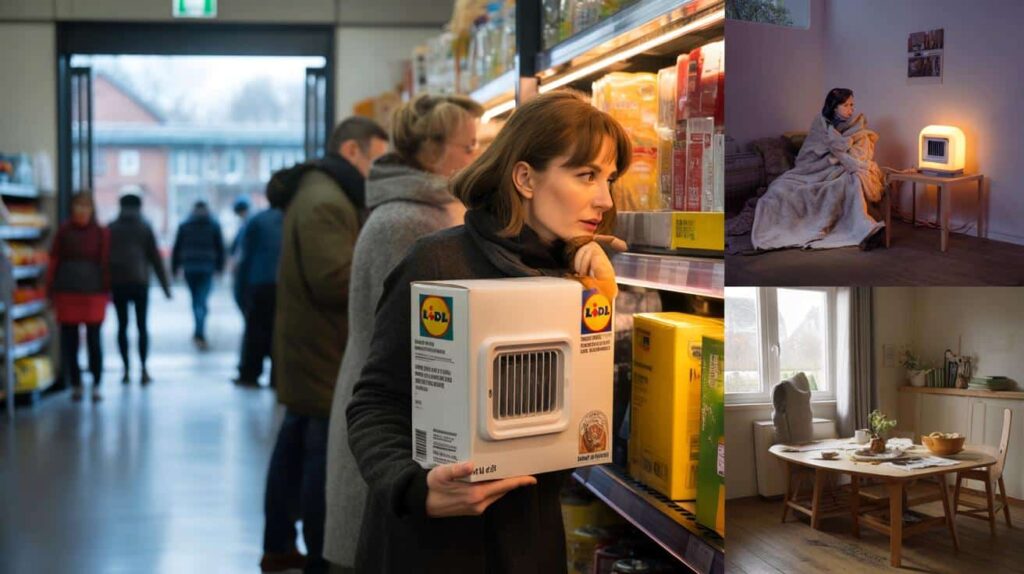
Someone joked that this little box might save Christmas. Someone else muttered that it would just eat up electricity in silence.
The buzz around this gadget was loud.
The doubts were quieter.
Lidl’s new winter ‘hero’ – and the split down the aisle
The product causing the fuss is Lidl’s latest winter buy: a compact electric heater that’s been making the rounds on money‑saving forums after Martin Lewis praised similar low‑wattage gadgets for targeted heating. It’s cheap to buy, light enough to move from room to room, and sold with that magic phrase stamped across the label: energy efficient.
On paper it sounds like a no‑brainer. Warm the person, not the whole house. Heat the room you’re actually in, not the spare bedroom no one’s used since August. For shoppers watching every penny, it feels less like a purchase and more like a small act of survival.
You can see the appeal in scenes like one shared by a young dad on social media. He posted a picture of his toddler playing on the living room rug, the new Lidl heater glowing softly beside a pile of toys. “Gas went up again this month,” he wrote. “Can’t afford to heat the whole house, so we’re doing ‘warm corners’ instead.”
Under his post, the comments split sharply. Some people chimed in to say their bills dropped when they switched to small heaters in the evenings. Others replied with screenshots of electricity usage apps, claiming their costs jumped the moment they plugged one in.
Same gadget. Two completely different stories.
This is where the quiet maths starts to matter. These small heaters use electricity, which is usually pricier per unit than gas. When Martin Lewis talks about them, he’s careful: they can save money if you’re heating only one small space instead of firing up the whole central heating system. Once you start running them for hours in multiple rooms, the equation flips.
The thing is, most of us don’t sit with a calculator in one hand and a plug in the other. We’re cold, we’re tired, and we just want our fingers to stop aching while we work on the laptop at the kitchen table. *That’s exactly the grey zone where a “money‑saving gadget” can quietly become an expensive habit.*
How to use Lidl’s heater like a saver, not a spender
If you’re going to buy into the Lidl heater hype, the trick is to treat it like a scalpel, not a sledgehammer. Use it for short, sharp bursts of warmth in small, well‑defined spaces. Think: 30 minutes under the desk while you answer emails. An hour by the sofa on a cold night when you don’t want to heat the whole house.
The basic rule is simple: the smaller the area, the shorter the time, the more chance this thing actually saves you money. Keep the door closed, pull the curtains, throw on a hoodie. Let the heater top things up, not do all the work alone. That’s when it starts to act like the “Martin Lewis‑approved” helper people expect, not a sneaky bill booster.
Where shoppers start to lose out is when the heater becomes background noise. It gets left on in an empty room “just to keep it nice”. It runs all afternoon because you forgot to switch it off for that quick trip to the shops. It goes from being a tool to being a habit.
We’ve all been there, that moment when a small comfort quietly turns into a constant companion. The problem is that electricity doesn’t care about your comfort. It just keeps ticking the meter over, minute by minute. Let’s be honest: nobody really reads the energy label every single day and tracks the hours. That’s why people end up feeling betrayed by something they thought would save them.
The people who seem happiest with Lidl’s heater are the ones who set rules for themselves. One shopper I spoke to said she only uses it during “red zones”: first thing in the morning getting dressed, and last thing at night before bed. That’s it.
“I bought it because Martin Lewis kept saying, ‘Heat the human, not the home,’” she said. “So I decided to be strict. If the heater’s on, I’m in that room, wearing a jumper, with the door closed. No exceptions. Used that way, it’s cut my gas bill and my electricity hasn’t gone wild.”
To copy this kind of disciplined use, it helps to keep things visual and simple:
- Set a phone timer every time you switch the heater on.
- Stick a Post‑it note by the plug: “Am I staying in this room?”
- Limit it to one or two “heat zones” in your home, not everywhere.
- Check one month of bills and tweak your routine, instead of guessing.
These aren’t glamorous hacks, but they’re the small edges that turn a tempting gadget back into a genuine tool.
So is Lidl’s gadget a hero or a quiet budget trap?
Walking past the Lidl middle aisle, the scene almost feels like a winter micro‑drama. On one side you’ve got shoppers who swear this little heater changed their evenings, letting them switch off the boiler and still feel their toes while watching TV. On the other, people who feel stung, insisting their “cheap” gadget turned out to be a silent drain on their prepaid meter.
The truth sits awkwardly in the middle. The heater isn’t a miracle. It isn’t a scam. It’s just a tool that magnifies whatever habits you bring to it. If you’re already used to zoning your heating, closing doors and timing your usage, it can dovetail neatly into your life. If you live with doors open, lights on, TV blaring in three rooms at once, this gadget will happily join the party and drag your electricity bill along for the ride.
| Key point | Detail | Value for the reader |
|---|---|---|
| Know when it saves money | Best for short bursts in small, closed rooms instead of whole‑house heating | Helps you decide if the Lidl heater fits your lifestyle before buying |
| Watch your new habits | Leaving it on for hours or in empty rooms wipes out any savings | Prevents the gadget turning into a “silent” bill booster |
| Test, don’t guess | Compare one month of bills and tweak your use based on real numbers | Gives you concrete proof whether it’s a hero or a drain in your home |
FAQ:
- Question 1Does the Lidl heater really save money compared to central heating?
- Question 2What kind of room is this type of heater best suited for?
- Question 3How many hours a day can I run it without my bill jumping?
- Question 4Is this the same type of gadget Martin Lewis talks about on his show?
- Question 5What’s the simplest way to tell if it’s helping or hurting my budget?